


 Back


2026 Supreme(Guj) 290
IN THE HIGH COURT OF GUJARAT AT AHMEDABAD
HEMANT M. PRACHCHHAK, J.
Sureshbhai Amrabhai Vankar – Appellant
Versus
State Of Gujarat And Ors. - Respondents
R/CRIMINAL APPEAL (AGAINST ACQUITTAL) NO. 1359 of 2014
Decided On : 19-06-2026
For the Appellant : Hcls Committee, Mr Nirad D Buch
For the Respondent: Mr Amrish K Pandya, Mr.Maulin Barot, Ms Jyoti Bhatt, Addl. Public Prosecutor
Appellate courts maintain a double presumption of innocence in acquittal appeals, only interfering if the judgment is perverse or legally flawed. The prosecution must prove all ingredients of statutory offences, including occurrence in public view for special status-based crimes, by providing substantial and credible evidence.
Headnote:(A) Indian Penal Code, 1860 - Sections 143, 147, 148, 504, 506(2); Scheduled Castes and Scheduled Tribes (Prevention of Atrocities) Act, 1989 - Section 3(1)(10); Code of Criminal Procedure, 1973 - Section 378 - Appeal against acquittal - Requirements of proof for special legislation offences include demonstrating that abusive utterances occurred in a public place within public view - Failure to produce medical evidence or independent witnesses regarding alleged injuries or incident circumstances warrants confirmation of acquittal. (Paras 12, 13)
(B) Appellate Jurisdiction - Principles regarding acquittal - Court sitting in appeal must respect the double presumption of innocence accorded to an accused - Interference is restricted to cases where the lower court's finding is marked by manifest illegality or perversity - If two reasonable interpretations are possible, the appellate court should not substitute its view for that of the trial court. (Paras 14, 15, 17)
Facts of the case:
The appellant challenged an order of acquittal passed by the trial court concerning charges of rioting, criminal intimidation, and offences under special legislation for protection of designated communities. The record reflected a delay of over a month in filing the complaint. The prosecution failed to provide medical evidence to substantiate allegations of physical harm and did not examine independent witnesses to confirm that the alleged events transpired in a public place within public view as stipulated by the statute.
Findings of Court:
The prosecution failed to prove the charges beyond reasonable doubt. The delay in investigation, absence of medico-legal documentation, and failure to present corroborative independent testimony rendered the prosecution's case unsustainable.
Issues: Whether the trial court erred in its appreciation of evidence, and whether the essential ingredients for offences under the relevant special legislation against the accused were established.
Ratio Decidendi: An appellate court should avoid disturbing an order of acquittal unless the reasoning of the lower court is perverse. Since the trial court correctly identified the lack of independent evidence and the failure of the prosecution to meet the statutory thresholds for the alleged offences, the acquittal must be upheld in accordance with the principle that the trial court's decision reinforced the presumption of innocence.
Result: Appeal dismissed.
| Table of Content |
|---|
| 1. procedural history and factual background regarding the acquittal appeal. (Para 1 , 2 , 3 , 4 , 5 , 6 , 7) |
| 2. summary of conflicting arguments from appellant and respondent parties. (Para 8 , 9 , 10) |
| 3. evaluation of prosecution evidence failure and validity of trial court findings. (Para 11 , 12 , 18 , 19) |
| 4. appellate standards for reviewing acquittals and requirements for section 3(1)(10) atrocity act offenses. (Para 13 , 14 , 15 , 16 , 17) |
| 5. final order confirming the trial court's judgment of acquittal. (Para 20) |
JUDGMENT :
HEMANT M. PRACHCHHAK, J.
1. The appellant – original complainant has preferred this appeal under Section 378 of the Code of Criminal Procedure, 1973 against the judgment and order dated 04.01.2014 passed by the learned 2nd Additional District & Sessions Judge, Vadodara (hereinafter be referred to as “the trial Court”) in Special (Atrocity) Case No.31 of 2011, whereby the trial Court has acquitted the original accused (respondent Nos.2 to 9 herein) from the offences punishable under Sections 143, 147, 148, 504, 506(2) etc of the Indian Penal Code (hereinafter be referred to as “the IPC”) read with Section 3(1)(10) of he Scheduled Castes and Scheduled Tribes (Prevention os Atrocities)Act, 1989 (hereinafter be referred to as “the Atrocity Act”).
2. Short facts of the prosecution case are that on 20.03.2011, the respondents No.2 to 9 assembled and with connivance to each other came to the appellant's place and threatened the appellant and entire family with dire consequences in the public at large at the residence in the presence of mob openly conveyed words which are directly attracting the provisions of Atrocity Act and, since all the respondents in connivance to each other armed with sticks and Dharia came, the interveners subsided the heat generated by them and since this has happened even prior in point of time, the appellant was constrained to lodge the complaint. Even in the month of April, 2011 before Desar police station an application was given on 13.04.2011, however, since the respondents assailants herein are the headstrong persons, even the police authorities were not ready to accept the complaint. It is the case of the appellant that the appellant was a member of Panchayat and the respondents wanted to take out undue advantage of the situation and since the appellant could not succumb, as a retaliation of it, the respondents herein committed an offence which was initially then registered as Atrocity Case No.31 of 2011 (before Desar police station bearing CR No.1-20 of 2011).
2.2 The charge was farmed against the respondents herein who are the accused persons for the offences punishable under Section 143, 147, 148, 504, 506 (2) of the IPC read with Section 3(1)(10) of the Atrocity Act. On being explained it to them, the accused have denied having committed any offence. The accused pleaded not guilty to the charge and pleaded for trial and hence, the case was tried by the learned Sessions Judge, Vadodara.
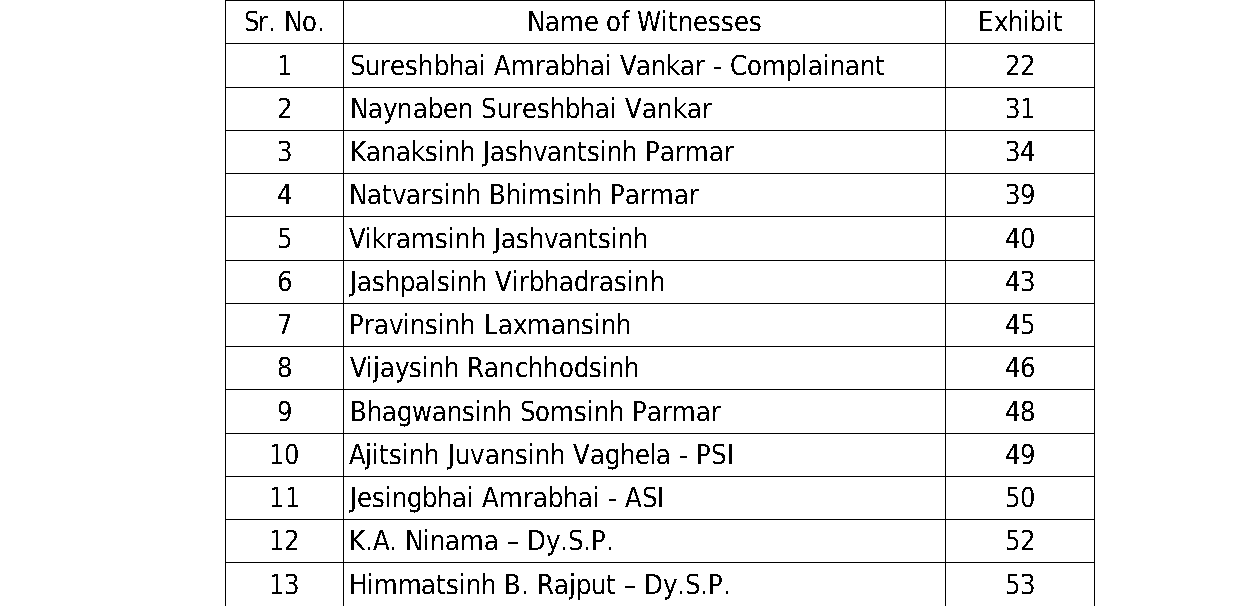
3. It appears from the records that to prove the case, the prosecution has examined the following witnesses:-
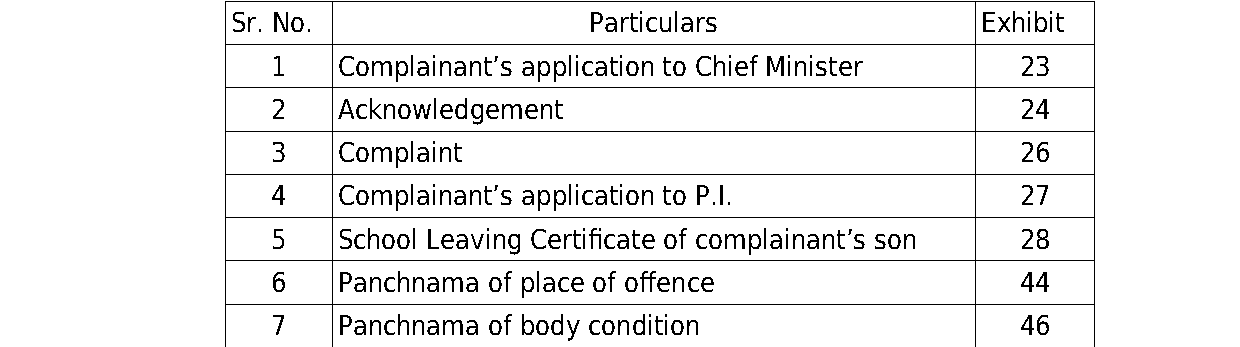
4. In addition to this, the prosecution has also produced the following documentary evidence:-

5. After closure of the evidence, the statements of the accused under section 313 of the Criminal Procedure Code, 1973 have been recorded wherein they denied of having committed any offence and have stated that they are innocent.
6. After hearing both sides and considering the evidence on records, the trial Court by impugned judgment and order has acquitted the accused from all the charges levelled against them.
7. Being aggrieved by and dissatisfied with the aforesaid judgment and order of acquittal the appellant – original complainant has preferred this Appeal. This Court on 12.12.2014 admitted the appeal and issued bailable warrant to the respondents in sum of Rs.2,000/-.
8. Heard Mr.Nirad Buch, learned counsel appearing for the appellant – original complainant, Ms.Jyoti Bhatt, learne







