Back





2026 Supreme(Guj) 405
IN THE HIGH COURT OF GUJARAT AT AHMEDABAD
NISHA M. THAKORE, J.
Moghibai Widow Of Madhavdas Ravji & Ors. – Appellant
Versus
Shantiben Wd/O Deceased Chhabildas Ravji (Deleted) & Ors. – Respondent
R/FIRST APPEAL NO. 1313 of 1985 With CIVIL APPLICATION NO. 1 of 1987, CIVIL APPLICATION (FOR ADDITIONAL EVIDENCE) NO. 1 of 2014 CIVIL APPLICATION (FOR PRODUCTION OF ADDITIONAL EVIDENCES) NO. 3 of 2025, R/CIVIL REVISION APPLICATION NO. 747 of 1992 With CIVIL APPLICATION (FOR BRINGING HEIRS) NO. 2 of 2023, CIVIL APPLICATION (FOR CONDONATION OF DELAY) NO. 2 of 2024
Decided on : 30-06-2026
Important Points
Subject
Civil Law - Property and Inheritance Law
Act Referred
Headnote
(B) Appellate Jurisdiction - Substitution of views - Appellate court must ensure findings are not perverse or based on misinterpretation of law - When lower court ignores specific provisions of law regarding partnership assets and relies on documents improperly construed, interference is warranted. (Paras 7, 30)
Facts of the case:
The dispute involved claims for partition of property, with the main contention being whether the subject properties were ancestral joint family co-ownership properties or assets of a partnership firm. The trial court held the properties to be co-ownership properties and decreed partition. The appellants challenged this, citing evidence that the properties were introduced into the firm as assets and never legally de-merged.
Findings of Court:
The High Court found that the trial court erred in interpreting the nature of the property. The evidence indicated the properties were thrown into the partnership hotchpot and remained assets until a final winding up, which did not occur. The use of the term "co-owner" in some documents was deemed loose usage that did not override the established legal character of the partnership assets.
Issues: Whether the subject properties were partnership firm property or co-ownership property, whether the firm had dissolved, and whether the widow was entitled to claim partition or possession of the specific premises in dispute.
Ratio Decidendi: Once property is contributed to a partnership as an asset, it retains that character regardless of entries in individual or joint names. It remains subject to the firm's debts and settlement of accounts upon dissolution. Mere description in government records or colloquial correspondence does not shift title or change the legal character from partnership asset to co-ownership.
Result: Appeals allowed; trial court judgment and preliminary decree quashed and set aside.
For the Appellant : MR SAURABH G AMIN(2168)
For the Respondent:MR. DEVAN PARIKH, SENIOR ADVOCATE WITH MR. MAYUR DHOTRE FOR NANAVATI ASSOCIATES(1375) MR. MEHUL S. SHAH, SENIOR ADVOCATE WITH MR. JENIL M SHAH(7840) for MR AJ YAGNIK(1372) MR RAJESH K SAVJANI(2225) MS MEGHA JANI(1028)
| Table of Content |
|---|
| 1. factual history and nature of the ancestral properties. (Para 1 , 2 , 4 , 5) |
| 2. trial court proceedings and the characterisation of property as co-ownership. (Para 6 , 7 , 8 , 9 , 10) |
| 3. partnership assets vs individual ownership distinction. (Para 11) |
| 4. estoppel and conduct regarding co-ownership status of assets. (Para 12 , 14) |
| 5. maintenance rights and section 14 of hindu succession act. (Para 13) |
| 6. determination of partnership asset status through hotchpotch and indian partnership act. (Para 16 , 17 , 18 , 19 , 20 , 21 , 22 , 23 , 24 , 25 , 26 , 27 , 28 , 29 , 30 , 31 , 32 , 33 , 34 , 35 , 36 , 37 , 38 , 39 , 40 , 41 , 42) |
| 7. widow's right to maintenance and residence as a pre-existing right. (Para 43 , 44 , 45 , 46 , 47 , 48 , 49 , 50 , 51 , 52) |
| 8. setting aside the preliminary decree and allowing the appeals. (Para 53 , 54 , 55 , 56) |
JUDGMENT :
NISHA M. THAKORE, J.
CHALLENGE :
1. The present appeal is filed under Section 96 of the Code of Civil Procedure, 1908 (hereinafter to be referred as “the Code”) by the original defendant nos.1 to 8, being aggrieved and dissatisfied with the judgment and order dated 29.03.1985 passed by the learned 3rd Joint Civil Judge, Senior Division at Jamnagar in Special Civil Suit No.54 of 1974.
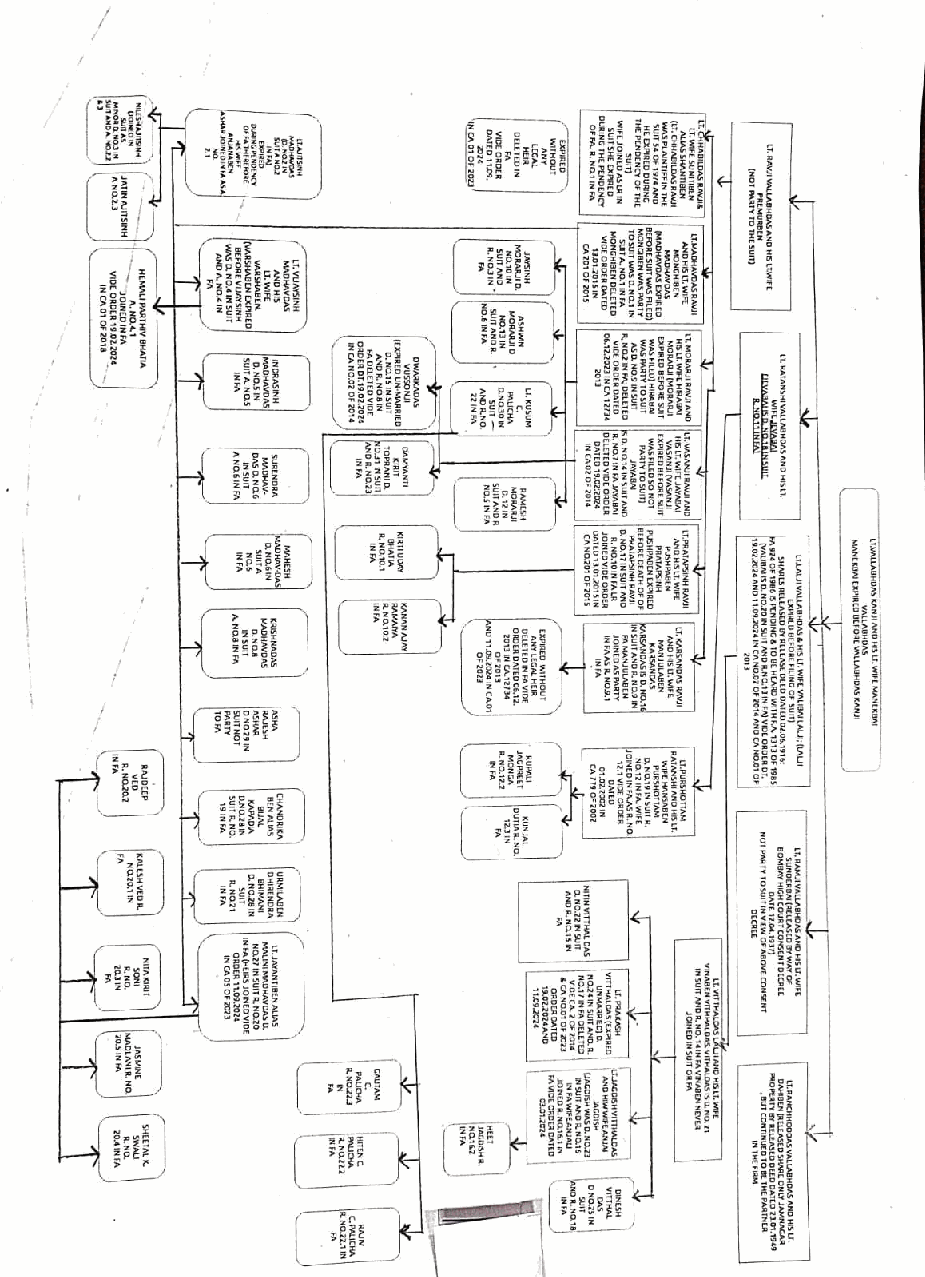
1.1 By the said impugned judgment and order, the trial court has partly allowed the suit preferred by the original plaintiffs, thereby granting preliminary decree by declaring that the plaintiff has 1/12th share in the properties mentioned in the Exh.8 appended with the plaint, by treating it as co-ownership properties of the parties. This includes the structures and open land on the subject properties. The plaintiff is further entitled to get division and partition by metes and bounds of his 1/12th share and to secure actual possession, accordingly. Consequently, the trial court has also declared and decreed in favour of the heirs of branch of Madhavdas Ravji which consists of 11 heirs i.e. original defendant nos.1 to 8 and defendant nos.26 to 29, in which, defendant no.3 is also included holding 1/12th share of the total, thereby, each of these defendants are held entitled to get 1/32 share. Similarly, the heirs of branch of Morarji Ravji consisting of original defendant nos.9 to 13 and 30 are also held entitled to 1/12th of the total share, and thereby, has granted each of these defendants 1/72 share and, lastly the heirs of Vasanji Ravji consisting of defendant nos.32, 40 and 50 are held entitled to get 1/12th of the total share, and thereby, has held each of these defendants entitled to 1/36 share.
2. The appellants of the First Appeal no. 1313 of 1985 are the original defendants no. 1 to 8 representing the branch of Madhavdas Ravji. They have approached in appeal under section 96 of the Code of Civil Procedure, 1908, disputing the preliminary decree mainly on the ground that the trial court committed grave error by treating the subject properties as co-ownership property instead of partnership property and, further disputing the proportionate share decreed in favour of the respective parties. The cognate appeal being First Appeal no. 924 of 1986 is filed by the original defendants no. 20 to 25 viz. on behalf of Bai Vali Lalji and her son Vitthaldas Lalji, challenging the directions of the trial court of handing over the possession of property ‘Boriwali ni Chawl ‘. Whereas, cross objections have been filed by the original plaintiff challenging the part of the impugned judgment and order whereby their prayer seeking relief of audit of the accounts has been denied.
3. Considering the grounds raised in the appeal memo, and the submissions made by learned advocates for the respective parties, who have appeared at the stage of admission, the appeal was admitted. Subsequently, it was directed to be heard with First Appeal No. 924 of 1986. The Cross-objections filed by the respective respondents were also directed to be heard along with these appeals for final hearing. Pending the hearing and fin