
 Back
Back





IN THE HIGH COURT OF KERALA AT ERNAKULAM
JOHNSON JOHN, J.
Mamuni Jayan @ Jayakumar, S/O.Narayanan – Appellant
Versus
State Of Kerala – Respondent
Crl. Appeal Nos. 1655, 1688 & 1930 of 2006
Decided on : 28-06-2024
IPC - Robbery - Sections 392, 302, 201, 139, 120B, 34 - The judgment discusses the circumstantial evidence and the burden of proof required to establish guilt under the Indian Penal Code. It highlights the need for reliable evidence and the conditions necessary for the applicability of Section 27 of the Indian Evidence Act.
Fact of the Case:
The appellants were convicted for robbery and murder after an incident involving a bag containing money. The prosecution alleged that the accused committed dacoity and caused the death of an individual during a scuffle for the bag.
Finding of the Court:
The court found that the prosecution failed to establish foundational facts and adduce reliable evidence to prove the guilt of the accused. It noted discrepancies in witness testimonies and lack of direct evidence regarding the money in the bag. The court also highlighted the conditions necessary for the applicability of Section 27 of the Indian Evidence Act.
Issues: The key issues revolved around the sufficiency of evidence to establish guilt, the reliability of witness testimonies, and the conditions necessary for the applicability of Section 27 of the Indian Evidence Act.
Ratio Decidendi: The judgment emphasized the need for reliable and conclusive circumstantial evidence to establish guilt. It highlighted the conditions necessary for the applicability of Section 27 of the Indian Evidence Act and the burden of proof required in cases based on circumstantial evidence.
Final Decision: The court set aside the conviction and sentence imposed on the appellants, acquitting them of all charges. The appeals were allowed, and the appellants were set at liberty.
JUDGMENT :
The appellants are accused Nos. 1 to 3 in S.C. No. 324 of 2002 on the file of the IInd Additional Sessions Judge, Kozhikode and they are challenging the conviction and sentence imposed on them for the offence under Section 392 IPC.
2. The prosecution case is that PW1 and PW11 exchanged their vehicles and in that transaction, PW1 had to pay Rs.1,87,000/- to PW11. But, subsequently, the vehicle was seized by the financier at Madras and then it was agreed between PWs 1 and 11 that PW1 will pay Rs.1,87,000/- to the financier and that the balance amount due to the financier will be paid by PW11 and accordingly, they decided to meet the financier at Madras for releasing the vehicle. The 5th accused was the broker between PWs 1 and 11 in connection with the vehicle transaction and when he came to know about the journey, he entered into a criminal conspiracy with accused Nos. 1 to 4 to rob the money by committing dacoity. On 13.11.1998. PW1, PW15, accused No.5 and the deceased Kunhimoosa, who is the brother-in-law of PW1, boarded train No. 6602 Mangalore- Madras Mail from Payyannur Railway Station and the deceased was in possession of the bag containing Rs.2,20,000/- and accused Nos. 1 to 4 also unauthorisedly boarded S-V compartment of the said train in which Kunhimoosa and others travelled. When the train reached Parappanangadi, the 3rd accused snatched the bag containing money from Kunhimoosa. But, Kunhimoosa caught the 3rd accused with the bag and then accused Nos. 1, 2 and 4 forcibly released the 3rd accused from the hands of Kunhimoosa and thereafter, accused Nos. 1 to 4 jumped to the platform with the bag containing money and then Kunhimoosa also jumped into the platform and there occurred a scuffle for the bag in the platform and accused Nos. 1 to 4, after getting possession of the bag, pushed Kunhimoosa towards the running train and he was run over by the train and died instantaneously. Accused Nos. 1 to 5 are thereby alleged to have committed the offences under Sections 395, 302, 201, 139, 120B and 34 IPC. Additionally, the 5th accused is alleged to have committed the offences under Sections 177, and 203 of IPC.
3. In the trial court, the accused persons pleaded not guilty to the charges and accordingly, PWs 1 to 34 were examined and Exhibits P1 to P39 and MOs1 to 18 were marked from the side of the prosecution and from the side of the defence, Exhibits D1 to D10 were marked.
4. After hearing both sides and considering the oral and documentary evidence on record, the learned Additional Sessions Judge, by the impugned judgment dated 18.08.2006, convicted and sentenced accused Nos. 1 to 3 to undergo rigorous imprisonment for 10 years and to pay a fine of Rs.15,000/- each and in default of payment of fine, to undergo rigorous imprisonment for one year each. Accused Nos. 4 and 5 are acquitted of all the charges and accused Nos. 1 to 3 are acquitted of all other offences charged against them.
5. Heard Sri. T.K. Sandeep, the learned counsel for the appellants/accused Nos. 1 and 3, Sri. T.V. Jayakumar Namboodiri, the learned counsel for the appellant/second accused and Sri. Sanal P. Raj, learned Public Prosecutor and perused the records.
6. The point that arises for consideration is whether the conviction entered and the sentence passed against the accused/appellants are legally sustainable.
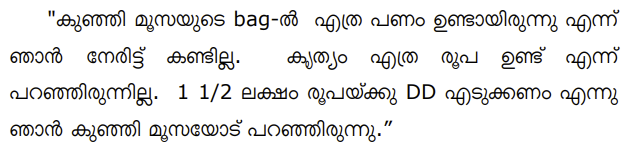
7. The learned counsel appearing for the appellants argued that the evidence adduced from the side of the prosecution is of a circumstantial nature and the prosecution has not succeeded in fully establishing the circumstances from which the conclusion of guilt is to be drawn. It is argued that apart from the hearsay evidence of PW1, there is absolutely no proof, either documentary or oral, to show that the deceased carried Rs.2,20,000/- in the bag and that the evidence of PW7, the only witness who happened to see the incident, would show that the 1st accused was not there at the place of occurrence and he was not among the persons who jumpe
AI

The prosecution must establish a complete chain of circumstantial evidence that is consistent solely with the guilt of the accused; otherwise, the accused are entitled to acquittal.

Once the Prosecution bases its case on Section 27 of the Evidence Act then necessarily the procedure laid down therein must be followed to the hilt, as the liberty of an individual is at stake.

The prosecution must establish a complete chain of events in cases based on circumstantial evidence, and the burden of proof lies with the prosecution to prove the guilt of the accused beyond reasona....


(1) Legal representatives of deceased appellant have right to seek acquittal and continue appeal against conviction of deceased appellant so as to remove stigma of conviction of their deceased family....


Convictions under circumstantial evidence require a complete and unbroken chain of proof; mere suspicion is insufficient for establishing guilt.



An indispensable Tool for Legal Professionals, Endorsed by Various High Court and Judicial Officers
Please visit our Training & Support
Center or Contact Us for assistance

Scan Me!
India’s Legal research and Law Firm App, Download now!


For Daily Legal Updates, Join us on :



 Back to top


