
 Back
Back





IN THE HIGH COURT OF KERALA AT ERNAKULAM
THE HONOURABLE MR. JUSTICE RAJA VIJAYARAGHAVAN V, THE HONOURABLE MR. JUSTICE G.GIRISH
Saritha K.P – Petitioner
Versus
State Of Kerala Represented By The Additional Chief Secretary To Government, Home And Vigilance Department And Ors. – Respondents
WP(CRL.) NO.641 OF 2024
Decided On : 19-07-2024
DETAINMENT - Habeas Corpus under KAAPA - KAAPA Section 3(3), Article 22(4) & (5) - The court discussed the procedural requirements under Section 3(3) of the Kerala Anti-Social Activities (Prevention) Act, 2007 (KAAPA), emphasizing the necessity for timely reporting of detention orders to the government. The court interpreted 'forthwith' to mean without undue delay, referencing precedents that highlight the importance of adhering to procedural safeguards in preventive detention. The failure to comply with these provisions was deemed a violation of the detenu's constitutional rights, leading to the quashing of the detention order.
Fact of the Case:
The petitioner sought a Writ of Habeas Corpus to challenge the detention of her husband, Sri.Krishnadas, under the KAAPA, initiated due to his involvement in multiple criminal cases. The petitioner argued that the detention order was flawed due to lack of specific allegations, procedural delays, and failure to consider her husband's representation against the detention.
Finding of the Court:
The court found significant procedural lapses in the detention process, particularly the failure to report the detention order to the government within the mandated timeframe and the delay in considering the detenu's representation. These failures were deemed violations of the detenu's rights under Article 22 of the Constitution.
Issues: 1. Whether the detention order complied with the procedural requirements of KAAPA, particularly Section 3(3). 2. Whether the failure to consider the detenu's representation constituted a violation of Article 22(5) of the Constitution.
Ratio Decidendi: The court held that the procedural safeguards in preventive detention laws must be strictly adhered to, as any lapse undermines the legality of the detention. The interpretation of 'forthwith' in Section 3(3) was established to mean without undue delay, and the failure to consider the detenu's representation promptly violated constitutional rights.
Final Decision: The court allowed the Writ Petition, quashed the detention order dated 5.4.2024, and ordered the immediate release of the detenu unless required in other cases.
JUDGMENT :
Raja Vijayaraghavan, J.
Sri.Krishnadas, the husband of the petitioner herein, was detained on 11.4.2024 pursuant to an order passed by the 2nd respondent under Section 3 of the Kerala Anti-Social Activities (Prevention) Act, 2007 (‘KAAPA’ for brevity). This Writ Petition is filed seeking issuance of a Writ of Habeas Corpus and to quash the order of detention.
2. Facts:
It is on account of the involvement of the alleged detenu in six cases, that proceedings under KAAPA were initiated against him. The details of the cases are as under:
A. Cases in which the final report has been laid.
a) O.R.No.5 of 2020 registered under Section 9 r/w. Section 2 (36), 39, 50, and 51 of the Wild Life Protection Act, 1972.
b) Crime No. 457 of 2020 registered inter alia under Section 452 and Section 27 of the Arms Act, 1959.
c) Crime No. 614 of 2022 registered inter alia under Section 307 r/w. Section 149 of the IPC.
B. Cases under investigation:
a) Crime No. 1034 of 2023 registered under Section 20(b)(ii)(B) of the Narcotic Drugs and Psychotropic Substances Act, 1985.
b) Crime No. 1048 of 2023 registered under Section 3 and Section 25(1-B)(a) of the Arms Act, 1959.
C. Settled Cases:
a) Crime No. 413 of 2021 inter alia under Section 308 r/w. Section 34 of the IPC.
3. Taking note of the predilection of the detenu to continue to involve himself in anti-social activity and to disrupt public order, a report was submitted by the District Police Chief on 26.1.2024 and a further report on 3.4.2024 before the authorized officer recommending the initiation of proceedings under the KAAPA. On its basis, Ext.P1 order dated 5.4.2024 has been issued. The detention order was executed on 11.4.2024.
4. Submissions of the petitioner:
a) O.R.No. 5 of 2020 and Crime No. 457 of 2020 have been registered in respect of the very same transaction. No specific overt act is alleged against the detenu.
b) In Crime No. 614 of 2022, the detenu is not assigned any serious role and his rank has not been specified.
c) In Crime No. 1034 of 2023, the contraband was seized from a car driven by another person and the detenu was merely an occupant.
d) In Crime No. 1048 of 2023, the complainant is a Police Officer and the said crime was liable to be eschewed as the recovery has not been effected in the presence of independent witnesses.
e) There has been a long and inordinate time gap between the last prejudicial activity and the order of detention.
f) Insofar as the last two crimes are concerned, other than mentioning that the detenu is involved, no other documents are furnished before the detaining authority to pinpoint the role of the detenu.
g) Under Section 3(3) of the Act, any order made under Section 3(2) is required to be reported forthwith to the Government and the Director General of Police, Kerala together with a copy of the order and supporting records. However, in the instant case, the records obtained under the Right to Information Act, 2005 would disclose that despite the fact that the detention order was passed on 11.4.2024, it was only on 21.06.2024 that the detention order along with the accompanying documents were forwarded to the Government.
h) The detenu was detained on 11.6.2024 and a representation was submitted by him on 13.6.2024. Though the same was received by the Government, no orders have been passed. This would amount to a blatant violation of the rights guaranteed to the detenu under Articles 22 (4) & (5) of the Constitution of India.
5. Since we felt that the contentions (g) and (h) raised by the detenu were formidable, we directed the learned Public Prosecutor to respond to the submissions.
6. Submissions of the learned Public Prosecutor:
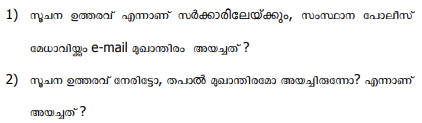
a) Insofar as the non-compliance of Section 3(3) of the Act is concerned, the learned Public Prosecutor submits that the records reveal that the documents were actually forwarded only on 21.6.2024. The attempt to forward the documents through e-mail failed because the Addressee’s mail ID was incorrect.
b) Insofar as the representatio
AI
The court established that strict compliance with procedural requirements in preventive detention laws is essential to protect individual liberties, and any failure to do so renders the detention ord....
The main legal point established in the judgment is the necessity to consider representations without delay under Article 22(5) of the Constitution of India and the consequences of unexplained delay ....

The court held that delays in executing detention orders are not fatal if justified by circumstances, emphasizing compliance with statutory requirements under the Kerala Anti-Social Activities (Preve....


The violation of a detenue's rights under Article 22(5) leads to the quashing of detention orders when there is inordinate delay in considering representations.



An indispensable Tool for Legal Professionals, Endorsed by Various High Court and Judicial Officers
Please visit our Training & Support
Center or Contact Us for assistance

Scan Me!
India’s Legal research and Law Firm App, Download now!


For Daily Legal Updates, Join us on :



 Back to top


