Back
Back





2024 Supreme(Ker) 1477
IN THE HIGH COURT OF KERALA AT ERNAKULAM
SOPHY THOMAS, J.
James, S/o. Ouseph – Appellant
Versus
State Of Kerala, Represented By The Public Prosecutor, High Court Of Kerala – Respondent
Crl. A. No. 2185 Of 2007
Decided On : 18-12-2024
For the Appellant : Sri. T.D. Robin, Sri. R. Anup.
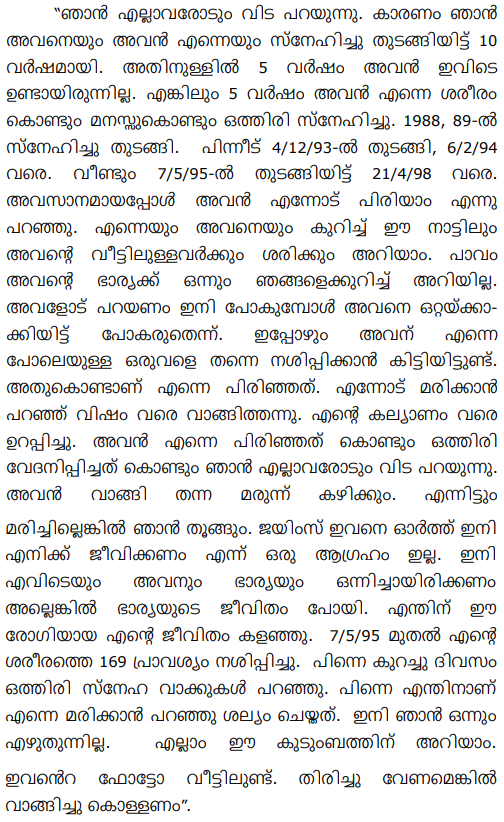
For the Respondent: Smt. Seena C., Public Prosecutor.
IMPORTANT POINT
The court upheld the conviction under Section 306 IPC, affirming that the accused abetted the suicide, supported by credible evidence including the deceased's letters.
Headnote:
(A) Indian Penal Code, 1860 - Section 306 - Abetment of suicide - Conviction of accused upheld for abetting the suicide of the deceased, supported by letters indicating her distress and relationship with the accused - The trial court found sufficient evidence to convict under Section 306 - Sentence of one year imprisonment and fine upheld. (Paras 36, 37)
(B) Evidence Act, 1872 - Section 32(1) - Dying declaration - Suicide note deemed relevant as it outlines the circumstances leading to the death of the deceased - The court emphasized that non-examination of contents during Section 313 questioning did not prejudice the accused. (Paras 22, 36)
Facts of the case:
The accused was charged with abetting the suicide of Ms. Bindu, who was found deceased in a rubber plantation. Evidence included letters indicating her distress and relationship with the accused, and a handwriting expert confirmed the letters were authored by her. (Paras 2, 10, 12)
Findings of Court:
The court upheld the conviction under Section 306, finding that the suicide note was admissible as a dying declaration and indicative of the accused's role in the suicide. (Paras 36, 37)
Issues: The main issues included whether the accused abetted the suicide and whether the trial was conducted fairly regarding the presentation of evidence. (Paras 18, 36)
Ratio Decidendi: The court ruled that the evidence presented, including the suicide note, was sufficient to confirm the accused's guilt, and that procedural issues regarding the examination under Section 313 did not compromise the trial's integrity. (Paras 36, 37)
Result: Appeal dismissed.
JUDGMENT :
(Sophy Thomas, J.)
This appeal is at the instanance of the sole accused in SC No.325 of 2005 on the file of Additional Sessions Judge (Adhoc-I), Ernakulam challenging his conviction and sentence under Section 306 of IPC, vide judgment dated 19.10.2007.
2. The prosecution case is that, between 10.30 p.m on 26.04.1998, and 5.30 a.m on 27.04.1998, one Ms.Bindu committed suicide by hanging, on the lean-to of the house of the accused bearing No.12/700 in Rayamangalam Panchayath, and it was the accused who abetted her suicide. The accused removed her dead body to a rubber estate for destroying evidence. So he was charged under Section 306 and 201 of IPC.
3. On committal, and on appearance of the accused before the trial court, charge was framed against him under Sections 306 and 201 of IPC, to which, he pleaded not guilty and claimed to be tried.
4. PWs 1 to 10 were examined, Exts.P1 to P15 were marked and MOs 1 to 3 were identified.
5. On closure of prosecution evidence, accused was questioned under Section 313 of Cr.P.C. He denied all the incriminating circumstances brought on record, and he pleaded innocence. No defence evidence was adduced except marking Ext.D1 thondi list.
6. On analysing the facts and evidence and on hearing the rival contentions from either side, the trial court found that prosecution succeeded in proving the guilt of the accused under Section 306 of IPC, and he was convicted thereunder. But destruction of evidence could not be proved and so he was acquitted under Section 201 of IPC. Under Section 306 of IPC, he was sentenced to undergo simple imprisonment for one year and to pay fine of Rs.10,000/- with a default sentence of simple imprisonment for two months. Challenging the conviction and sentence under Section 306 of IPC, he preferred this appeal.
7. Heard learned counsel for the appellant and learned Public Prosecutor.
8. Learned counsel for the appellant would contend that, the conviction and sentence of the appellant under Section 306 of IPC is not sustainable either in law or on facts. Prosecution could not prove that, Exts.P4 and P5 letters were written by the deceased. The deceased was an epileptic patient suffering from depression and there is nothing to show that the appellant abetted her suicide. So, according to him, the impugned judgment is liable to be set aside.
9. Heard learned counsel for the appellant and learned Public Prosecutor for the respondent-State.
10. PW2-the brother of the deceased saw the dead body of his sister Bindu, in the rubber plantation near to his house, at 7.30 a.m on 27.04.1998. He would say that, his sister was in an affair with the accused. After her death, he saw a letter in the pocket of his shirt, which was written by deceased Bindu and he identified that letter as Ext.P4. Another letter recovered from the dead body of deceased Bindu was identified by him as Ext.P5. It was he who produced Ext.P3 series notebooks of deceased Bindu before Police. He further stated that, marriage of deceased Bindu was proposed with one Mr.Saji and she had agreed to inform her decision within two days. She had handed over her chain and bangles to her mother, two days prior to her death. PW4-the paternal uncle of the deceased, also stated about the affair of deceased Bindu with the accused, and according to him when that relationship became strained, she committed suicide.
11. Exts.P4 and P5 are the letters alleged to have been written by deceased Bindu prior to her death. Ext.P4 letter was addressed to PW2-her brother, and Ext.P5 letter was recovered by Police from her dead body, at the time of inquest.
12. PW2 produced Ext.P3 notebooks of deceased Bindu, before Police. Ext.P15-the report of the handwriting expert shows that Exts.P4 and P5 letters were written by the very same person who had written Ext.P3 series notebooks.
13. Learned counsel for the appellant would say that, since PW2 had not seen deceased Bindu writing Ext.P3 series notebooks or Exts.P4 and P5 letters, it cannot be