
 Back
Back





IN THE HIGH COURT OF KERALA AT ERNAKULAM
P.B. SURESH KUMAR, JOBIN SEBASTIAN, JJ.
Aleema A., P.M. Muhammed Kunhi – Petitioner
Versus
State Of Kerala, Represented By Its Secretary To Government, Home Department and Ors. – Respondents
W.P.(Crl.) No.1189 of 2024
Decided On : 18-12-2024
(A) Kerala Anti-Social Activities (Prevention) Act, 2007 - Sections 2(i), 2(j), and 3(1) - Writ of habeas corpus - Detention of the petitioner's son as a drug-offender - The court held that the consumption of ganja and possession of MDMA do not qualify as anti-social activities without evidence of harmful public order impact - The subjective satisfaction of the detaining authority was upheld. (Paras 1, 4, 5, 6, and 7)
(B) Definition of 'goonda' - The court clarified that a drug offender falls under the definition of 'goonda' without needing additional evidence of harmful activities, as the law explicitly includes drug offenders within its scope. (Paras 6 and 7)
Facts of the case:
The petitioner sought the release of his son detained under the Act, arguing that the allegations against him did not meet the definitions of 'drug-offender' and 'goonda' as per the Act, referencing multiple criminal cases related to drug offenses.
Findings of Court:
The court concluded that the son's activities constituted sufficient grounds for detention under the Act, affirming the detaining authority's satisfaction regarding the necessity of detention.
Issues: The primary issues were whether the son's actions constituted being a 'drug-offender' and 'goonda' under the Act and whether the detaining authority's satisfaction was valid.
Ratio Decidendi: The court reasoned that being classified as a 'drug-offender' inherently qualifies an individual as a 'goonda' under the Act, irrespective of additional harmful activity requirements.
Result: Writ petition dismissed.
JUDGMENT :
(P.B. Suresh Kumar, J.)
This writ petition(Crl) is instituted seeking a writ of habeas corpus directing the respondents to produce the son of the petitioner, Abdul Safwan, who is detained in terms of Ext.P1 order issued under Section 3(1) of the Kerala Anti-Social Activities (Prevention) Act, 2007 (the Act) and to set him at liberty. The petitioner seeks the relief aforesaid on the premise that the detention of the son of the petitioner is otherwise than in accordance with the Act.
2. Ext.P1 order proceeds on the premise that the son of the petitioner is a “drug-offender” as defined under Section 2(i) of the Act and since he is a drug-offender, he is a “goonda” in terms of Section 2(j) of the Act also and inasmuch as the son of the petitioner is found to have committed the requisite number of acts within the meaning of the term “goonda”, he is liable to be regarded as a “known goonda” as defined under Section 2(o) of the Act and that he needs to be detained under the Act to prevent him from committing antisocial activities.
3. The prejudicial activities attributed to the son of the petitioner are his involvement in seven cases registered under the Narcotic Drugs and Psychotropic Substances Act, 1985 (NDPS Act). The following are the cases:
i. Crime No.187 of 2022 of Hosdurg Police Station registered on 28.01.2022 for the offence punishable under Section 27(b) of the NDPS Act.
ii. Crime No.667 of 2022 of Hosdurg Police Station registered on 26.05.2022 for the offence punishable under Section 27(b) of the NDPS Act.
iii. Crime No.987 of 2022 of Hosdurg Police Station registered on 04.08.2022 for the offence punishable under Section 22(b) of the NDPS Act.
iv. Crime No.1292 of 2022 of Hosdurg Police Station registered on 08.10.2022 for the offence punishable under Section 27(b) of the NDPS Act.
v. Crime No.212 of 2023 of Neeleswaram Police Station registered on 19.03.2023 for the offence punishable under Section 22(b) of the NDPS Act.
vi. Crime No.1082 of 2023 of Hosdurg Police Station registered on 18.07.2023 for the offence punishable under Section 27(b) of the NDPS Act.
vii. Crime No.446 of 2024 of Hosdurg Police Station registered on 18.05.2024 for the offence punishable under Section 22(b) of the NDPS Act.
It is seen that four among the cases registered against the son of the petitioner are cases registered with the allegation that the son of the petitioner has consumed ganja under Section 27(b) of the NDPS Act and the remaining are cases registered with the allegation that the son of the petitioner possessed for sale methylenedioxy phenethylamine (MDMA) under Section 22(b) of the NDPS Act. The quantities of the contraband involved in the three cases registered under Section 22(b) of the NDPS Act are less than the commercial quantity, but greater than the small quantity in terms of the provisions of the NDPS Act. Out of the three cases registered under Section 22(b) of the NDPS Act, final reports have already been filed in two cases.
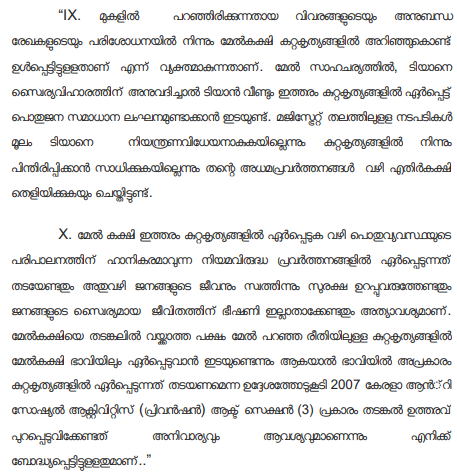
4. According to the learned counsel, consumption of ganja and mere possession of MDMA cannot be regarded as acts which would fall within the scope of the definition of “drug-offender”, and if the son of the petitioner, against whom the allegations are only that he consumed ganja and possessed MDMA, cannot be regarded as a “drug-offender”, he cannot be regarded as a “goonda” also and if that be so, he cannot be detained under the Act styling him as a “known goonda”. The learned counsel has relied on the decision of the Full Bench of this Court in Suhana v. State of Kerala, 2024 (7) KHC 212(FB), in support of this argument. It was also contended by the learned counsel that even if the son of the petitioner satisfies the definition of “drug-offender”, he will not automatically become a “goonda” as defined under the Act for, in order to satisfy the definition of “goonda”, there should be materials to indicate that he has indulged in any activity which is harmful for the maintenance of the publ
AI
Consumption of narcotics does not exempt an individual from being classified as a 'drug-offender' or 'goonda' under the Kerala Anti-Social Activities (Prevention) Act, 2007.

Mere possession of narcotics without intent to sell does not qualify as 'drug-offender' under KAA(P)A.

The court clarified that a valid order of preventive detention must solely rely on relevant offences fitting the defined categorization, and reliance on irrelevant offences invalidates such orders.
Repeated possession of small quantities of drugs constitutes anti-social activity within the meaning of KAAPA, allowing for preventive detention; thus, a person may be classified as a 'goonda' withou....
Possession of small quantities of drugs can constitute anti-social activity under KAAPA, warranting preventive detention for repeated offenses despite previously conflicting interpretations.

Preventive detention – Unless offences alleged to have been committed by detune are punishable under provisions of Chapter XVI or Chapter XVII or Chapter XXII of IPC, he would not fit into definition....

Preventive detention orders must consider all relevant material, including granted bail orders; failure to do so renders the detention invalid.

Detention order - An instance of an offence involving a person, which satisfies the conditions specified in the definition of known rowdy referred to in clause (p) of section 2 can also be taken in t....
The court upheld the detention order under the KAAP Act, affirming that prior classification as a 'known rowdy' and subsequent criminal activity justified continued detention.



An indispensable Tool for Legal Professionals, Endorsed by Various High Court and Judicial Officers
Please visit our Training & Support
Center or Contact Us for assistance

Scan Me!
India’s Legal research and Law Firm App, Download now!


For Daily Legal Updates, Join us on :



 Back to top


