
 Back
Back





IN THE HIGH COURT OF KERALA AT ERNAKULAM
A. Badharudeen, J.
K.S.Dinachandran, S/O. Late N.S.Sreedharan – Petitioner
Versus
Shyla Joseph, W/O. Joseph And Ors. – Respondents
RFA NO. 915 OF 2012, RFA NO. 82 OF 2013
Decided On : 10-01-2025
(A) Code of Civil Procedure, 1908 - Section 96 and Order XLI Rule 1 and 2 - Indian Succession Act - Section 63(c) - Evidence Act - Section 68 - Partition suit - The trial court held that the Will was not duly executed as the defendants failed to prove its execution and attestation. The appeals were dismissed confirming the trial court's findings. (Paras 8, 25)
(B) Will - Essentials for proving a Will - The court reiterated that the burden to prove the execution of the Will lies on the propounder, and if there are suspicious circumstances, the propounder must dispel them. (Paras 10, 11)
Facts of the case:
The plaintiff sought partition of properties inherited from their father, claiming the Will presented by the defendants was not validly executed. The defendants contended that the properties were bequeathed to them under the Will. (Paras 5, 6)
Findings of Court:
The court confirmed the trial court's ruling that the defendants failed to prove the due execution and attestation of the Will, thus upholding the partition. (Paras 25)
Issues: The main issues were whether the trial court erred in its findings regarding the Will's execution and the necessity of interference by the appellate court. (Paras 14)
Ratio Decidendi: The court found that the defendants failed to meet the statutory requirements for proving the Will, affirming that the burden of proof lies on the propounder to establish the Will's validity. (Paras 25)
Result: Appeals dismissed.
JUDGMENT :
A. Badharudeen, J.
R.S.A. No.915 of 2012 has been filed by the 1st defendant in O.S. No.633/2011 on the files of the II Additional Sub Court, Ernakulam under Section 96 read with Order XLI Rule 1 and 2 of the Code of Civil Procedure, 1908, challenging the preliminary decree of partition passed in the above case dated 14.06.2012. The respondents herein are the plaintiff and other defendants.
2. R.F.A. No.82 of 2013 is also filed challenging the preliminary decree of partition in O.S. No.633/2011, at the instance of defendants 2, 3 and 5 to 8, arraying the plaintiff and other defendants as the respondents.
3. Heard the learned counsel for the appellants and the learned counsel appearing for the respondents, in detail. Perused the verdict under challenge and the records of the trial court.
4. Parties in these appeals shall be referred as “plaintiff” and “defendants” with reference to their status before the trial court.
5. Short facts: - The plaintiff instituted a suit seeking partition of the plaint schedule properties and to allot 1/9 share to her, contending that the plaint schedule properties were originally owned by one Sreedharan, who is the father of the plaintiff and defendants and he died intestate.
6. The defendants resisted the suit mainly relying on Will Deed No.26/1988 of SRO, Ernakulam dated 26.03.1988 asserting that, as per the Will, late Sreedharan transferred his right to the defendants in exclusion of the plaintiff and they perfected title in the respective shares in terms of the Will. Therefore, the plaint schedule properties are not partible.
7. The trial court ventured the matter, after raising necessary issues. Exts.A1 and A2 marked on the side of the plaintiff. DWs 1 and 2 examined and Exts.B1 to B12 marked on the side of the defendants. Ext.B2 is the Will.
8. On anxious consideration of the evidence tendered, the learned Sub Judge found that the defendants failed to prove the due execution and attestation of Ext.B2 Will and therefore, the plaint schedule properties are partible. Accordingly, preliminary decree of partition was passed by allotting 1/9 share to the plaintiff and defendants 1 to 8.
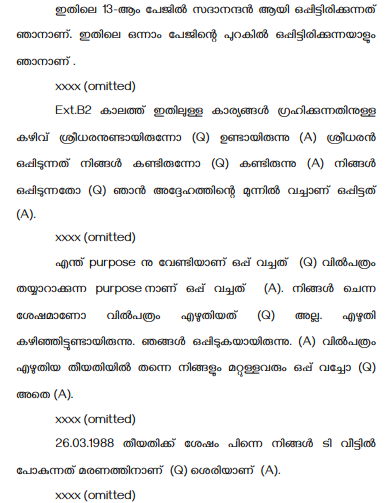
9. While assailing the judgment of the trial court, the main challenge raised by the defendants is regarding the finding of the trial court that defendants miserably failed to prove the execution and attestation of Ext.B2. It is zealously argued that, there are two attesting witnesses in Ext.B2, out of which, as per the proof affidavit filed by DW1, he asserted that Sri.Xavier was no more. Accordingly, the remaining attesting witness Sri.Sadanandan got examined. After reading the evidence given by DW2, regarding the manner in which he had signed in the Will, it is pointed out by the learned counsel for the defendants that, DW2 given evidence that he signed in the Will in the presence of the testator and he also witnessed the testator signing the same. Further, DW2 also given evidence that, DW2 and others signed in the Will on the same day. Relying on his evidence, it is pointed out that, when the evidence of DW2 is taken together, the essentials necessary to prove a Will, within the ambit of Section 63(c) of the Indian Succession Act read with Section 68 of the Evidence Act are complied and therefore, the trial court failed in holding that Ext.B2 was not properly proved.
10. The learned counsel for the defendants placed latest decision of the Apex Court reported in [2023 INSC 847] Meena Pradhan and Others v. Kamla Pradhan and Another, where the Apex Court, after referring the earlier decisions, in paragraph Nos.10 and 11, summarized the essentials to prove a Will as under:
10. Relying on H. Venkatachala Iyengar v. B.N. Thimmajamma, 1959 Supp (1) SCR 426 (3- Judge Bench), Bhagwan Kaur v. Kartar Kaur, (1994) 5 SCC 135 (3-Judge Bench), Janki Narayan Bhoir v. Narayan Namdeo Kadam, (2003) 2 SCC 91(2-Judge Bench) Yumnam Ongbi Tampha Ibema Devi v. Yumnam Joykumar Singh, (2009) 4 SCC 780 (3-Judge Bench) and Shivakumar v. Sh
AI
The burden to prove the validity of a Will lies with the propounder, and failure to meet statutory requirements results in its invalidation.

The burden of proof for the execution of a Will lies with the propounder, who must establish compliance with statutory requirements, including the testimony of attesting witnesses.
The burden to prove the execution of a Will and the free will of the testator lies on the propounder. The propounder must establish attestation and remove suspicious circumstances affecting the genui....

Proof of execution of Will – There can be no interference to Will which stands proved unequivocally.


Single attesting witness's testimony proving both attestations suffices for Will proof under Sections 63(c), Succession Act and 68, Evidence Act.
The court affirmed that the execution of a Will must comply with statutory requirements, particularly the necessity for attestation by witnesses who observe the testator's signature.

The court established that a Will must comply with statutory requirements to be considered valid, emphasizing the importance of proper attestation and execution.
The propounder of a Will must prove its execution and attestation in accordance with law, and any suspicious circumstances surrounding the Will must be dispelled for it to be considered valid.
The necessity for proving a Will through attesting witnesses is emphasized, particularly that one attesting witness must be examined unless valid exemptions apply under the law.



An indispensable Tool for Legal Professionals, Endorsed by Various High Court and Judicial Officers
Please visit our Training & Support
Center or Contact Us for assistance

Scan Me!
India’s Legal research and Law Firm App, Download now!


For Daily Legal Updates, Join us on :



 Back to top


