
 Back
Back





IN THE HIGH COURT OF KERALA AT ERNAKULAM
P.B.Suresh Kumar, Jobin Sebastian, JJ.
Prasanna – Petitioner
Versus
State Of Kerala, Represented By Public Prosecutor and ors. – Respondents
WA NO. 1245 OF 2024
Decided On : 11-04-2025
(A) Indian Penal Code - Section 302 - Kerala Prisons and Correctional Services (Management) Act, 2010 - Section 77 - Premature release of prisoners - The court examined the discretionary power of the Government to grant remission, emphasizing that blanket exclusions based on the nature of the crime are arbitrary and violate principles of reformation and rehabilitation. The court directed the Government to reconsider the recommendations for premature release of long-term prisoners who have demonstrated good behavior. (Paras 1 , 20 , 24 )
(B) Remission Policy - The court highlighted that the absence of a clear remission policy by the Government necessitates adherence to the provisions of the Act and Rules, ensuring that well-behaved long-term prisoners are considered for release. (Paras 19 , 21 )
(C) Judicial Precedent - The court reaffirmed the binding nature of the Supreme Court's decision in Joseph, which criticized arbitrary exclusions from remission based on the nature of the offence. (Paras 22 , 24 )
Facts of the case:
The appellants challenged the Government's refusal to grant premature release to their husbands, convicted of murder, despite recommendations from the Advisory Committee for their release after serving significant time.
Findings of Court:
The court found that the Government's refusal was based on arbitrary classifications and directed a fresh consideration of the prisoners' cases.
Issues: The main issues included the legality of the Government's blanket exclusion policy and the proper application of the Act and Rules regarding premature release.
Ratio Decidendi: The court ruled that the Government must exercise its discretion in a fair manner, considering individual circumstances rather than applying blanket exclusions based on the nature of the crime.
Result: Writ appeals allowed, directing the Government to reconsider the recommendations for premature release.
JUDGMENT :
P.B.Suresh Kumar, J.
The questions that arise for consideration in these matters are common and as such, they are disposed of by this common judgement. For a proper adjudication of the questions, a clear articulation of the facts involved in the matters is essential.
W.A.No.1245 of 2024
2. The appellant is the petitioner in the writ petition from which the appeal arises. Her husband is undergoing imprisonment for life pursuant to his conviction under Section 302 of the Indian Penal Code (IPC) for having committed the murder of one Geetha, with whom he was having an illicit relationship. The convict has undergone 22 years, 3 months and 19 days of imprisonment as on 10.06.2024 and has also earned a remission of 6 years, 3 months and 22 days. The period of sentence of the convict inclusive of remission would workout to be approximately 29 years. Although the case of the convict is being recommended by the Advisory Committee constituted under Section 77(1) of the Kerala Prisons and Correctional Services (Management) Act, 2010 (the Act) for premature release from the year 2017 onwards, the same is not being accepted by the Government. The appellant, in the circumstances, preferred W.P.(Crl.) No.320 of 2023 before this Court voicing the grievance and the writ petition was disposed of as per Ext.P3 judgment directing the Government to consider the case of the convict for premature release in the light of the latest recommendation of the Advisory Committee. Pursuant to the said direction, the Government issued Ext.P4 order holding that the case of the convict being a case involving the brutal murder of a widow who requires special care in the society, his premature release would facilitate offences against women and that therefore, the case of the convict cannot be considered for premature release. The present writ petition is instituted challenging Ext.P4 order.
3. A counter affidavit was filed in the writ petition on behalf of the State Government contending, among others, that punitive measures imposed on persons convicted for offences against women are found not sufficient to deter and curb such offences; that stopping crimes against women is essential to ensure their safety and security; that criminal activities against women restrict their freedom and hinders their active participation in the society; that granting release to those involved in offences against women may facilitate offences against women and that they are, therefore, not extended the benefit of premature release.
4. The learned Single Judge dismissed the writ petition holding that the power conferred on the Government to grant remission is discretionary, and having regard to the facts of the case, the impugned order does not warrant interference. The appellant is aggrieved by the decision of the learned Single Judge.
W.A. No.2137 of 2024
5. The appellant is the petitioner in the writ petition from which the appeal arises. Her husband is undergoing imprisonment for life pursuant to his conviction under Sections 302 and 307 IPC for having committed the murder of his mother and attempted to commit the murder of his father. The convict has undergone 20 years, 9 months and 27 days of imprisonment as on 30.06.2024 and he has earned a remission of 5 years, 10 months and 10 days. The period of sentence of the convict inclusive of remission would workout to be approximately 26 years. The case of the convict was recommended twice by the Advisory Committee constituted under Section 77(1) of the Act for premature release. The recommendations were, however, not accepted by the Government. The appellant, in the circumstances, preferred a writ petition before the Apex Court, and the same was disposed of by the Apex Court in terms of Ext.P5 order directing the appellant to make a representation before the Government and directing the Government to consider the same. Pursuant to Ext.P5 order, the appellant preferred a representation and the same was rejected by the Government
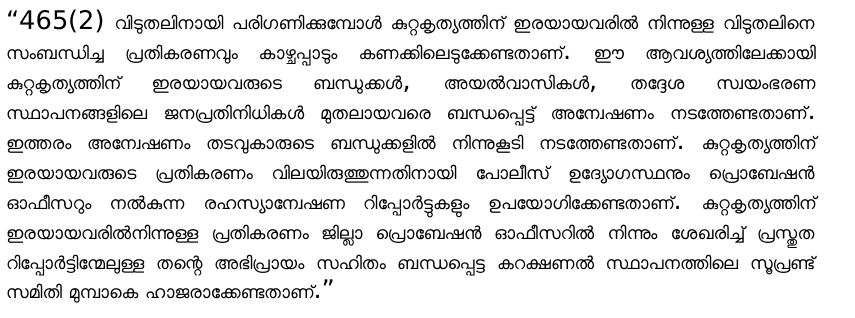
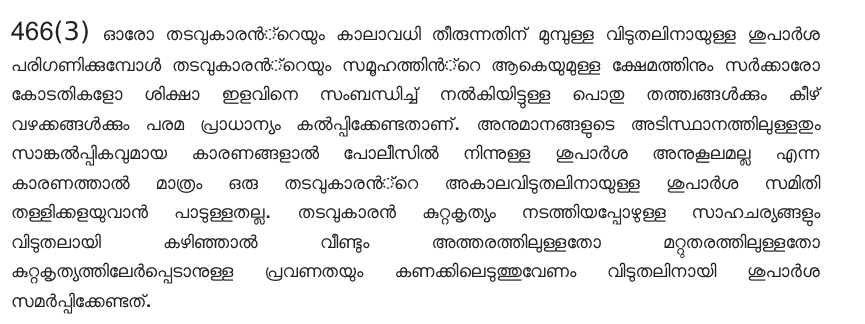
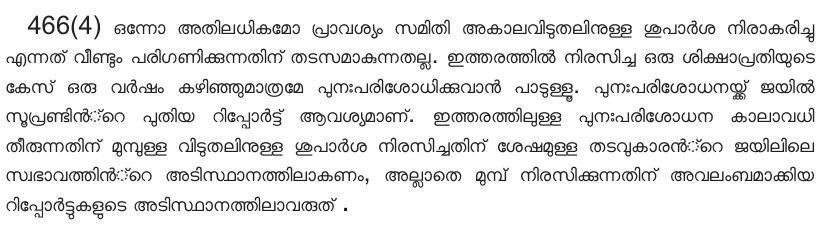
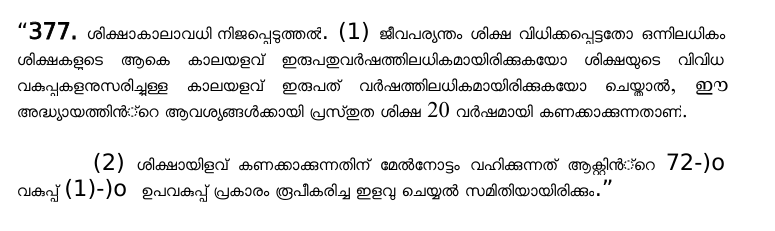
The court ruled that blanket exclusions from premature release based on the nature of the crime are arbitrary and violate principles of reformation, directing the Government to reconsider individual ....

(1) Remission policy prevailing on the date of conviction, is to be applied in a given case, and if a more liberal policy exists on the day of consideration, then latter would apply.(2) Blanket exclu....
The court emphasized that the decision for premature release must consider individual circumstances and cannot be arbitrarily denied based on the nature of the crime.

The court mandated the reconsideration of a convict's premature release proposal, emphasizing rehabilitation, age, and new evidence over the initial decision to reject it based on the severity of the....

The government must provide proper reasoning for rejecting applications for premature release, ensuring uniformity and adherence to established policies.

The court emphasized that the Government must provide consistent and reasoned decisions regarding premature release applications, ensuring compliance with established policies and avoiding arbitrary ....
The court emphasized that the Government must provide consistent and reasoned decisions for premature release applications, ensuring compliance with established policies and avoiding arbitrary reject....
The policy in effect at the time of conviction must be the primary consideration for determining premature release, unless a more liberal policy is subsequently adopted.
The Government must provide consistent and reasoned decisions when rejecting applications for premature release of convict prisoners, ensuring compliance with natural justice principles.

The exercise of executive power of clemency is a duty vested in the Authority for the welfare of the people, and the case of premature release of a life convict is governed by the policy/guidelines o....



An indispensable Tool for Legal Professionals, Endorsed by Various High Court and Judicial Officers
Please visit our Training & Support
Center or Contact Us for assistance

Scan Me!
India’s Legal research and Law Firm App, Download now!


For Daily Legal Updates, Join us on :



 Back to top


