


 Back
Back





2025 Supreme(Ker) 523
IN THE HIGH COURT OF KERALA AT ERNAKULAM
SATHISH NINAN, SHOBA ANNAMMA EAPEN, JJ.
Nirmala Cheriyan & Ors. - Appellants
Versus
Sunil, S/o. Madambikkattil Soman & Ors. - Respondents
Mat. Appeal No. 815 of 2019
Decided On : 08-04-2025
For the Appellants : K.S. Bharathan, Sri. Abel Antony.
For the Respondents: Sri. P.V. George (Puthiyadom), T.N. Manoj, G.P. Shinod, Ajit G. Anjarlekar, Govind Padmanaabhan, Atul Mathews.
IMPORTANT POINT
The right to maintenance does not invalidate property transfers, and a mere declaration of charge over property is insufficient without a claim for further relief.
Headnote:
(A) Hindu Adoption and Maintenance Act - Section 27 - Transfer of Property Act - Section 39 - Specific Relief Act - Section 34 - Petitioners sought to set aside sale deeds executed by the husband, alleging fraud and undue influence. The Family Court dismissed the petition, finding insufficient evidence to support claims of fiduciary relationship and lack of consideration. The court ruled that the petitioners' right to maintenance does not render the sale deeds void or voidable. (Paras 4 , 8 , 10 , 12 )
(B) Maintenance Rights - The court emphasized that a mere declaration of charge over property for maintenance is not maintainable without a claim for further relief, as per Section 34 of the Specific Relief Act. (Paras 10 , 11 )
(C) Evidence - The court noted that the evidence presented did not substantiate the claims of undue influence or lack of consideration for the sale deeds. (Paras 6 , 12 )
Facts of the case:
The petitioners, wife and son of the deceased husband, sought to set aside sale deeds executed by him, alleging they were executed under undue influence and without consideration. The Family Court found no merit in these claims.
Findings of Court:
The Family Court's dismissal of the petition was upheld, as the petitioners failed to prove their allegations.
Issues: The main issues included whether the sale deeds were executed under undue influence and whether the petitioners had a valid claim for maintenance.
Ratio Decidendi: The court held that the right to maintenance does not invalidate the sale deeds, and a mere declaration of charge over property is not sufficient without a claim for further relief.
Result: Appeal dismissed.
JUDGMENT :
Sathish Ninan, J.
The appellants, who are the petitioners before the Family Court, are the wife and the son. The first respondent is the husband/father. The other respondents are the assignees of properties under the first respondent-husband. The Original Petition was filed seeking to set aside Exts.A1 to A3 Sale Deeds. The Original Petition was dismissed by the Family Court.
2. According to the petitioners, the first respondent-husband is a drunkard and did not allow a peaceful life of the petitioners. He is addicted to alcohol. The petitioners are residing separately since 2008-09. The plaint schedule properties belong to the first respondent. The petitioners have a charge over the same towards their maintenance. Respondents 2 to 5 and the husband of the sixth respondent claimed to be friends of the first respondent and aided and influenced the first respondent to alcohol addiction. He was treated at various hospitals. By exerting fraud and undue influence, respondents 2 to 4 got the plaint schedule property conveyed in their favour, under Exts.A1 to A3 Sale Deeds. The sale deeds are not supported by consideration. They have been got executed taking undue advantage of the fiduciary relationship with the first respondent. The petitioners have charge over the property for their maintenance. The conveyances have been executed to defeat the right of the petitioners. With the above allegations the Original Petition was filed seeking to set aside Exts.A1 to A3 Sale Deeds.
3. The first respondent died pending the Original Petition. The other respondents denied the allegations levelled. They denied of having aided the first respondent in his liquor addiction etc. The allegations of fiduciary relationship and undue influence were denied. It was contended that the sale deeds are supported by valid consideration. It was also contended that after Exts.A1 to A3 conveyance the first respondent had purchased another property having an extent of 5 cents with a residential house thereon which, on his death, has devolved on the petitioners.
4. The Family Court held that the allegations of fiduciary relationship, undue influence and lack of consideration for Exts.A1 to A3 Sale Deeds were not proved. It was also held that the petitioners are not entitled for a charge over the property under Section 27 of the Hindu Adoption and Maintenance Act . The claim for charge under Section 39 of the Transfer of Property Act was also declined.
5. We have heard the learned counsel on either side.
6. With regard to the challenge against Exts.A1 to A3 Sale Deeds on the ground of it being vitiated by fraud, undue influence etc., as was noticed, the Family Court has negatived the challenge based on evidence. The learned counsel for the appellant concedes that the evidence is not sufficient enough to contend otherwise before this Court. So also he concedes on the finding of the Family Court declining charge under Section 27 of the Hindu Adoption and Maintenance Act .
7. The only point urged by the appellant before this Court is based on Section 39 of the Transfer of Property Act. The wife is entitled for maintenance from her husband. The alienation under Exts.A1 to A3 cannot affect her right of maintenance. In terms of Section 39, the wife is entitled to proceed against the properties of the husband, which could even be traced to the hands of a purchaser with notice, he contends. To fortify his contention that there need not even be a decree for maintenance to attract Section 39, but a right to claim maintenance is sufficient, the learned counsel relied on the judgments in Vaddeboyina Tulasamma v. Vaddeboyina Sesha Reddi (1977 KHC 820), Divakaran v. Chellamma (1985 KHC 225), Raghavan and another v. Nagammal and another (1979 KHC 1710). Hence, the alienations under Exts.A1 to A3 are subject to the charge for maintenance of the petitioners, is the contention.
8. The relief claimed in the original petition reads thus :-
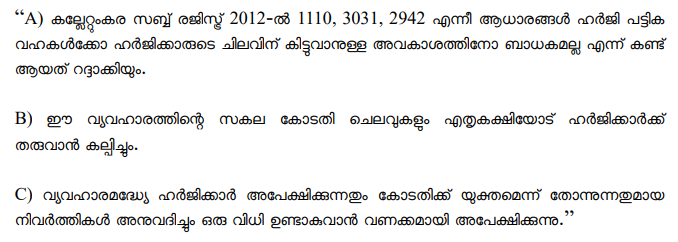
The petitioners seek to set aside the sale d














