
 Back
Back





IN THE HIGH COURT OF KERALA AT ERNAKULAM
ZIYAD RAHMAN A.A., J.
Zahhad C/o Ashitha - Appellant
Versus
State of Kerala - Respondent
W.P. (C) No. 23763 of 2023
Decided On : 02-06-2025
| Table of Content |
|---|
| 1. transgender parents' rights in birth certificate issuance. (Para 1 , 2 , 3 , 4 , 5 , 6) |
| 2. respondents' objections to the petitioners' claims. (Para 7 , 8 , 9) |
| 3. legal framework governing birth registration and transgender rights. (Para 10 , 11 , 12 , 13 , 14 , 15) |
| 4. court's analysis of societal changes and legal adaptation. (Para 16 , 17 , 18 , 19 , 20 , 21 , 22 , 23) |
| 5. evolution of law to accommodate transgender parents' identities. (Para 24 , 25 , 26 , 27 , 28 , 29) |
| 6. court orders modification of birth certificate issuance process. (Para 30) |
JUDGMENT :
1. In this case, an interesting, rare and exceptional issue has come up, that relates to the rights of transgender persons touching upon the necessity to safeguard their interests, when it comes to the question of the identity of their children who are born as normal persons. The essential issue to be dealt with in this writ petition pertains to the furnishing of the details of parents and their identities in terms of their gender, while issuing a birth certificate to a child born to the transgender parents.
2. The brief facts which are necessary to decide the issue are as follows: The 1st petitioner was born as a female and as per the Secondary School Leaving Certificate, the gender of the 1st petitioner was noted as female. Later the 1st petitioner recognised herself as a male, as an inclination to be a male developed in her mind. Based on such desire, she had taken a decision to lead a life of a male and accordingly, she changed the name by adopting a male name. The transgender identity card issued by the District Magistrate as contemplated under the provisions of the Transgender Persons (Protection of Rights) Act, 2019 (hereinafter referred to as ‘Transgender Persons Act’) was also obtained in the form of Ext.P1.
3. The 2nd petitioner was born as a male and in the Secondary School Leaving Certificate his gender was shown as male. Later, he identified himself as a female just the way the 1st petitioner felt, and accordingly he decided to live as a female. Therefore, he adopted the name of a female. He also obtained a transgender identity card from the competent authority under the Transgender Persons Act. Exhibits P1 and P2 are the transgender identity cards of the 1st and 2nd petitioners, respectively. Both of them have obtained Aadhar cards in their favour, wherein, the gender of the parties is shown as male and female respectively. Exhibits P4 and P6 are the Aadhar cards of the petitioners 1 and 2, whereas Exhibits P3 and P5 are the Secondary School Leaving Certificates showing their gender at the time of their birth.
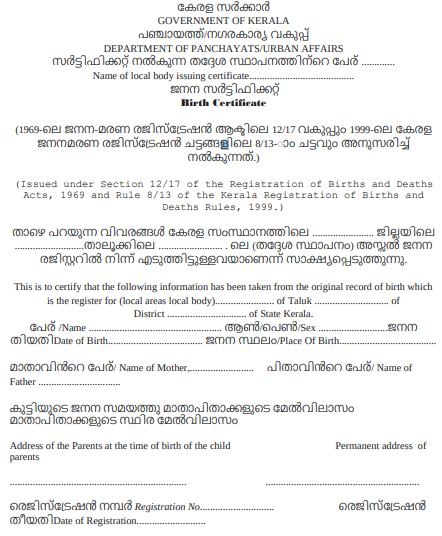
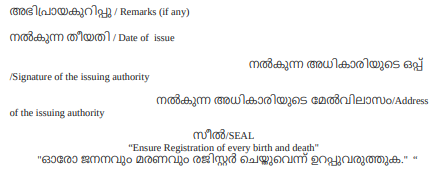
4. The 1st and 2nd petitioners started to live together and during this period, the 1st petitioner (trans-man) became pregnant and delivered a baby boy on 08.02.2023 at the Medical College Hospital, Kozhikode. The 3rd petitioner is the child born to the petitioners and the child is not a transgender child. Upon the birth of the child, the hospital authorities reported the birth to the 5th respondent, the Secretary to Kozhikode Corporation, and the details of the petitioners and the birth of the 3rd petitioner were incorporated in the Register maintained by the 5th respondent under the provisions of the Registration of Births and Deaths Act, 1969 (hereinafter referred to as ‘the Act 1969’) and the rules framed thereunder. In the details furnished, the 1st petitioner was shown as the mother of the 3rd petitioner and the 2nd petitioner was shown as the father. Exhibit P7 is the birth certificate of the 3rd petitioner, issued by Kozhikode Corporation on 17.02.2023, which contains the details as referred to above.
5. The grievance highlighted by the petitioners is follows:
Now the 1st petitioner, who is described as the mother of the 3rd petitioner in Ext.P7, is leading the life of a male, with an identity of a male and the 2nd petitioner, who is described as the father of the 3rd petitioner, is leading a life of a female, with an identity of a femal
AI
The court affirmed that legal frameworks must evolve to recognize the identities of transgender individuals, particularly regarding parental status on birth certificates, to prevent prejudice against....

The court ruled that the Registration of Births & Deaths Act, 1969 must be amended to allow changes in name and gender identity for transgender individuals, aligning with the rights conferred under t....



Correction of entry in Register of Births – Registrar should be convinced that grounds mentioned in Section 15 of Act, 1969 and Rule 11 of Rules, 1999 are available.

Registration of adoption deed is not mandatory for obtaining a birth certificate under the Hindu Adoption and Maintenance Act; the authorities cannot impose such a requirement without legal basis.



An indispensable Tool for Legal Professionals, Endorsed by Various High Court and Judicial Officers
Please visit our Training & Support
Center or Contact Us for assistance

Scan Me!
India’s Legal research and Law Firm App, Download now!


For Daily Legal Updates, Join us on :



 Back to top


