Back
Back





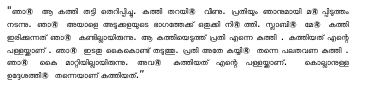
2025 Supreme(Ker) 1825
IN THE HIGH COURT OF KERALA AT ERNAKULAM
P.B. SURESH KUMAR, JOBIN SEBASTIAN, JJ.
Biju Molla, S/o. Gulmajan Molla – Appellant
Versus
State Of Kerala, Represented By Public Prosecutor, High Court Of Kerala – Respondent
Crl. Appeal No.333 of 2024
Decided On : 18-06-2025
For the Appellant : Sri. P. Mohamed Sabah, Sri. Libin Stanley, Smt. Saipooja, Sri. Sadik Ismayil, Smt. R. Gayathri, Sri. M. Mahin Hamza, Shri. Rayees P., Shri. Alwin Joseph.
For the Respondent: Smt. Ambika Devi S., Spl. Public Prosecutor.
The court upheld the conviction for murder and attempted murder based on reliable eyewitness accounts and forensic evidence, establishing intent through the nature of the attack.
Headnote:(A) Indian Penal Code - Sections 302, 307, 392, 397, 449 - Conviction for murder and attempted murder - The appellant was convicted for the murder of Nimisha and attempted murder of Elias, following a robbery attempt resulting in violent attacks - The court examined the evidence of multiple witnesses and forensic reports to establish the appellant's guilt - The court concluded that the evidence presented formed a complete chain indicating the appellant's involvement in the crimes - The appellant's arguments regarding inconsistencies in witness testimonies were dismissed as lacking merit - The court upheld the conviction based on the evidence of injured witnesses and forensic corroboration. (Paras 1-30)
(B) Evidence - Admissibility of witness statements - The court reiterated the principle that the testimony of injured witnesses is considered highly reliable - Discrepancies in witness accounts were found insufficient to undermine their credibility - The court emphasized the importance of corroborating evidence from forensic examinations linking the appellant to the crime scene. (Paras 19-24)
(C) Legal Principles - The court clarified that intention to commit murder may be inferred from the nature of the attack and the weapon used - The appellant's act of slitting the throat of the victim was deemed indicative of intent to kill. (Paras 30-31)
Facts of the case:
The appellant, a cleaning staff, was convicted for trespassing into the house of Thambi to commit robbery, during which he killed Nimisha and injured Elias with knives - The prosecution relied on eyewitness accounts and forensic evidence linking the appellant to the crime.
Findings of Court:
The court found the appellant guilty of murder and attempted murder, supported by eyewitness testimony and forensic evidence, thus confirming the conviction and sentence.
Issues: The main issues included the sufficiency of evidence to establish the appellant's guilt and the arguments regarding discrepancies in witness testimonies.
Ratio Decidendi: The court held that the evidence presented formed a coherent narrative establishing the appellant's guilt, and discrepancies in witness testimonies did not detract from their overall reliability.
Result: The appeal was dismissed.
| Table of Content |
|---|
| 1. appellant's conviction for serious crimes. (Para 1 , 2 , 3) |
| 2. arguments regarding evidence and guilt. (Para 4 , 5) |
| 3. witness testimonies supporting prosecution. (Para 6 , 7 , 8 , 9 , 10 , 11) |
| 4. forensic evidence corroborating witness accounts. (Para 12 , 13 , 14 , 15 , 16 , 17 , 18) |
| 5. defense arguments against prosecution's evidence. (Para 19 , 20 , 21) |
| 6. court's reasoning on intent and culpability. (Para 23 , 24 , 25 , 26 , 27 , 28 , 29) |
| 7. final judgment and dismissal of appeal. (Para 30 , 31) |
JUDGMENT :
(P.B. Suresh Kumar, J.)
The appellant is the sole accused in S.C.No.101 of 2019 on the files of the Additional Sessions Court-II, North Paravur. He stands convicted and sentenced for offences punishable under Section s 449 , 392, 397, 307 and 302 of the Indian Penal Code (IPC).
2. The appellant hails from the State of West Bengal. He was employed as a cleaning staff under one Hasbul Ali Mulla in a factory at Kizhakkambalam. The crime that forms the subject matter of the case was registered on 30.07.2018 at Thadiyittaparambu Police Station. As per the final report filed in the case, at about 9.45 a.m. on 30.07.2018, the appellant, with the intention of committing robbery, trespassed into the house of one Thambi and attempted to snatch the gold chain worn by the mother of Thambi. When Nimisha, the daughter of Thambi, tried to prevent the appellant from doing so, he grabbed the kitchen knife that Nimisha was carrying then and killed her by slitting her throat. He then forcibly snatched the gold chain worn by Mariyamma, the mother of Thambi. At that point, Elias, the elder brother of Thambi, tried to intervene. The appellant then attempted to kill him also by trying to slit his throat with the knife. When Elias knocked the knife out of the hand of the appellant and attempted to overpower him, the appellant repeatedly stabbed him aiming at his chest with another knife which he found in the kitchen slab of the house. As Elias warded off the blows, the stabs landed on his left hand. The appellant thereafter fled from the scene with a piece of the gold chain snatched by him.
3. Pursuant to the final report, when the appellant was committed to trial, the Court of Session framed charges against him under Sections 449 , 392, 397, 307 and 302 IPC . The appellant denied the charges. The prosecution thereupon adduced evidence to establish the guilt of the accused. The evidence comprises of the oral testimony of 40 witnesses and 68 documents. A large number of material objects were also produced during the trial. When the incriminating evidence were put to the appellant in terms of the provisions contained in Section 313 of the Code of Criminal Procedure (the Code), he denied the same and maintained that he is innocent. Thereupon, on a consideration of the evidence, the Court of Session found the appellant guilty of the offences, convicted him and sentenced, among others, to undergo imprisonment for life. The appellant is aggrieved by his conviction and sentence.
4. Adv.Sai Pooja addressed arguments on behalf of the appellant and Smt.Ambika Devi, the Special Public Prosecutor addressed arguments on behalf of the state.
5. The essence of the elaborate submissions made by the learned counsel for the appellant is that the evidence let in by the prosecution does not establish that it was the appellant who caused the death of Nimisha and injured Elias. Alternatively, it was argued by the learned counsel that even if it is assumed that it was the appellant who caused the death of Nimisha and injured Elias, there are no materials to come to the conclusion that the appellant is guilty of the offences punishable under Sections 302 and 307 IPC .
6. The point that arises for consideration is whether the conviction of the appellant for the offences charged, and the sentences passed against him, are sustainable in law.
7. In order to adjudicate the point formulated for decision, it is apposite to refer to the evidence in the case. As no