
 Back
Back





IN THE HIGH COURT OF KERALA AT ERNAKULAM
JOHNSON JOHN, J.
Rajappan, S/o.Vijayan – Appellant
Versus
State Of Kerala – Respondent
Crl.A No. 835 of 2014
Decided on : 15-09-2025
JUDGMENT :
JOHNSON JOHN, J.
The appellant, who is the accused in S.C. No. 346 of 2013 on the file of the Additional Sessions Judge-IV, Thodupuzha, is challenging the conviction and sentence imposed on him for the offences punishable under Sections 55(g) and 8(1) r/w 8(2) of the Abkari Act.
2. The prosecution case is that on 25.03.2011, at about 5 p.m., the Excise Inspector and party searched the house and premises of the accused at Kannampady in Peermedu Taluk and from the property adjacent to the house, they recovered 125 litres of wash and utensils for manufacturing arrack and they also recovered 5 litres of arrack in a white can from a pit in the said property.
3. After investigation, final report was filed against the accused for the offences punishable under Sections 55(a) and (i) and 8(1) r/w 8(2) of the Abkari Act.
4. On appearance of the accused before the trial court, charge was framed for the offences under Sections 55(g) and 8(1) r/w 8(2) of the Abkari Act. When the accused pleaded not guilty to the charge, the prosecution examined PWs 1 to 6 and marked Exhibits P1 to P9 and MOs 1 to 7. No evidence was adduced from the side of the accused.
5. After trial and hearing both sides, the learned Additional Sessions Judge found the accused guilty of the offences under Sections 55(g) and 8(1) r/w 8(2) of the Abkari Act. For the offence under Section 55(g) of the Abkari Act, the accused was sentenced to undergo rigorous imprisonment for 4 years and to pay a fine of Rs.1,00,000/- and in default of payment of fine, to undergo simple imprisonment for six months. The accused was also sentenced to undergo rigorous imprisonment for 4 years and to pay a fine of Rs.1,00,000/- and in default of payment of fine, to undergo simple imprisonment for 6 months for the offence under Section 8(1) r/w 8(2) of the Abkari Act.
6. Heard Sri. Anto Thomas, the learned counsel representing the learned counsel for the appellant and Sri. Alex M. Thombra, the learned Senior Public Prosecutor.
7. The learned counsel for the appellant argued that there is violation of Section 53A of the Abkari Act and the prosecution has not adduced any evidence to show that the property from where the contraband item is alleged to be recovered, is in the possession or ownership of the accused and therefore, the impugned judgment is liable to be set aside.
8. PWs 4 and 5 are the independent witnesses examined by the prosecution to prove the occurrence; but, they turned hostile to the prosecution and their evidence shows that they have not witnessed the occurrence.
9. PW2 is the Excise Inspector who detected the offence. The evidence of PW2 and Exhibit P3, search list, shows that no contraband item is recovered from house bearing No.1/192 of Upputhara Grama Panchayat. In cross examination, PW2 deposed as follows:
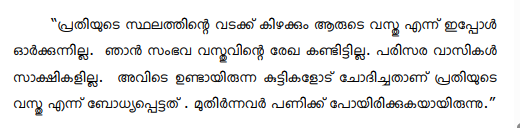
10. PW3 is the Preventive Officer who accompanied PW2 for the search. The evidence of PW3 also shows that no contraband item is recovered from the house and that the contrabands items are recovered from the property near to the house. In cross examination, PW3 stated as follows:
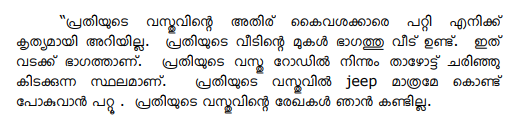
11. PW6 is the Excise Circle Inspector who conducted the investigation and filed the final report. The evidence of PW6 in cross examination shows that he has not taken any steps to obtain documents relating to the ownership and possession of the property from where the contraband items are alleged to have recovered.
12. In Ravi C. v. State of Kerala [2011 (3) KHC 427 = 2011 (3) KLT 627], it was held by this Court that only because an article is found kept or stored in a building or house, the owner or occupier of such building cannot be said to have ‘stored’ the article, nor can it be said that he is in ‘possession’ of such article. In the said decision, it was further held that even if the owner or occupier of the house was present in the house at the time of seizure, he cannot be presumed to be in possession of the article or stored the same. In Santhosh v. State of Kerala [2021 (5) KHC 214 = 2021
Prosecution must demonstrate ownership or possession of premises where contraband recovered; failure to comply with procedural mandates vitiates the case.

The mandatory requirements under Section 53A of the Abkari Act for disposal of seized articles and the certified inventory list as the primary evidence of the offence.
Conviction set aside - Prosecution in a case of this nature can succeed only if it is proved that the sample which was analysed in the Chemical Examiner's laboratory was the very same sample which wa....
Procedural defects in the collection and handling of evidence undermine the prosecution's case, necessitating acquittal when the chain of custody is not established.
The central legal point established in the judgment is the necessity for the prosecution to establish the genuineness of the seized sample and the clear link connecting the accused with the contraban....
The main legal point established in the judgment is that the prosecution must prove the guilt of the accused beyond reasonable doubt, and the mandatory provisions of the Abkari Act, such as Section 5....

The prosecution must prove uninterrupted chain of custody of contraband for a valid conviction.
Possession of materials alone is insufficient for conviction under S.55(g) of Abkari Act without proving intent to manufacture liquor.
Failure to comply with statutory requirements for inventory preparation and certification under the Kerala Abkari Act undermines the prosecution's case, leading to acquittal.
The prosecution must establish the chain of custody for contraband from seizure to laboratory analysis; failure to do so undermines the evidentiary value of chemical analysis reports.



An indispensable Tool for Legal Professionals, Endorsed by Various High Court and Judicial Officers
Please visit our Training & Support
Center or Contact Us for assistance

Scan Me!
India’s Legal research and Law Firm App, Download now!


For Daily Legal Updates, Join us on :

 Back to top


