
 Back
Back





IN THE HIGH COURT OF KERALA AT ERNAKULAM
N.NAGARESH, J.
Babilu Sankar S/o Late Sankaran Kutty Nair – Appellant
Versus
Sree Padmanabha Swamy Temple, Thiruvananthapuram – Respondent
W.P. (C) No. 17528 of 2025
Decided On : 27-02-2026
| Table of Content |
|---|
| 1. petitioner’s employment ceased over disciplinary actions. (Para 1 , 2 , 3 , 4 , 5) |
| 2. the legality of the termination and disciplinary processes. (Para 6 , 7 , 12) |
| 3. arguments by counsel and considerations from the court. (Para 14) |
| 4. stigmatic conclusions without proper enquiry are invalid. (Para 17 , 23) |
| 5. court’s final order to reinstate the petitioner. (Para 24) |
JUDGMENT :
N. NAGARESH, J.
1. The petitioner is holding the post of Senior Upper Division Clerk in the Mathilakam office of Sree Padmanabha Swamy Temple. This writ petition is filed aggrieved by Exts.P5 and P18 orders by which the petitioner has been declared as ceased to be an employee of the Temple.
2. The petitioner states that he has rendered many years of unblemished service in the Temple. In the year 2023, the petitioner submitted Ext.P1 complaint dated 28.01.2023 to the Chairman of the Administrative Committee pointing out certain irregularities. Instead of enquiring into the complaint, the petitioner was issued with Ext.P2 charge memo dated 01.04.2023 alleging that the petitioner is purportedly making reckless and baseless imputations against the Administrative Committee. The petitioner submitted Ext.P3 reply. The respondents initiated disciplinary proceedings.
3. While the inquiry was going on, the respondents arbitrarily reverted the petitioner from the post of Senior UDC to the post of Store Keeper, as per Ext.P5 order dated 17.02.2023. The petitioner hence filed W.P.(C) No.17504/2023. This Court allowed the writ petition in part as per Ext.P6 judgment dated 11.08.2023. The Administrative Committee was directed to consider the petitioner's objection to the memo of charges. The petitioner was permitted to approach the Executive Officer with an application for leave.
4. To the surprise of the petitioner, on the very same day, the 2nd respondent issued Ext.P7 fresh memo of charges framing additional charges for unauthorised absence from duty. The petitioner submitted reply to Ext.P7 enclosing Medical Certificate to show that he was suffering from non alcoholic liver cirrhosis with complications of intermittent spitting of blood, which incapacitated him from working inside the Temple premises.
5. The disciplinary authority, however, proceeded with the enquiry. By Ext.P10 letter dated 06.11.2024, the petitioner requested the respondents to drop the enquiry proceedings. The petitioner could not attend all the inquiry sittings due to persisting medical condition. The Enquiry Officer proceeded ex-parte without accommodating his request for adjournment on medical grounds. The Enquiry Officer submitted Ext.P12 Enquiry Report holding the charges as proved.
6. The petitioner was required to show-cause as to why major punishment should not be imposed, proposing the punishment of demotion from the Cadre of Senior UDC. The writ appeals preferred by the petitioner were dismissed as per Ext.P14 judgment.
7. To the surprise of the petitioner, while the disciplinary proceedings were pending, the 2nd respondent issued Ext.P13 Show-cause Notice dated 07.01.2025 alleging that the petitioner was found guilty of misconduct under Rule 22(1) and Rule 18 of Chapter 4A of the Mathilakam Service Rules, 1963 requiring the petitioner to show-cause why he should not be removed from service. Ext.P13 imputed that the petitioner did not submit any reply to the memo of charges, which is factually incorrect, contends the petitioner.
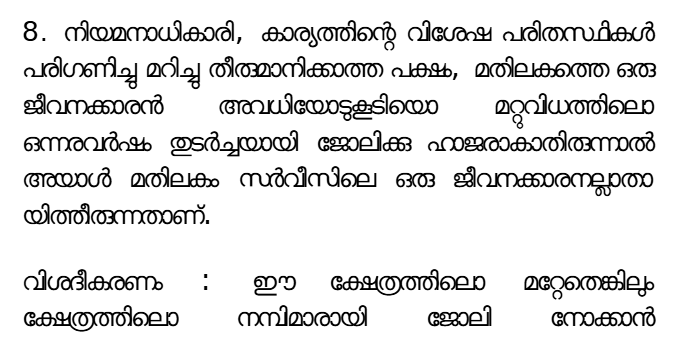
8. After receiving Ext.P17 representation, the 3rd respondent issued Ext.P18 order whereby the petitioner was declared to have ceased to be in service, as a disciplinary punishment. The petitioner states that Ext.P18 arbitrarily penalised and punished the petitioner. Exts.P5 and P18 orders are illegal and unsustainable and are liable to be set aside.
9. The respondents filed a counter affidavit. The respondents asserted that Ext.P18 order has been issued strictly in accordance with the Mathilakam Rules governing the affairs of the Sree Padmanabha Swamy Tem

Disciplinary actions declaring an employee ceased to be in service must comply with principles of natural justice, especially when findings are stigmatic and involve adverse consequences.

Employment decisions must adhere to principles of natural justice, even if not explicitly mentioned in governing rules.

suspension must be a step in aid to the ultimate result of the investigation or inquiry. The authority also should keep in mind public interest of the impact of the delinquent’s continuance in office....

Executive Officer empowered under HR&CE Act Rule 14 to implement disciplinary actions; failure to prove enquiry participation upholds dismissal.

The importance of following prescribed procedures and principles of natural justice in disciplinary proceedings.


The court upheld the authority of the Administrative Committee in temple management and affirmed the validity of ongoing disciplinary proceedings against the appellant.

Termination without proper procedure and documentation is disproportionate, violating legal norms on employee's rights.
The court emphasized the shockingly disproportionate nature of the punishment of removal from service in the context of the respondent's prolonged absence due to mental illness, highlighting the need....



An indispensable Tool for Legal Professionals, Endorsed by Various High Court and Judicial Officers
Please visit our Training & Support
Center or Contact Us for assistance

Scan Me!
India’s Legal research and Law Firm App, Download now!


For Daily Legal Updates, Join us on :



 Back to top


