Back
Back





2026 Supreme(Ker) 279
IN THE HIGH COURT OF KERALA AT ERNAKULAM
Viju Abraham, J.
Kooplicat Ayurveda Hospital – Petitioner
Versus
State Of Kerala Represented By Chief Secretary - Respondent
WP(C) No. 11841 of 2020
Decided On : 17-03-2026
For the Petitioner: Shri.S.Ranjit , Sri.Abhilash Bhaskar, Sri.Binu John, Sri.Gokul Das V.V.H.
For the Respondent: GP Nima Jacob
A lease agreement is not subject to increased stamp duty under construction law provisions when alterations by tenants require landlord consent, as it does not constitute a development agreement.
Headnote:(A) Kerala Stamp Act, 1959 - Articles 5(c) and 33(a)(iv) - Registration of lease deed - Petitioners sought to register a lease deed which was returned for lacking compliance with stamp duty as a construction agreement under Article 5(c) - The court concluded that the deed does not empower construction by the tenant and is not subject to the burdens of Article 5(c) - Petitioners not liable for differential stamp duty - Writ petition allowed. (Paras 3-12)
(B) Legal interpretation - Conditions in lease agreements related to alterations do not change the nature of the agreement from lease to development - General clauses meant to protect landlords’ interests cannot trigger increased stamp requirements. (Paras 9-10)
Facts of the case:
Petitioners entered into a lease agreement for a commercial space to operate an Ayurveda Hospital. The registration authority refused to register the deed citing its potential as a construction agreement requiring higher stamp duty under Article 5(c) of the Kerala Stamp Act.
Findings of Court:
The designation of clauses regarding alterations does not transform the lease into a construction contract; thus, the higher duty requirement is unjustified.
Issues: Whether clauses of consent for alterations in a lease agreement can trigger additional stamp duty as under a construction agreement was central to this ruling.
Ratio Decidendi: The court asserted that as per the relevant articles, merely providing for tenant alterations does not convert a lease agreement into one for construction, thus, Article 5(c) is not applicable.
Result: Writ petition allowed, earlier orders set aside.
| Table of Content |
|---|
| 1. factual background of the lease agreement. (Para 2 , 3) |
| 2. arguments regarding applicability of article 5(c). (Para 4) |
| 3. counterarguments and basis for rejecting stamp duty claims. (Para 5 , 10) |
| 4. court's reasoning on lease agreement stipulations. (Para 6 , 8 , 9) |
| 5. determination of valid stamp duty according to law. (Para 7 , 11) |
| 6. conclusion and final ruling on the writ petition. (Para 12) |
JUDGMENT :
Viju Abraham, J.
The above writ petition is filed challenging Exts.P3 and P6 orders and for a consequential direction to the 3rd respondent to register Ext.P1 sale deed within a time limit to be fixed by this Court.
2. Petitioners 2 and 3 are the partners of the 1st petitioner firm M/s. Kooplicat Ayurvedic Hospital, a partnership firm constituted under the Indian Partnership Act , 1932. Respondents 5 and 6 are the owners of a total extent of 11.25 Ares of land in Perumbaikkad Village, and they constructed a multi-storeyed commercial complex by the name ‘Othalathumoottil Complex’ on the strength of a building permit issued by the Kottayam Municipality. Petitioners 1 to 3 requested respondents 5 and 6, the landlords of the building, to lease out the entire 2nd floor having built-up area of 480.66 sq.mtrs together with 139.35 sq.mtrs open space, besides the north staircase, solely for the purpose of conducting an Ayurveda Hospital and other allied activities. Thus, the parties entered into an agreement and executed Ext.P1 lease deed dated 28.02.2020 in favour of the 1st petitioner partnership firm, which is for a period of 20 years from the date of execution.
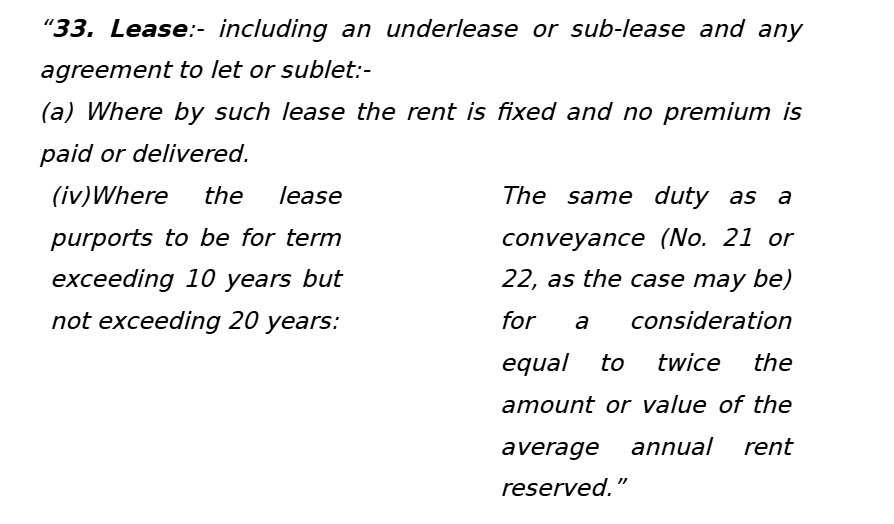
3. The deed was prepared on stamp papers worth Rs.2,72,500/- as stamp duty was calculated as provided under Article 33(a)(iv) of the schedule appended to the Kerala Stamp Act , 1959 (for short, ‘the Act, 1959’). Thus, it is the case of the petitioner that the stamp duty payable will come to Rs.2,72,237/-, which has been rounded off to Rs.2,72,500/-, and the lease deed was prepared on a stamp paper of Rs.2,72,500/-. Over and above the same, Rs.86,500/- was paid as registration fee, and the petitioners have paid the said amount. But by Ext.P3 order, the 3rd respondent returned Ext.P1 lease deed, refusing to register the same, mainly holding that since in Clause No.17 of Ext.P1 deed it is stipulated that the tenant is given right for building construction and as per Clause no.18 there is also a provision for return of the same to the landlord, stamp duty as per Article 5(c) of the Schedule appended to the Stamp Act, is liable to be paid on the estimated value.
4. The contention of the petitioners is that Article 5(c) is not applicable in the facts and circumstances of the present case. Article 5(c) is applicable in cases where authority or power is given to a promoter or developer for construction and development or sale or transfer of any immovable property, but, in the present case the petitioners have entered into a lease agreement based on mutual consensus, whereby respondents 5 and 6 leased out the entire 2nd floor of the multi storeyed commercial complex for a period of 20 years. Therefore, it is contended that Ext.P1 deed is nothing but an ordinary lease agreement. It is further submitted that Clause 17 in Ext.P1 deed is only a general clause which states that, if the tenant makes any alteration or addition they should obtain the prior consent from the landlord before doing so, and it is only meant to protect the interest of the landlord, thereby restricting the tenants from doing any alteration whatsoever at his whims and fancies. The incorporation of the said clause does not mean that the tenant is going to make any alteration or addition, as it deals with an uncertain contingency, which may or may not arise.
5. A detailed counter affidavit has been filed by the 4th respondent, wherein it is stated that on examination of the deed, tenant has been given the right to carry out a construction of the building as per clauses 16 and 17, and since such authority tr