
 Back





2026 Supreme(Ker) 516
IN THE HIGH COURT OF KERALA AT ERNAKULAM PRESENT
J. NISHA BANU, SHOBA ANNAMMA EAPEN, JJ.
Dyna Scaria @ Thresiamma D/O. Scaria N.S. – Appellant
Versus
Vernin Varkey @ John s/o. Varkey ku. – Respondent
MAT.APPEAL NO. 826 OF 2025
Decided on : 31-03-2026
Important Points
Subject
Family Law - Divorce
Act Referred
Headnote
Legal Category Hierarchy
-
family law
-
marriage dissolution
- divorce by mutual consent
-
family court procedure
- decree setting aside
- cooling period and reconciliation
-
marriage dissolution
-
civil procedure
- appeals
- evidence and affidavits
For the Appellant : SMT.GISA SUSAN THOMAS SMT.G.ASHWINI SMT.A.R.DIVYA
| Table of Content |
|---|
| 1. appellant argues husband's deposition supports divorce consent. (Para 4 , 5) |
| 2. court examines depositions confirming mutual divorce intent. (Para 6 , 7 , 8) |
| 3. no consent withdrawal; divorce decree granted on appeal. (Para 9 , 10) |
JUDGMENT :
Shoba Annamma Eapen, J
1. This appeal is filed by the wife, who is the second petitioner in the original petition, challenging the judgment and decree dated 23.06.2025 on the file of the Family Court, Thalassery, disallowing the prayer for dissolution of marriage under Section 10-A of the Divorce Act, 1869 . The appellant and the respondent are wife and husband respectively.
2. The marriage between the parties was solemnised on 13.05.2023 at St.Mary's Forane Church, Edoor as per the rites and rituals prevailing in the Roman Catholic Christian Community. Subsequently, their marriage was also registered before the Local Registrar of Marriage, Aralam Grama Panchayath on 03.06.2023. After marriage, the appellant and respondent resided together as husband and wife in the matrimonial home. Thereafter, owing to differences between the parties, the appellant left the matrimonial home. Despite conciliation efforts undertaken by both families, the appellant and the respondent mutually decided to separate, as they were unable to lead a harmonious married life. Subsequently, Annexure A1 original petition was filed seeking divorce by mutual consent before the family court. After the cooling period of six months, the parties underwent counselling and the attempt for reunion was not materialised. Thereafter, Annexures A2 and A3 proof affidavits were filed before the family court. The appellant deposed in tune with the affidavit filed by her. While recording the statement, the respondent deposed that there is no indifference between the couple, but they are living separately for no reason for more than a year. The family court dismissed the original petition, observing that the respondent had stated that they were living separately without any valid reason, and further finding that there was no mutual consent between the parties. Aggrieved by this, the wife has filed this appeal.
3. We have heard the learned counsel for the appellant.
Though notice was served on the respondent, he had chosen not to appear before this Court.
4. Learned counsel for the appellant produced the certified copy of the original petition filed before the family court, the sworn affidavit and the depositions of PWs.1 and 2 and submitted that the respondent-husband has categorically stated that he wanted divorce. But the family court, without considering the afore aspects, had dismissed the original petition by not granting divorce.
5. Learned counsel for the appellant also relied on the judgment of the Madras High Court inIn Re: A.C.Mathivanan & Another [2016 KHC 4077] and submitted that the court should not ask reason for not staying together in a petition of mutual consent divorce and is duty bound to allow divorce in a petition under Section 10A of the Divorce Act filed by the Family court.
6. We have considered the arguments raised by the learned counsel for the appellant.
7. It is an admitted fact that the appellant and respondent had filed Annexure A1 petition under Section 10(A) of the Divorce Act,1869 before the Family Court, Thalassery. After the cooling period of six months, they filed Annexures A2 and A3 separate proof affidavits. They were also examined as PWs.1 and 2 before the Family Court. PW1 deposed as follows:-
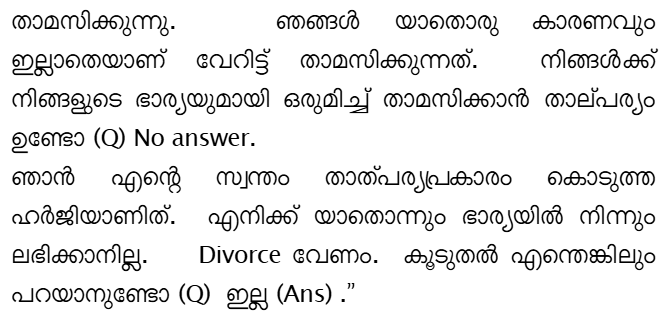
Translated portion is as follows:-
“I am the 1st petitioner. The 2nd petitioner is my wife. The marriage was conducted on 13/05/2023 at St. Mary’s Forane Church, Edoor as per Christian religious rites. The marriage has been registered. That certificate was shown to me, Marked as Ext. A1. We have been residing separately since 08/06/2024. We are residing separately without any reason. Do you wish to live together with your wife? (Q)
No answer.
This is a petition filed of my own free will. I have nothing











