
 Back
Back





IN THE HIGH COURT OF KERALA AT ERNAKULAM
SHOBA ANNAMMA EAPEN, J.
The Oriental Insurance Company Limited Kannur – Appellant
Versus
Kunhikannan T.P, S/o. Kunhappu – Respondent
Maca No. 101 of 2020
Decided On : 29-05-2026
| Table of Content |
|---|
| 1. factual basis of the motor accident claim. (Para 2 , 3) |
| 2. assessment of evidence regarding deceased's monthly income. (Para 4 , 5) |
| 3. correct application of personal expense deduction and future prospects. (Para 6) |
| 4. standardization of non-pecuniary damages and final order. (Para 7) |
JUDGMENT :
SHOBA ANNAMMA EAPEN, J.
This appeal is filed by the 3rd respondent insurer in O.P. (MV) No.753 of 2017 on the file of the Motor Accidents Claims Tribunal, Thalassery. The respondents herein were the claimants before the tribunal.
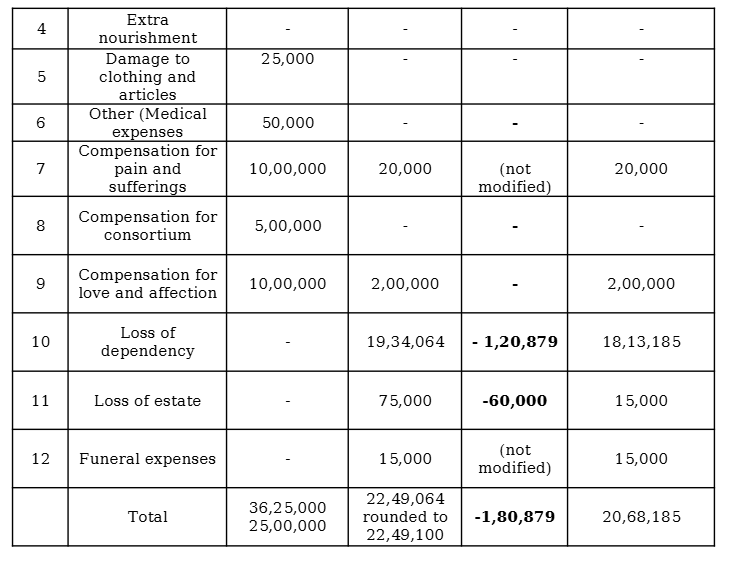
2. Brief facts of the case are as follows: On 13.06.2017, at about 12.30 p.m., while the deceased was riding her scooter bearing registration No.KL-13Y-9585, a bus bearing registration No.KL-13V-9007 driven by the second respondent in a rash and negligent manner hit on the scooter whereby the deceased fell down, sustained serious injuries and succumbed to the injuries. The claimants, who are the legal heirs of the deceased, approached the tribunal claiming a total compensation of Rs. 36,25,000/- which is limited to Rs. 25,00,000/-.
3. The first and second respondents, being the owner and driver of the bus respectively, filed a joint written statement admitting the insurance coverage of the vehicle, but denying the negligence attributed to the second respondent in causing the accident. The third respondent - insurer filed a written statement admitting the insurance policy, disputing the liability and quantum of compensation claimed. It was also contended that the driving licence of the deceased expired on 14.04.2017. Before the tribunal, PWs 1 and 2 were examined and Exts.A1 to A6 and A7 (series) were marked. The tribunal, after analysing the pleadings and materials on record, found that the accident occurred due to negligence on the part of the second respondent and awarded a sum of Rs. 22,49,064/-, which is rounded to Rs. 22,49,100/- as compensation under different heads with interest @ 8% per annum from the date of petition till realization with proportionate costs. Challenging the quantum of compensation awarded by the tribunal, the third respondent - insurance company has come up in appeal.
4. Heard the learned standing counsel for the appellant/insurance company and the learned counsel for the respondents/claimants.
5. The learned standing counsel appearing for the Insurance Company challenged the award passed by the tribunal, mainly with respect to the fixation of the monthly notional income of the deceased at Rs. 16,650/-. The learned standing counsel appearing for the insurance company submitted that there was no clear evidence to prove that the deceased was earning an amount of Rs. 16,650/- per month and that the tribunal had fixed the income solely relying on Ext.A7 series documents.
The learned counsel appearing for the respondents, however, submitted that Ext.P7 series documents were not challenged by the insurance company. It was further submitted that the husband of the deceased was examined before the tribunal as PW2. Taking into consideration the afore-two aspects, the tribunal had fixed the income as Rs. 16,650/-.
Considering the rival contentions raised by both sides and on a perusal of the impugned award, it is seen from paragraph 20 that the tribunal fixed the monthly income of the deceased at Rs. 16,650/- mainly for the following reasons; firstly, the tribunal relied on Ext.A7 series documents, which consisted of bills showing purchase of clothes from a garment shop. The owner of the garment shop was examined as PW1 and he deposed that the deceased used to purchase clothes from his shop and sell them door-to-door by taking a minimum commission of 25%. As per the bills produced, the total purchase for the month of May 2017 amounted to Rs. 66,602/-. Taking into account a 25% commission, the tribunal assessed the monthly income at Rs. 16,650/-.
Secondly, the tribunal relied on the evidence of PW2, the husband of the deceased, wherein he had asserted that the monthly income of the deceas
In motor accident claims, the deduction for personal and living expenses must strictly adhere to statutory and appellate guidelines based on the number of legal heirs, and compensation for loss of es....

The judgment establishes that income assessment must consider proven professional skills, and contributory negligence cannot be attributed without independent evidence. Furthermore, non-pecuniary com....

The court reserves power to modify compensation amounts based on legal reasoning, adjusting income calculations and deductions according to precedent.
Compensation adjustments for loss of dependency and conventional damages must follow binding judicial precedents.
In motor accident compensation claims involving a deceased spinster, only siblings who provide evidence of active financial dependency qualify for loss of dependency compensation; furthermore, one-ha....
Just compensation in motor accident claims requires reevaluation of notional income and loss dependency while maintaining adherence to precedents limiting duplicative awards.
In motor accident claims, tribunals must determine notional income based on realistic standards for the deceased's occupation to serve the principle of just and reasonable compensation, ensuring all ....
The court highlighted that just compensation should reflect notional income, appropriate deductions for dependents, and adhere to established legal precedents in personal injury claims and compensati....
The court underscores the need for proper compensation calculation while avoiding duplication under different heads.
Compensation awarded in fatal motor accident claims must accurately reflect notional income and future prospects, while ensuring deductions for personal expenses are justly applied.



An indispensable Tool for Legal Professionals, Endorsed by Various High Court and Judicial Officers
Please visit our Training & Support
Center or Contact Us for assistance

Scan Me!
India’s Legal research and Law Firm App, Download now!


For Daily Legal Updates, Join us on :



 Back to top


