
 Back
Back





IN THE HIGH COURT OF KERALA AT ERNAKULAM
RAJA VIJAYARAGHAVAN V, K.V.JAYAKUMAR, JJ
Hussain – Appellant
Versus
State Of Kerala Represented By Public Prosecutor – Respondent
CRL.A NO. 601 OF 2023, CRL.A NO. 598 OF 2023, CRL.A NO. 602 OF 2023, CRL.A NO. 604 OF 2023, CRL.A NO. 661 OF 2023, CRL.A NO. 676 OF 2023, CRA(V) NO. 27 OF 2024
JUDGMENT :
Raja Vijayaraghavan, J.
1. Prologue:
The Preamble of the Constitution of India holds out two solemn promises among others: Justice — social, economic and political — and Equality of status and of opportunity. These were not merely aspirational words. They were a declaration of intent by a nation that had seen, across centuries, what the organised denial of justice and equality could do to the human spirit. They were words written, in no small measure, for the emancipation of the downtrodden who had been humiliated, excluded, and shamed by deliberate social design.
1.2. On the 25th of November, 1949, Dr. B.R. Ambedkar, the principal architect of our Constitution, stood up before the Constituent Assembly and stated what can only be described as a warning to posterity. (See Constituent Assembly Debates, Volume X, Page 979)
“On the 26th of January 1950, we are going to enter into a life of contradictions. In politics we will have equality and in social and economic life we will have inequality. In politics we will be recognizing the principle of one man one vote and one vote one value. In our social and economic life, we shall, by reason of our social and economic structure, continue to deny the principle of one man one value. How long shall we continue to live this life of contradictions? How long shall we continue to deny equality in our social and economic life? If we continue to deny it for long, we will do so only by putting our political democracy in peril. We must remove this contradiction at the earliest possible moment or else those who suffer from inequality will blow up the structure of political democracy which this Assembly has so laboriously built up."
The conflict that Sri. B.R. Ambedkar described between political equality and social and economic inequality is still alive in Indian public life today. If any proof is required, one only needs to look at the facts of this case. The distance between the solemn promise in the Preamble and the facts of this case is a verdict not merely on the accused, but on “We the People”.
2. The Death of Madhu:
2.1. These Appeals concern the brutal assault and death of Madhu, a 27-year-old tribal man, who, if the prosecution version is believed, was publicly beaten, stripped, paraded in a semi-naked condition, humiliated on social media, and subjected to sustained violence before succumbing to his injuries. The incident occurred in broad daylight, involved multiple accused persons, and was recorded on digital devices.
2.2. The alleged perpetrators of the crime, according to the prosecution, are 16 individuals, all residents of Mannarkkad and its surrounding areas. They stood trial before the Additional Sessions Court, Mannarkkad, in S.C.No. 265 of 2018 and were charged under Sections 143, 147, 323, 324, 326, 294(b), 342, 352, 364, 367, 368, and 302 r/w. Section 149 of the Indian Penal Code, and additionally under Sections 3(1)(d), 3(1)(r), 3(2)(v) and 3(2)(va) of the Scheduled Castes and Scheduled Tribes (Preventionof Atrocities) Act, 1989 [“SC/ST (PoA) Act”].
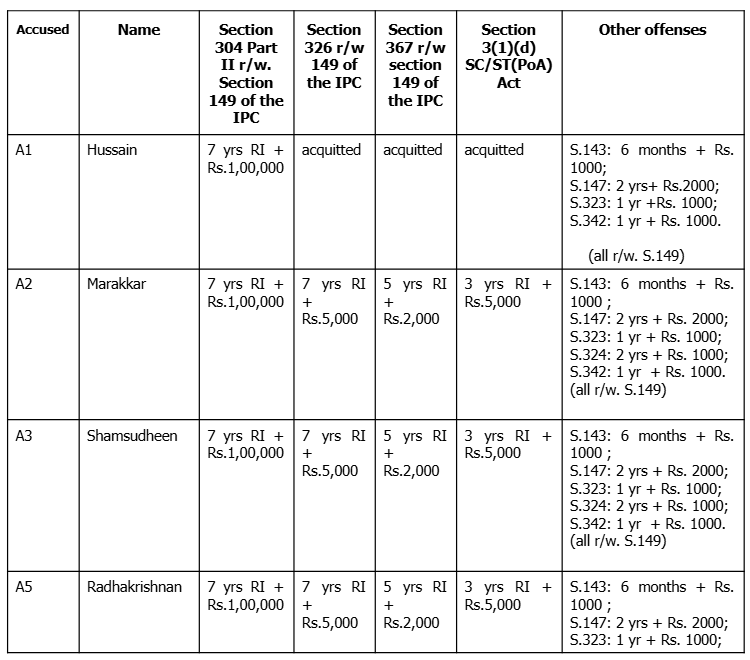
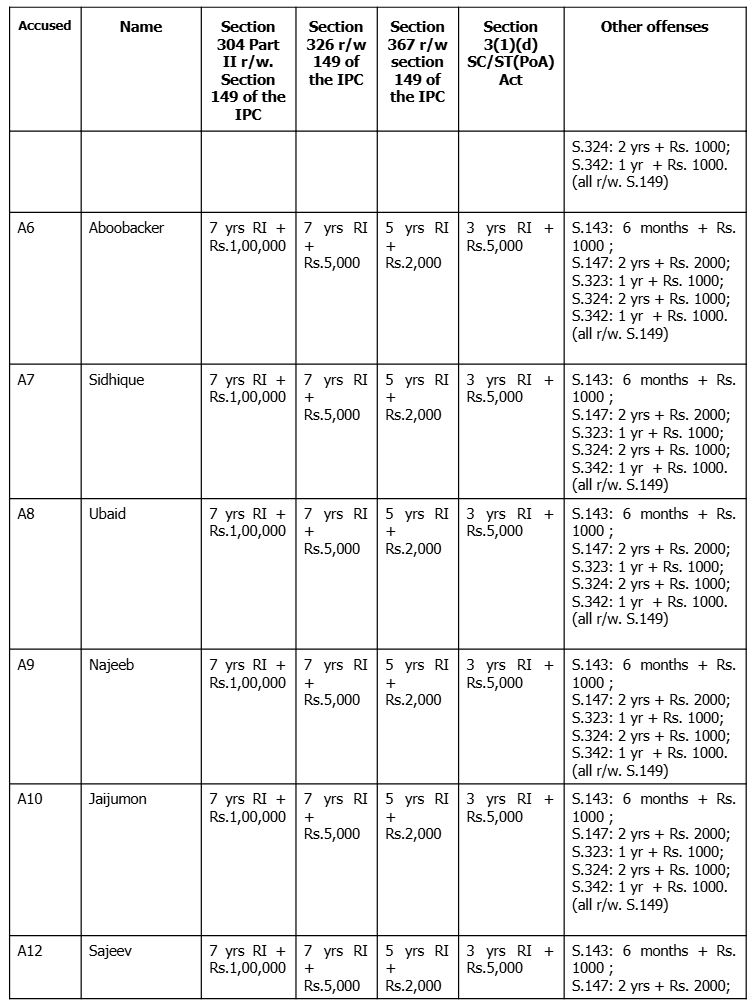
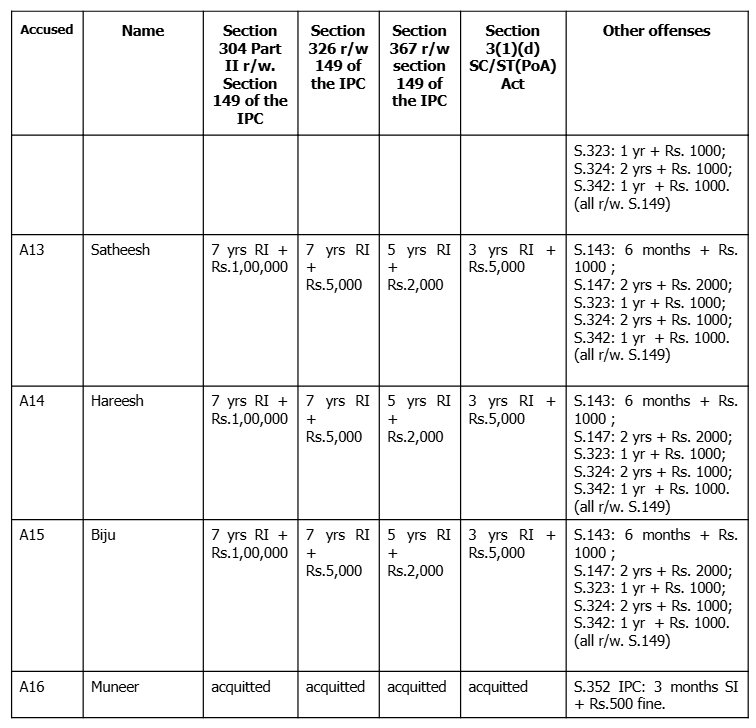
2.3. The trial court, by the impugned judgment, acquitted a few and convicted the rest for lesser offences. Accused Nos. 4 and 11 were acquitted of all charges framed against them. Insofar as the remaining 14 accused is concerned, though the court did not find them guilty of the offence under Section 302 of the IPC, they were found guilty, convicted and sentenced for several of the other offences, the details of which are set out in the chart below:
3. The Nature and Scope of the present Appeals:
3.1. The following appeals have been preferred before this Court, assailing the finding of guilt, conviction and sentence.
a) Crl. A. No. 601 of 2023 is filed by the 1st accused;
b) Crl. A. No. 602 of 2023 is filed by accused Nos. 2 and 5;
c) Crl. A. No. 598 of 2023 is filed by accused Nos. 3, 6, & 8 to 10;
d) Crl. A. No. 604 of 2023 is filed by accused Nos. 7, 12, 13, 14 and 15;
e) Crl. A No. 676 of 2023 is filed by the 16th accused;
f) Crl.

Membership in an unlawful assembly incurs liability for crimes committed in furtherance of a common object, regardless of specific overt acts attributed to each member.

The prosecution must prove each element of the offence beyond a reasonable doubt, including the nature of injuries and adherence to procedural requirements in cases under the SC/ST (POA) Act.

Court emphasized the need for consistent witness testimonies to sustain convictions under SC/ST Act and recognized the importance of specific attribution of actions to the accused in assault cases.

Convictions under SC & ST (POA) Act must be supported by compelling and consistent evidence of caste-based abuse in public.

Eyewitness testimony, even from an interested witness, can sustain a conviction if corroborated by credible evidence and circumstances.

The main legal point established in the judgment is the requirement for consistency and credibility in evidence, as well as the principle that 'no man is guilty until proven so.' The judgment emphasi....

The central legal point established in the judgment is the assessment of evidence, contradictions in witness testimony, and the applicability of specific sections of the Indian Penal Code, considerin....



An indispensable Tool for Legal Professionals, Endorsed by Various High Court and Judicial Officers
Please visit our Training & Support
Center or Contact Us for assistance

Scan Me!
India’s Legal research and Law Firm App, Download now!


For Daily Legal Updates, Join us on :



 Back to top


