1. Students challenge their suspension and disciplinary enquiry initiated by the University following a protest and alleged untoward incident during a campus Syndicate meeting. (Para 2 )
 Back
Next 





2026 Supreme(Ker) 1436
2026 KER 89409
IN THE HIGH COURT OF KERALA AT ERNAKULAM
P.V.KUNHIKRISHNAN, J.
Archana P.S., D/o Sasidharan – Petitioner
Versus
Sri Sankaracharya University Of Sanskrit Kalady – Respondent
Wp(C) No. 35256 Of 2026
Decided On : 23-11-2026
Advocates Appeared :
For the Petitioner : Shri.P.G.Pramod, Smt.Nadiya K.M., Sri.T.A.Shaji (Sr.), Sri.Gopalakrishna Kurup (Sr.)
For the Respondent : Smt.Silpa Sreekumar, Sc, Sri.George Poonthottam (Sr.)
Important Points
Disciplinary proceedings against students must adhere to the principles of natural justice, specifically requiring the issuance of a clear memo of charges and a reasoned "speaking order" in the enquiry report, otherwise, such actions are unsustainable and subject to judicial review under Article 226.
Subject
Education Law - Student Discipline
Act Referred
CONSTITUTION OF INDIA : Art.226
UNIVERSITY GRANTS COMMISSION REDRESS OF GRIEVANCES OF STUDENTS REGULATIONS : Reg.3(1)(f)(xvi), Reg.3(1)(f)(xvii), Reg.3(1)(f)(xviii)
SREE SANKARACHARYA UNIVERSITY OF SANSKRIT ACT : S.14, S.14(2)(t), S.14(2)(u), S.6, S.7, S.7(xix), S.7(xxvi)
Headnote
(A) Constitutional Law - Article 226 - Maintainability of writ petition despite alternative remedy - Where the alternative remedy provided is not efficacious (e.g., grievance redressal by an authority appointed by the accused party) or there is a blatant violation of natural justice, the High Court may invoke its extraordinary jurisdiction under Article 226 (Paras 11-14).
(B) Administrative Law - Disciplinary Proceedings - Principles of Natural Justice - A disciplinary enquiry must be a quasi-judicial process. Failure to issue a memo of charges, failure to provide witnesses' statements for rebuttal, and the issuance of an enquiry report that is not a "speaking order" (lacking reasoned findings and discussion of evidence) renders the proceedings and subsequent punishments unsustainable (Paras 23-26).
(C) Education Law - University powers and discipline - Statutory powers to regulate student discipline and conduct enquiries are valid under university acts and statutes, provided the procedure adopted does not violate the principles of natural justice (Paras 16-19).
Facts of the case:
Students were suspended following a protest and subsequent clashes during a campus visit by university authorities. An enquiry committee was constituted to investigate the incident. Although the students participated in hearings, they were not served with a memo of charges, nor were the evidence and complaints relied upon by the committee furnished to them. The resulting enquiry report contained conclusions without discussing the evidence or providing reasons for the findings. The university subsequently refused to allow students to write examinations, citing insufficient attendance despite an undertaking given to the apex court to hold separate examinations if favorable orders were passed by the High Court.
Findings of Court:
The suspension order, the constitution of the enquiry committee, the enquiry report, and the consequential punishment orders were found to be illegal as they violated the principles of natural justice. The court found that the enquiry report was a unilateral decision based on evidence not shared with the students. The university was further directed to honor its unconditional undertaking given to the apex court to conduct separate examinations for the affected students.
Issues: Whether the writ petition was maintainable despite the existence of an alternative grievance redressal mechanism and whether the suspension and disciplinary enquiry were sustainable given the lack of a memo of charges and a reasoned enquiry report.
Ratio Decidendi: Disciplinary proceedings that impact a student's career must be conducted judicially. The fundamental requirement of natural justice is that the accused must be told the charges against them in clear and unambiguous terms. Furthermore, an enquiry report must be a speaking order; a mere statement that charges are proved, without a reasoned appraisal of evidence, constitutes a non-application of mind, rendering the proceedings vitiated.
Result: Writ Petition disposed of. Impugned orders set aside. Petitioners permitted to enter campus and attend classes. University directed to hold separate examinations for the specific petitioners who missed them within six weeks.
Legal Category Hierarchy
- administrative law
- practice and procedure
- education law
Advocates:
For the Appellants/Petitioners: P.G. Pramod, Nadiya K.M., T.A. Shaji, Gopalakrishna Kurup
For the Respondents: Silpa Sreekumar, George Poonthottam
Table of Contents
2. Petitioners argue the proceedings lack statutory support and violate natural justice, while the University contends the writ is not maintainable due to an alternative grievance redressal mechanism. (Para 6 , 7 )
3. The court observed that the Internal Grievance Redressal Committee is not an efficacious remedy when the University authorities are accused of bias, necessitating judicial intervention. (Para 11 , 12 , 13 , 14 )
4. Disciplinary proceedings against students must strictly comply with principles of natural justice, including providing a clear memo of charges and reasoned findings to avoid being declared ex parte. (Para 25 , 26 , 27 )
5. The court set aside the suspension order and enquiry report, directing the University to reinstate the petitioners and conduct a fresh examination for affected students. (Para 36 )
6. Can a writ petition be rejected for non-exhaustion of alternative remedies when an internal committee is involved?
No, if the committee is appointed by the same authority responsible for the impugned action, the remedy is akin to an appeal from Caesar to Caesar's wife and is not considered efficacious. (Para 11 )
7. What are the minimum requirements for a valid student disciplinary enquiry report?
A disciplinary enquiry report must be a speaking order, provide a clear memo of charges to the student, allow for the cross-examination of witnesses, and base conclusions on evidenced materials discussed in the report. (Para 23 , 24 , 25 , 26 )
8. Does a university have inherent power to regulate student discipline if no specific ordinance exists?
Yes, under statutory powers to supervise and control the conduct and discipline of students, the University can constitute committees for disciplinary enquiry even in the absence of specific ordinances. (Para 16 , 17 , 18 , 19 )
JUDGMENT :
P.V.KUNHIKRISHNAN, J.
The petitioners are students of Sree Sankaracharya University of Sanskrit, Kalady, enrolled in various courses in different streams under the University. They are aggrieved by their suspension and consequential disciplinary actions taken by the respondent University.
Statement of Facts
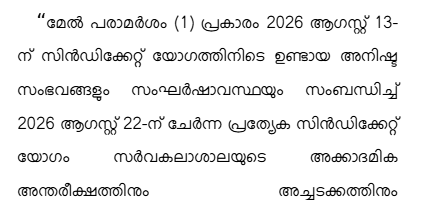
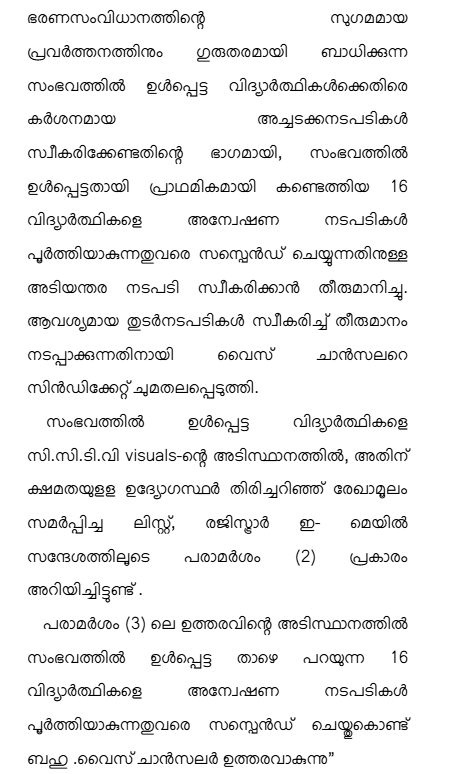
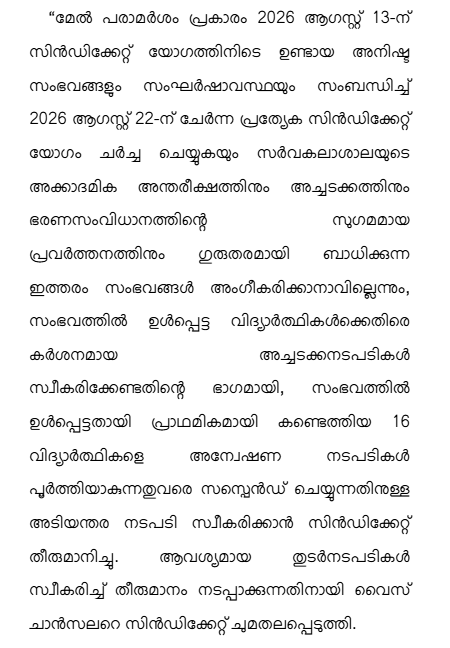
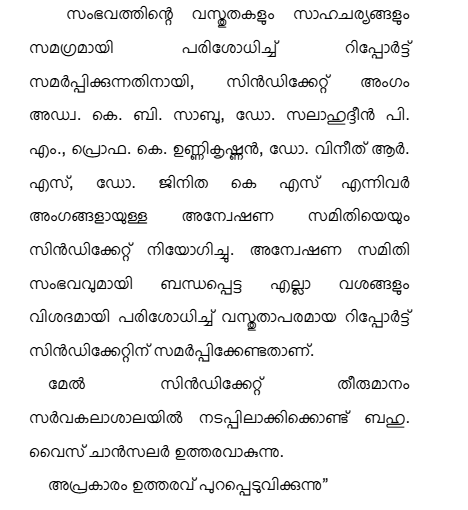
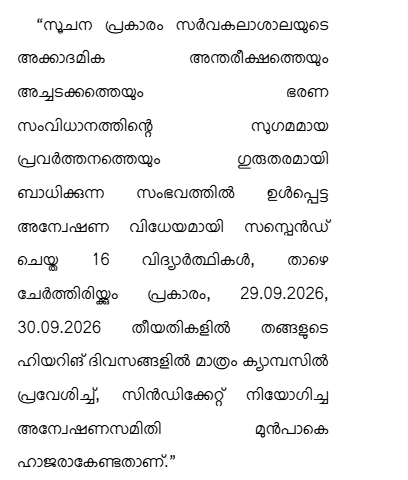
2. According to the petitioners, they are raising various demands to address the grievances of the students in the University, including the non-filling up of 27 vacant posts of Lecturers, the inability on the part of the 1st respondent University to grant printed certificates, the lack of basic infrastructure facilities, disbursal of fellowship amounts, etc., and the students were compelled to protest before the authorities of the University for getting their facilities for a smooth academic session. On 13.08.2026, while the Vice Chancellor of the University visited the campus to attend the Syndicate meeting of the University, the students gathered and demanded an opportunity to meet the Vice Chancellor to get the various difÏculties they were facing in the University redressed, as submitted by the petitioners. But, according to the petitioners, the Vice Chancellor and the University authorities did not accede to this demand. The students continued to gather and raised the demand for a chance to meet the Vice Chancellor to redress their grievances, is the further submission. Despite repeated requests, they were not granted permission to meet, or have an audience with, the Vice Chancellor, as submitted by the petitioners. According to the petitioners, the Vice Chancellor left the campus accompanied by police force without redressing the grievances of the petitioners and other students. Based on the students gathering in protest and demanding a meeting with the Vice Chancellor, an incident occurred in which there was a push-and-pull between the students and the police authorities. Consequently, Crime No. 735 of 2026 was registered by the Kalady police, as evident from Ext.P1 F.I.R. Ext.P1 F.I.R. was registered based on a statement given by the then Sub Inspector of Police, Kalady Police Station, who was present on the premises when the law and order problem arose. The F.I.R. was registered on 13.08.2026 at 23:22 hours based on the alleged incident that happened on 13.08.2026 at 19:40 hours. Subsequently, the Vice Chancellor filed a complaint on 16.08.2026 at 15:47 hours, and based on the said complaint, the Kalady Police registered another F.I.R. as Crime No.744 of 2026, as evident from Ext. P2, in which the alleged incident is also stated to have occurred on 13.08.2026 at 19:15 hours, as in Ext.P1. Thereafter, on 01.09.2026, the petitioners were suspended by the University as per Ext.P3 order, wherein the reason stated for the suspension was the alleged untoward incident that occurred on 13.08.2026 in connection with the Syndicate meeting. On 01.09.2026 itself, by Ext. P4 order, the respondents constituted an enquiry committee to enquire into the untoward incident that occurred on 13.08.2026. Subsequently, the petitioners received Ext. P5 memo dated 22.09.2026, granting permission to appear for the enquiry on 29.09.2026 and 30.09.2026. In the meantime, Ext. P6 notification was issued by the respondent University notifying the FYUGP/UG/PG/Diploma/PG Diploma Degree Examination. At that stage, the petitioners filed the above writ petition.
3. When this writ petition came up for consideration before this Court on 30.10.2026, this Court directed the University to allow the petitioners to appear for the examination subject to the result of the writ petition. This Court also made it clear in the order that the petitioners' appearance in the examination will not give them any right or equity while deciding the case finally. Ext. P7 is the interim order dated 30.10.2026 in I.A. No.2 of 2026 in W.P.(C) No.35256 of 2026. The above interim order was challenged by the University before the Division Bench of this Court by filing W.