
 Back
Back





IN THE HIGH COURT OF JUDICATURE FOR RAJASTHAN AT JODHPUR
Yogendra Kumar Purohit, J.
Taruna W/o Mahendra Kumar Mundra - Petitioner
Versus
Gopal Singh S/o Mahendra Singh - Respondent
S.B. Criminal Misc(Pet.) No. 708/2023, S.B. Criminal Misc(Pet.) No. 707/2023
Decided On : 01-05-2024
PROSECUTION - CHEQUE DISHONOUR - The court held that under Section 138 of the Negotiable Instruments Act, only the drawer of the cheque can be prosecuted. The appellant, not being the drawer or signatory of the cheque, cannot be held liable under this provision. The court emphasized that in cases of joint accounts, all account holders must sign the cheque for prosecution to be valid, thereby preventing misuse of Section 138 as a means of coercion for debt recovery.
Fact of the Case:
The appellant was accused under Section 138 of the Negotiable Instruments Act for a cheque that was drawn from a joint account but was only signed by her husband. The appellant contended that she was not the drawer or signatory of the cheque.
Finding of the Court:
The court found that the appellant did not sign the cheque and therefore could not be prosecuted under Section 138. It reiterated that only the drawer of the cheque can be held liable for dishonour under this section.
Issues: Whether a person who is not a signatory to a cheque can be prosecuted under Section 138 of the Negotiable Instruments Act, particularly in the context of joint accounts.
Ratio Decidendi: The court established that under Section 138, only the drawer of the cheque can be prosecuted, and in the case of joint accounts, all joint account holders must sign the cheque for any prosecution to be valid. This principle serves to protect individuals from being unjustly prosecuted for debts owed by others.
Final Decision: The petition was accepted, and the summoning order against the appellant was quashed, allowing proceedings to continue only against her husband, who was the signatory of the cheque.
JUDGMENT :
Yogendra Kumar Purohit, J.
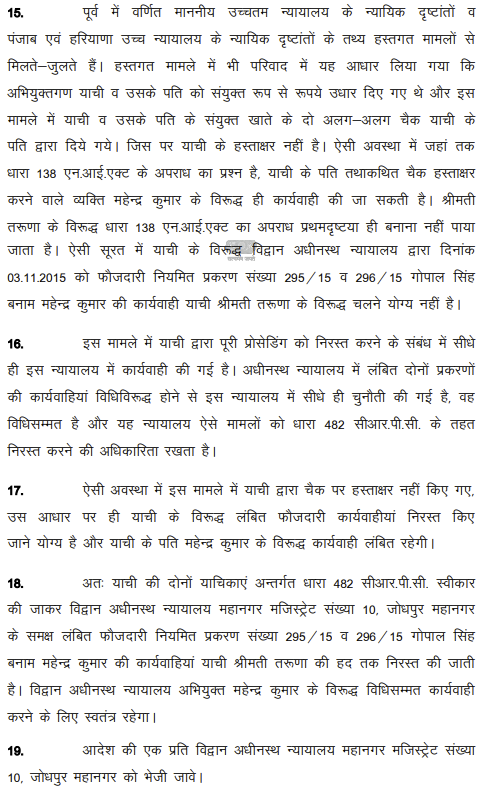
27. In the light of the above discussion, we hold that under Section 138 of the Act, it is only the drawer of the cheque who can be prosecuted. In the case on hand, admittedly, the appellant is not a drawer of the cheque and she has not signed the same. A copy of the cheque was brought to our notice, though it contains the name of the appellant and her husband, the fact remains that her husband alone had put his signature. In addition to the same, a bare reading of the complaint as also the affidavit of examination-in-chief of the complainant and a bare look at the cheque would show that the appellant has not signed the cheque.
28. We also hold that under Section 138 of the NI Act, in case of issuance of cheque from joint accounts, a joint account-holder cannot be prosecuted unless the cheque has been signed by each and every person who is a joint account-holder. The said principle is an exception to Section 141 of the NI Act which would have no application in the case on hand. The proceedings filed under Section
138 cannot be used as arm-twisting tactics to recover the amount allegedly due from the appellant. It cannot be said that the complainant has no remedy against the appellant but certainly not under Section 138. The culpability attached to the dishonour of a cheque can, in no case “except in case of Section 141 of the NI Act” be extended to those on whose behalf the cheque is issued. This Court reiterates that it is only the drawer of the cheque who can be made an accused in any proceeding under Section 138 of the Act. Even the High Court has specifically recorded the stand of the appellant that she was not the signatory of the cheque but rejected the contention that the amount was not due and payable by her solely on the ground that the trial is in progress. It is to be noted that only after issuance of process, a person can approach the High Court seeking quashing of the same on various grounds available to him. Accordingly, the High Court was clearly wrong in holding that the prayer of the appellant cannot even be considered. Further, the High Court itself has directed the Magistrate to carry out the process of admission/denial of documents. In such circumstances, it cannot be concluded that the trial is in advanced stage”.
10. Therefore, a person who is the signatory to the cheque and the cheque is drawn by that person on an account maintained by him and the cheque has been issued for the discharge, in whole or in part, of any debt or other liability and the said cheque has been returned by the bank unpaid, such person can be said to have committed an offence. Section 138 of the NI Act does not speak about the joint liability. Even in case of a joint liability, in case of individual persons, a person other than a person who has drawn the cheque on an account maintained by him, cannot be prosecuted for the offence under Section 138 of the NI Act. A person might have been jointly liable to pay the debt, but if such a person who might have been liable to pay the debt jointly, cannot be prosecuted unless the bank account is jointly maintained and that he was a signatory to the cheque.”
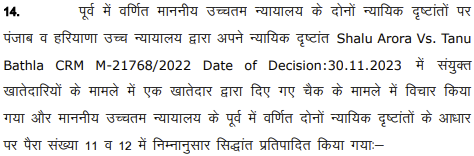
11. In view of the above discussion, it would be safe to observe that the petitioner is not liable for the cheque drawn by her husband from the joint account relating to both of them. However, the proceedings may continue against Raman Kumar Arora, her husband, as he had signed the cheque in question.
12. Resultantly, the present petition is accepted and the(Annexure P-1) and the summoning order 01.02.2020 (AnnexureP-2) passed by the Judicial Magistrate 1st Class, Mohali are ordered to be quashed qua the petitioner only.
AI
Only the drawer of a cheque can be prosecuted under Section 138 of the Negotiable Instruments Act, and in cases of joint accounts, all signatories must be involved for liability to attach.

Only the drawer of a cheque can be prosecuted under Section 138 of the NI Act; a joint account holder is not liable unless they signed the cheque.


A joint account holder cannot be prosecuted under Section 138 of the N.I. Act unless they are also a signatory on the cheque; prosecution of a non-drawer constitutes an abuse of process.

A person can only be prosecuted under Section 138 of the Negotiable Instruments Act if the cheque is drawn by them on an account maintained by them for the discharge of a debt or liability. Joint lia....


A joint account holder cannot be prosecuted under Section 138 of the NI Act unless the cheque is signed by each and every joint account holder.
Only the drawer of the cheque can be prosecuted under Section 138 of the Negotiable Instruments Act, and joint account holders cannot be held vicariously liable for the acts of the drawer.


Only the drawer of a cheque can be prosecuted under Section 138 of the Negotiable Instruments Act; joint account holders are not liable unless they signed the cheque.



An indispensable Tool for Legal Professionals, Endorsed by Various High Court and Judicial Officers
Please visit our Training & Support
Center or Contact Us for assistance

Scan Me!
India’s Legal research and Law Firm App, Download now!


For Daily Legal Updates, Join us on :



 Back to top


