
 Back
Back





RAJASTHAN HIGH COURT
Arun Bhansali, J.
Abdul Javed - Appellant
Versus
Shravan Kumar - Respondent
S.B. Civil Second Appeal No. 532/2011
Decided On : 27-04-2021
Land - Property Dispute - CPC Section 100, 105(2) - The court interpreted provisions of CPC regarding appeals and remand, emphasizing the finality of concurrent findings by lower courts unless substantial legal questions arise, which influenced the dismissal of the appeal.
Fact of the Case:
The plaintiff claimed ownership of land gifted by his father, alleging the defendant encroached upon it by constructing a hotel. The defendant contended he had a valid patta for the land, leading to a legal dispute over property rights.
Finding of the Court:
The court upheld the findings of the lower courts, which determined that the plaintiff's claims were unsupported by evidence, particularly regarding the distance of the road and the validity of the patta issued to the defendant.
Issues: Whether the lower courts erred in their findings regarding the ownership and encroachment of land, and if substantial questions of law arose from their decisions.
Ratio Decidendi: The court ruled that the concurrent findings of fact by the lower courts were not challenged on grounds of perversity, thus not giving rise to substantial questions of law under CPC.
Result: The appeal is dismissed.
JUDGMENT
1. This second appeal under Section 100 CPC is directed against the judgment & decree dated 04.08.2011 passed by Additional District Judge, Deedwana ('the first appellate court') affirming the judgment & decree dated 28.08.2008 passed by Civil Judge (Sr. Division), Deedwana ('the trial court'), whereby the suit filed by the appellant-plaintiff, was dismissed.
2. The predecessor of plaintiff-Kailash Chandra filed a suit, inter alia, with the submissions that a piece of land was purchased by plaintiff's father in Village - Baliya, which his father Jugal Kishore gifted to plaintiff-Kailash Chandra, which was indicated as CDEF in the plan annexed to the plaint.
3. It was alleged that on the western side of the land, the respondent has put an Almirah on the land of the way, started hotel business, regarding which, complaints were made to the Gram Panchayat, however, no action was taken. Subsequently, the plaintiff came to know that the respondent has got issued a patta of the land and obtained permission for construction, for which he applied to the Gram Panchayat for supplying of the copies, however, the same were not issued. It was alleged that on the western side of the plaintiff's land, government road at a distance of about 43.5 feet was situated and on account of construction of hotel by the respondent on 30 X 15 feet land, he had grabbed land of common way. It was prayed that the patta may be cancelled and by way of permanent injunction, respondent be restrained from raising any construction and whatever obstructions he has raised, may be ordered to be removed.
4. The respondent-defendant filed written statement and denied the plaint allegations. It was stated that the defendant was in possession of the land for a long time and that he has obtained patta from the Gram Panchayat, which was issued on the basis of possession and that the land was not that of way. It was contended that Gram Panchayat Baliya was a necessary party.
5. The plaintiff got the suit amended and sought relief of declaring the patta as illegal.
6. On the pleadings of the parties, several issues were framed by the trial court and the suit was decreed on 26.11.1990.
7. Feeling aggrieved, the defendant filed first appeal, which came to be decided by the Additional District Judge, Deedwana on 16.03.2005 and the matter was remanded back to the trial court to redecide the same.
8. Before the trial court on remand, the present appellant filed an application under Order I, Rule 10 CPC submitting that he has purchased the land from the plaintiff-Kailash Chandra and, therefore, he may be impleaded as party, the trial court by its order dated 11.07.2005 impleaded the present appellant as plaintiff. The written statement was also allowed to be amended as per direction of the appellate court on an application filed by the defendant under Order VI, Rule 17 CPC.
9. The trial court after recording the evidence of the parties by its impugned judgment dated 28.08.2008, dismissed the suit of the plaintiff-appellant.
10. Feeling aggrieved, the appellant filed first appeal. The first appellate court by its judgment and decree dated 04.08.2011, dismissed the appeal filed by the appellant and affirmed the judgment and decree dated 28.08.2008.
11. It is submitted by learned counsel for the appellant that both the courts below gravely erred in law in deciding issue No.3 against the plaintiff by wrongly framing the same, as the same was not based on the case of any of the parties. It was emphasized that the defendant, was occupying the land, which could not have been allotted by the Gram Panchayat and as such, the two courts below fell in error in dismissing the suit and the appeal filed by the appellant. It was submitted that the findings recorded by both the courts below give rise to substantial question of law and as such, the same deserves to be admitted.
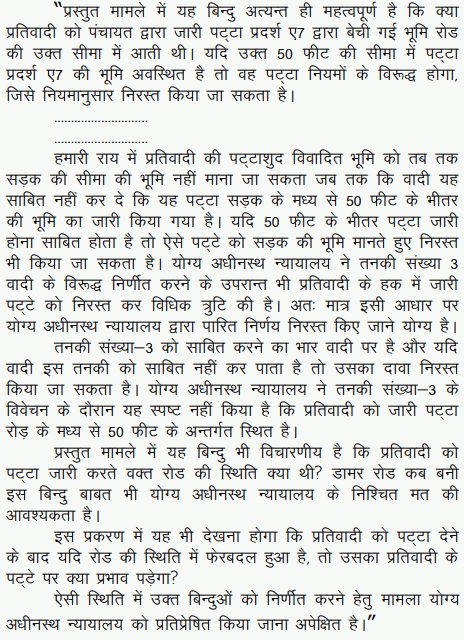
12. Learned counsel for the respondent vehemently opposed the submissions. It was submitted that both the courts below have c
AI

The central legal point established in the judgment is the reliance on evidence, particularly the documents showing the distance of the road from the boundary, in determining the ownership of the lan....
Concurrent findings of fact by lower courts are upheld unless substantial legal questions are presented, emphasizing the importance of evidence in property disputes.
The legality and validity of the patta issued in 1974, and the requirement for a declaratory suit when challenging land allotment.

The court affirmed the necessity of proving ownership despite acknowledged possession and ruled against reliance on a patta for property ownership lacking formal declaration.

Concurrent findings of fact and absence of substantial questions of law are essential for the exercise of jurisdiction under Section 100 of CPC.
A counter claim must be directed against the plaintiff, and lack of evidence for ownership results in dismissal of claims.

The court affirmed the Plaintiffs' easementary rights based on historical use and legal documentation, emphasizing the significance of such rights in property law.



An indispensable Tool for Legal Professionals, Endorsed by Various High Court and Judicial Officers
Please visit our Training & Support
Center or Contact Us for assistance

Scan Me!
India’s Legal research and Law Firm App, Download now!


For Daily Legal Updates, Join us on :



 Back to top


