
 Back
Back





RAJASTHAN HIGH COURT BENCH AT JAIPUR
Prakash Gupta, J.
Mahesh Kewalramani & Ors. - Appellants
Versus
Jogendra Singh & Ors. - Respondents
S.B. Civil Revision Petition No. 106 of 2021
Decided On : 08-09-2021
Limitation - Sale Deeds - Order 7 Rule 11, Section 151 CPC - The court interpreted the limitation period under Article 59 of the Limitation Act, 1963, concluding that the question of limitation was a mixed question of law and fact, influencing the dismissal of the defendants' application.
Fact of the Case:
The plaintiffs filed a suit to declare two sale deeds as null and void, while the defendants sought dismissal of the suit on the grounds of limitation, claiming the suit was barred under Article 59 of the Limitation Act, 1963.
Finding of the Court:
The court found that the trial court correctly determined that the question of limitation was a mixed question of law and fact, and that the plaintiffs had sufficient grounds to claim they only became aware of the sale deeds in 2019.
Issues: Whether the suit filed by the plaintiffs was barred by limitation under Article 59 of the Limitation Act, 1963.
Ratio Decidendi: The court held that the question of limitation could not be decided at the preliminary stage as it involved mixed questions of law and fact, thus supporting the trial court's decision.
Result: The revision petition filed by the defendants is dismissed.
ORDER
Prakash Gupta, J. - This revision petition has been filed by the petitioners-defendants (for short, 'the defendants') against the order dated 27.7.2021 passed by the trial court, whereby the application filed by the defendants under Order 7 Rule 11 readwith Section 151 CPC has been dismissed.
2. Facts of the case are that the respondents-plaintiffs (for short, 'the plaintiffs') filed a suit for declaring the sale deeds dated 17.12.1963 and 9.7.1968 as null and void and to cancel them; for possession and permanent injunction. During the pendency of the suit, the defendants filed an application under Order 7 Rule 11 readwith Section 151 CPC, which came to be dismissed by the trial court vide its order dated 27.7.2021. Hence, this revision petition has been filed.
3. Learned counsel for the defendants submits that one of the relief sought by the plaintiffs for declaring the sale deeds dated 17.12.1963 and 9.7.1968 as null and void, whereas as per Article 59 of the Limitation Act, 1963, limitation for filing such suit is only 3 years, therefore, the suit filed by the plaintiffs was barred by limitation and liable to be rejected on this ground. In support of his contentions, he has placed reliance on the following judgments:
i) Raghwendra Sharan Singh Versus Ram Prasanna Singh (Dead) by Lrs reported in AIR 2019 Supreme Court 1430
ii) Prem Singh & Ors. Versus Birbal & Ors. reported in 2006 (2) Court Cases 701 (SC)
iii) Sushil Yadav & Anr. Versus M/s. Valley View Developers Pvt. Ltd. & Ors. reported in 2016 (1) Civil Court Cases 739 (Delhi)
iv) Kishan Chand Versus Amar Singh reported in 2015 (4) Civil Court Cases 247 (P&H)
v) Smt. Dilboo (Dead) by Lrs. & Ors. Versus Smt. Dhanraji (Dead) & Ors.
4. On the other hand, learned counsel for the plaintiffs has opposed the same and submits that the suit property came in possession of the plaintiffs' father late Jagdish Ji on the basis of gift deed dated 16.2.1957 and the said gift deed dated 16.2.1957 was challenged by the defendants themselves in the Court of District Judge, Ajmer by filing a Civil Suit in the year 2020 wherein the cause of action was said to have arisen to them on 30.11.2019. In this way, the defendants are blowing hot and cold together. On the one hand, they are averring that the suit filed by the plaintiffs is time barred, whereas on the other hand, they themselves have filed a suit in the year 2020 in relation to the gift deed dated 16.2.1957. In the present matter, the question of limitation is a mixed question of law and fact, which cannot be decided at this stage.
Heard. Considered.
5. The trial court while dismissing the defendants' application under Order 7 Rule 11 CPC noted that the plaintiffs did not claim ownership / title of the suit property, but the main relief claimed by them was for declaring the sale deeds dated 17.12.1963 and 9.7.1968 as null and void, for which the Civil Court has jurisdiction to hear the matter.
6. So far as the objection taken by the defendants with regard to suit being barred by limitation was concerned, the trial court noted that in para 23 of the suit, the plaintiffs averred that for the first time they came to know about the sale deeds on 30.10.2019 and on 22.11.2019 they filed the suit mainly for declaring the sale deeds as null and void, therefore, at this stage, it could not be said that the suit is barred by limitation.
7. It is revealed that in paragraphs 16 and 20 of the suit, the plaintiffs averred as under:-
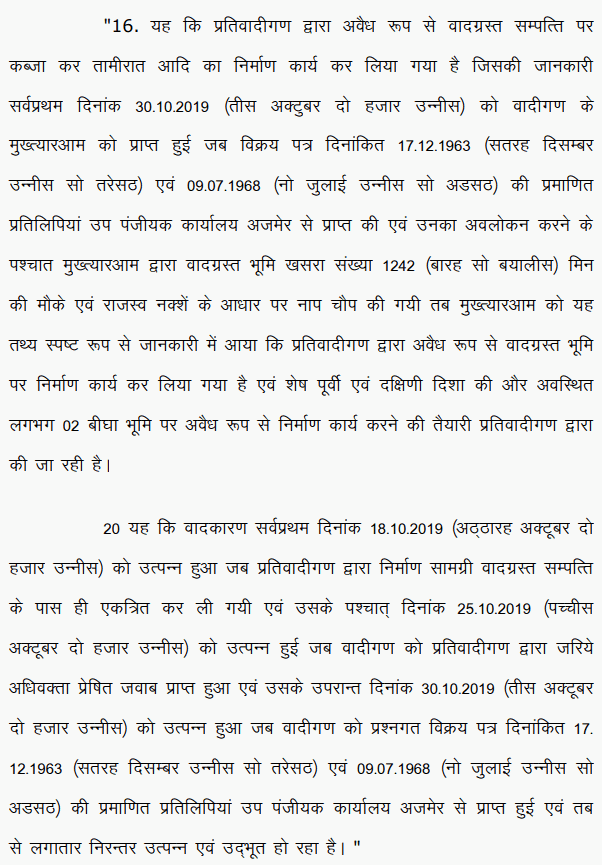
8. There is no averment in the plaint and no document on record, which shows that the plaintiffs had knowledge about the sale deeds in question prior to the aforesaid date.
9. Thus, from the above quoted paragraphs, in my considered view, the question of limitation in the present matter, is a mixed question of facts and law.
10. The judgments relied upon by the learned counsel for the defendants do not apply to the facts and circumstances of the present case.
11. I am in agreement with the findings arrived at by the trial cour
AI
The court established that limitation issues can involve mixed questions of law and fact, which cannot be resolved at the preliminary stage of proceedings.

The court clarified that knowledge of encroachment does not imply knowledge of a sale deed, impacting the limitation period for filing a suit.
Issues of limitation in civil suits must be resolved through evidence, preventing dismissal of plaints at an early stage based solely on claims of knowledge.
The question of limitation in civil suits is a mixed question of law and fact, requiring evidence to determine the plaintiff's knowledge of essential facts.
A perusal of the observations made indicates that the Court while laying down the above proposition has used the word ‘ordinarily’ and has not laid down that even in a case where the issue of limitat....


Parties cannot waive the defense of limitation; a suit filed beyond the statutory limit must be dismissed, regardless of any concession from opposing parties.

A plaint can be rejected under Order VII Rule 11 if it is barred by limitation or fails to disclose a cause of action, emphasizing the necessity for clear and truthful averments.



An indispensable Tool for Legal Professionals, Endorsed by Various High Court and Judicial Officers
Please visit our Training & Support
Center or Contact Us for assistance

Scan Me!
India’s Legal research and Law Firm App, Download now!


For Daily Legal Updates, Join us on :



 Back to top


