
 Back
Back





HIGH COURT OF RAJASTHAN (JAIPUR BENCH)
INDERJEET SINGH, VINOD KUMAR BHARWANI, JJ
CHANCHAL AGRAWAL D/O SHRI MAHESH CHANDRA BANSAL - Appellant
Versus
VIPIN KUMAR AGRAWAL S/O SHRI SUBHASH CHANDRA AGRAWAL - Respondent
CMA / 843 / 2015
Decided On : 06-01-2025
(A) Hindu Marriage Act, 1955 - Section 13 - Divorce - Application for divorce on grounds of cruelty dismissed by Trial Court - Appeal allowed as the marriage has irretrievably broken down due to long separation and absence of cohabitation - Misbehavior and dowry demand by husband established as cruelty - Decree of divorce granted. (Paras 10-14)
(B) Cruelty - Definition and scope - Cruelty can be physical or mental, and the absence of intention does not negate its existence - Long separation and absence of cohabitation constitute cruelty. (Paras 10-12)
Facts of the case:
The wife filed for divorce citing cruelty and dowry demands after a marriage lasting only a few days, with both parties living separately since 2008. The husband denied the allegations and claimed the wife was employed and capable of self-support.
Findings of Court:
The husband's behavior constituted cruelty, and the long separation indicated no chance of reconciliation, warranting the divorce.
Issues: The main issues were whether the husband's behavior amounted to cruelty and if the long separation justified the divorce.
Ratio Decidendi: The court held that the long separation and the husband's misbehavior constituted cruelty, justifying the dissolution of marriage under Section 13(1)(ia) of the Act. The continuation of the marriage would only perpetuate cruelty.
Result: Appeal allowed; marriage dissolved.
ORDER :
1. This appeal has been filed by the appellant-wife (hereinafter to be referred as “Wife”) against the judgment and decree dated 10.02.2015 passed by the learned District Judge, Dholpur, (hereinafter to be referred as ‘Trial Court’), whereby the learned Trial Court dismissed the application under Section 13 of the Hindu Marriage Act, 1955 (hereinafter to be referred as ‘Act of 1955’)filed on behalf of the wife.
2. Brief facts of the case are that the wife filed an application under Section 13 of the Act of 1955 before the learned Trial Court stating therein that the marriage between the respondent- husband (hereinafter to be referred as ‘husband’) and wife was solemnized on 04.12.2007. It was further stated in the application by the wife that the behaviour of the husband and his family members was not good with her and they have demanded the dowry. It was further stated in the application that she left the husband’s house as her life was in danger and there is no matrimonial relationship with both of them and prayed for granting the decree of divorce on the ground of cruelty.
3. The husband filed reply to the said application and denied the allegations made by the wife. It is further stated in the reply that the wife has completed her B.Ed course and doing job as teacher in a school and prayed for dismissal of the said application on the basis of pleadings of the parties recorded before the learned Trial Court.
4. The wife in support of his case submitted her own evidence as AW-1. On the other side the husband has produced his own evidence as NAW-1.
5. The learned trial court after hearing both the parties dismissed the application under Section 13 of the Act of 1955 filed by the wife. Being aggrieved by the judgment and decree dated 10.02.2005 passed by the learned Trial Court, the wife has filed the present appeal before this Court.
6. The learned trial court on the basis of pleadings of the parties framed two issues, which are as under:-
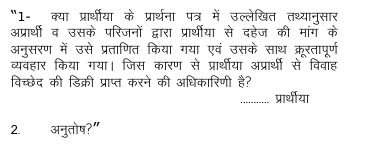
7. None present on behalf of the wife to argue the matter even in the second round.
8. Learned counsel appearing on behalf of the husband submits that the husband and wife both are living separately since 2008 and there is no chance to reunion after a delay of 16 years. Learned counsel further submits that the wife has lodged a false criminal case against her husband with regard to demand of dowry.
9. Heard learned counsel for the husband and perused the material available on record.
10. The point of cruelty has been considered by the Hon’ble Supreme Court at length & depth in catena of judgments and in a recent judgment delivered in the matter of Shri Rakesh Raman Vs. Smt. Kavita (Civil Appeal No.2012/2013) decided on 26.01.2023, wherein in Paras No.17 and 18, it has been has held as under:-
“17. Cruelty has not been defined under the Act. All the same, the context where it has been used, which is as a ground for dissolution of a marriage would show that it has to be seen as a ‘human conduct’ and ‘behavior” in a matrimonial relationship. While dealing in the case of Samar Ghosh (supra) this Court opined that cruelty can be physical as well as mental:-
“ 46…If it is physical, it is a question of fact and degree. If it is mental, the enquiry must begin as to the nature of the cruel treatment and then as to the impact of such treatment on the mind of the spouse. Whether it caused reasonable apprehension that it would be harmful or injurious to live with the other, ultimately, is a matter of inference to be drawn by taking into account the nature of the conduct and its effect on the complaining spouse.
Cruelty can be even unintentional:-
…The absence of intention should not make any difference in the case, if by ordinary sense in human affairs, the act complained of could otherwise be regarded as cruelty. Intention is not a necessary element in cruelty. The relief to the party cannot be denied on the ground that there has been no deliberate or wilful ill- treatment.”
This Court though did ultimately
Cruelty in marriage can be established through long separation and misbehavior, justifying divorce under the Hindu Marriage Act.

A dead marriage must be given a decent quietus.

Cruelty in matrimonial law encompasses behavior causing significant emotional distress, and long-term separation without cohabitation can establish grounds for divorce under the Hindu Marriage Act.
Divorce – Act of cruelty which can be reasonably perceived in one case may not be a cruelty in another case because of disparity in environment in which parties have grown up.

The judgment emphasizes the need to consider the cultural, ethical, and social aspects of the parties' lives in determining cruelty in matrimonial disputes, as well as the importance of ascertaining ....

Cruelty in marriage can be both physical and mental, and a long separation may constitute grounds for divorce under the Hindu Marriage Act.

Long separation between spouses can constitute mental cruelty, justifying divorce in cases where marriage has become unworkable.


Cruelty and desertion are valid grounds for divorce under the Hindu Marriage Act, with evidence of mental and physical cruelty substantiating the claims.



An indispensable Tool for Legal Professionals, Endorsed by Various High Court and Judicial Officers
Please visit our Training & Support
Center or Contact Us for assistance

Scan Me!
India’s Legal research and Law Firm App, Download now!


For Daily Legal Updates, Join us on :



 Back to top


