
 Back
Back





HIGH COURT OF JUDICATURE FOR RAJASTHAN, BENCH AT JAIPUR
SAMEER JAIN, J.
Sagarmal, Son Of Teja Ram and Ors. – Appellants
Versus
State Of Rajasthan, Through Pp and Anr. – Respondents
S.B. Criminal Appeal (Sb) No. 3152 of 2024 Connected With S.B. Criminal Appeal (Sb) No. 3153 of 2024
Decided On : 22-01-2025
(A) Scheduled Castes and Scheduled Tribes (Prevention of Atrocities) Act, 1989 - Section 14A(2) - Criminal Procedure Code, 1973 - Section 173(8) - Bail application - The appellants, accused of murder and related offences, sought bail citing lack of specific allegations and the principle of parity. The court noted the severity of injuries and criminal antecedents, ultimately dismissing the bail appeals. (Paras 1, 16)
(B) Bail - Considerations - The court emphasized the need to consider the history of criminal antecedents, nature of the offence, and potential risks to witnesses when adjudicating bail applications. (Paras 14, 16)
Facts of the case:
The appellants were accused in a murder case with 14 injuries inflicted on the deceased, who belonged to an underprivileged community. The FIR was lodged two days post-incident, raising concerns about its timeliness. (Paras 2, 11)
Findings of Court:
The court found that the appellants failed to establish a case for bail due to the nature of the offence and the risk of tampering with evidence. (Paras 16)
Issues: The main issues included the adequacy of evidence against the appellants and the implications of their criminal antecedents on the bail application. (Paras 5, 16)
Ratio Decidendi: The court ruled that the severity of the injuries and the appellants' criminal history warranted the denial of bail, emphasizing the need to protect the rights of the victim's community. (Paras 16)
Result: Bail appeals dismissed.
Judgment :
(SAMEER JAIN, J.)
1. The instant criminal appeals are filed under Section 14A(2) of the Scheduled Castes and Scheduled Tribes (Prevention of Atrocities) Act, 1989 (for short “the Act of 1989”) on behalf of the appellants, who are in custody in relation to FIR No.168/2023 registered at Police Station Peeplu, District Tonk for the offence under Sections 143, 302, 201 IPC read with Section 3(2)(v)(VA) of the Act of 1989).
2. Learned counsel for the appellants had submitted that as per the records, it can be noted that the alleged incident occurred on 27th June, 2023 and an FIR against the was lodged belatedly on 30th June, 2023 by brother of the deceased, stating that a group of persons who were employees of sand smugglers, have attacked and caused brutal injuries upon the deceased.
3. Learned counsel had further submitted that it is revealed from the medical report that as many as 14 injuries were sustained by the deceased, out of which, 11 were simple in nature and one was fatal/grievous/life threatening in nature. It is further averred that at present, qua certain alleged persons, proceedings under the provisions of Section 173(8) Cr.P.C. are initiated and qua some of the accused-persons charge sheet is not filed and investigation is ongoing, as per the factual report.
4. Learned counsel for the appellants had prayed that the present appeals may be allowed whislt enlarging the appellants on bail, on the ground that the Apex Court has granted the benefit of bail vide order dated 21st October, 2024 passed in Abhishek & Anr. Vs. State of Rajasthan & Ors.; Petition(s) for Special Leave to Appeal (Crl.) No.11876/2024.
5. Learned counsel for the appellants had urged and pleaded the Court to follow the principle of parity and contended as follows:
5.1 That FIR was made to be registered after two days of the alleged incident.
5.2 That no specific role is assigned to the appellants nor any allegations are made directly against the appellants.
5.3 That all the appellants are the sole bread-earners of their families and are aged in between 20 and 40 years.
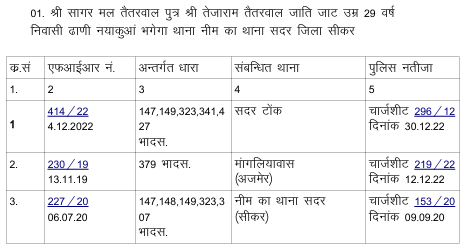
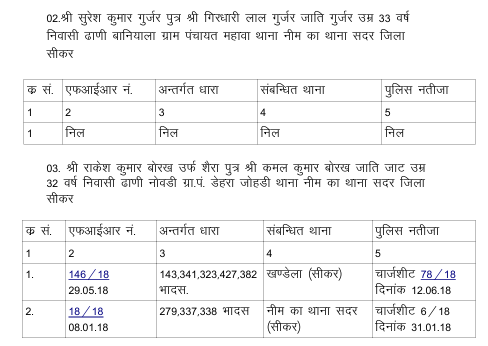
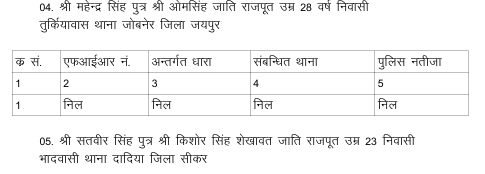
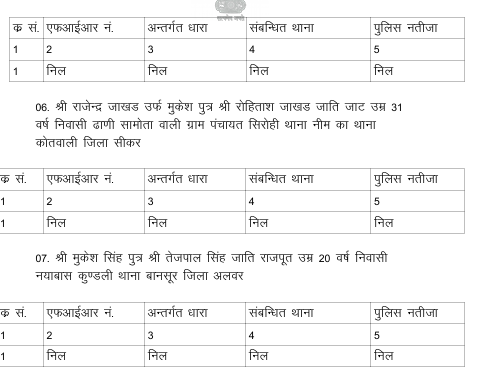
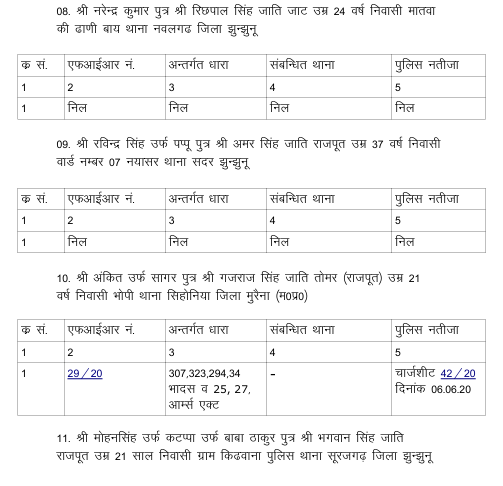
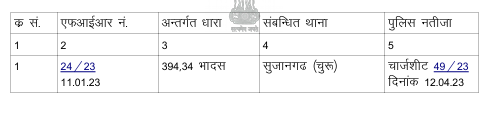
6. It was further submitted that there are zilch criminal antecedents registered against the appellants except a few of the appellants namely Rakesh Kumar, Sagar Mal and Ankit.
7. Consecutively, it was submitted that being aggrieved by the dismissal of the bail application, the co-accused appellants preferred a SLP before the Hon’ble Supreme Court registered as Rakesh Kumar Vs. State of Rajasthan & Ors.; Petition(s) for Special Leave to Appeal (Crl.) No.15963/2023, and SLP (Cr.) No. 16030/2023 which were dismissed vide order dated 14.12.2023 (Annexure – 4). Nonetheless, the same is not applicable to the present facts of the application, as the same was dismissed after filing of charge sheet.
8. Subsequently, it was submitted that statement of PW – 3 – Dr. Rajesh Kumar (Medical Officer) had not supported the story of the prosecution and depicts that the cause of death was not the injuries sustained by the deceased.
9. In support of the contentions made insofar learned counsel for the appellant had placed reliance upon the ratio encapsulated in Izharul Haq Abdul Hamid Shaikh & Ors. Vs. State of Gujarat reported in 2009 (2) ACR 1232 (SC) and Khet Singh & Anr. Vs. State of Rajasthan registered as SB Criminal Miscellaneous Bail Application no.861/2021;
10. While placing reliance upon the aforesaid ratio, it was contended that if one of the co-accused is granted the benefit of bail then the other co-accused are also entitled for the benefit of bail, as per the principle of parity. Moreover, the tenure of custody shall also be a relevant ground for consideration of the bail application.
11. Per contra, learned Public Prosecutor and the learned counsel appearing on behalf of the complainant, have vehemently opposed the instant appeal and have made manifold submissions, inter alia others a few of which are noted herein below:
11.1 That precisely it is noted in the said FIR that resultant to the brut
The court emphasized that the severity of the crime and the criminal history of the appellants outweighed their arguments for bail, highlighting the need to protect the victim's family's rights.

Bail applications under Section 14A(2) of the SC/ST Act require careful consideration of the nature of the alleged offence and the evidence of involvement.
Bail is the rule, and incarceration should be the exception, requiring careful consideration of the nature of the crime and potential for witness tampering.

The court emphasized the necessity of timely FIR registration and proper representation for marginalized communities, deferring final adjudication to ensure compliance with legal standards.

The court established that bail can be granted based on the absence of criminal history, the nature of the allegations, and the duration of custody, reinforcing the presumption of innocence.

The court denied bail due to the serious nature of the offense and the risk of tampering with evidence, emphasizing the need for judicial integrity.
The court emphasized that prolonged detention without substantial evidence serves no purpose, warranting bail for the accused.

The main legal point established in the judgment is the court's discretion in granting bail, considering the gravity of the offense, presence of eyewitnesses, and the need for expeditious trial proce....
The court's decision to grant bail was based on the specific circumstances of the case, including the nature of the allegation, the appellant's custody, and the absence of criminal antecedents.



An indispensable Tool for Legal Professionals, Endorsed by Various High Court and Judicial Officers
Please visit our Training & Support
Center or Contact Us for assistance

Scan Me!
India’s Legal research and Law Firm App, Download now!


For Daily Legal Updates, Join us on :



 Back to top


