
 Back
Back





HIGH COURT OF JUDICATURE FOR RAJASTHAN AT JODHPUR
REKHA BORANA, J.
M/s. Makrana Marble Centre, through Parnter Smt. Sadhna Indra Bhushan Sharma and Ors – Petitioners
Versus
Vinod Kumar Sharma, S/o Shri Kishan Gopalji Sharma and Ors. – Respondents
S.B. Civil Revision Petition No. 87 of 2014 AND S.B. Civil Revision Petition No. 89 of 2014
Decided On : 22-01-2025
(A) Indian Partnership Act, 1932 - Section 69 - Revision petitions against dismissal of applications under Order 7 Rule 11, CPC - The court upheld the trial court's finding of territorial jurisdiction based on the partnership deed indicating the administrative office at Parbatsar - The suit for dissolution and accounts is not barred under Section 69 as it falls within the exceptions provided. (Paras 5, 11, 13, 15)
(B) Jurisdiction - The court emphasized that the jurisdiction is determined by the averments in the plaint and supporting documents, not merely by the registered office location. (Paras 4, 7, 9)
Facts of the case:
The plaintiff filed a suit for dissolution and accounts against a partnership firm, claiming jurisdiction based on the administrative office's location in Parbatsar, despite defendants arguing otherwise.
Findings of Court:
The trial court's dismissal of the applications was upheld, affirming jurisdiction based on the partnership deed and the nature of the suit.
Issues: The main issues were the jurisdiction of the court and the applicability of Section 69 of the Indian Partnership Act.
Ratio Decidendi: The court ruled that the partnership deed's clause regarding the administrative office established jurisdiction, and the suit for dissolution is not barred under Section 69.
Result: Revision petitions dismissed.
| Table of Content |
|---|
| 1. suit for dissolution (Para 1 , 2) |
| 2. grounds of jurisdiction (Para 4 , 5) |
| 3. trial court's rejection (Para 6 , 7) |
| 4. jurisdiction based on deed (Para 8 , 9 , 10 , 11 , 12 , 13 , 14) |
| 5. revision petitions outcome (Para 15 , 16) |
Order :
(REKHA BORANA, J.)_
1. The present revision petitions arise out of the same order impugned and hence, were heard together and are being decided by this common order.
2. The present revision petitions have been preferred against the order impugned dated 28.02.2014 passed by the Additional District Judge, Parbatsar, District Nagaur in Civil Original Suit No.57/2012 whereby two applications under Order 7 Rule 11, CPC as preferred on behalf of defendant Nos.1 to 3 & defendant Nos.4 to 6 respectively, were dismissed.
3. The facts are that a suit for dissolution, rendition of accounts, recovery and permanent injunction was filed by plaintiff Vinod Kumar before the Court of Additional District Judge, Parbatsar. In the said suit two applications under Order 7 Rule 11, CPC were filed by defendant Nos.1 to 3 and defendant Nos.4 to 6 respectively.
4. The grounds raised by defendant Nos.1 to 3 in their applications was primarily that the Court at Parbatsar did not have the territorial jurisdiction to entertain the suit in question as the registered office of the partnership firm was at Rajkot. Further, no cause of action arose to the plaintiff at Parbatsar and hence, the Court at Parbatsar had no jurisdiction to entertain the suit in question.
5. Defendants No.4 to 6, while raising the above ground of territorial jurisdiction also raised an additional ground to the effect that the suit in question was barred by law in terms of Section 69 of the Indian Partnership Act, 1932 (hereinafter referred to as ‘the Act of 1932’). It was averred that the plaintiff was not a partner in defendant No.4-firm and hence, in terms of Section 69(1) of the Act of 1932, had no right to sue defendant No.4-firm and its partners.
6. The learned Trial Court proceeded on to reject both the applications with an observation that there was a specific clause in the partnership deed in question reflecting the administrative office of the firm in question to be at Parbatsar. The Court further observed that the partnership deed dated 01.04.1994 was an admitted document and hence, the specific clause of the said deed wherein the administrative office of the firm was mentioned to be at Parbatsar, would also be termed to be admitted.
7. The Court further observed that even otherwise, while deciding the application under Order VII Rule 11, CPC the Court is required only to consider the averments as made in the plaint and the documents as annexed with the plaint. As per the averments of the plaint, the firm had an administrative office at Parbatsar and even the income tax returns of the firm were filed at Parbatsar till the year 2014. The Court therefore observed that prima facie the plaint could not be rejected on the ground of lack of jurisdiction under Order VII Rule 11, CPC.
8. In the specific opinion of this Court, the finding as recorded by the learned Trial Court qua territorial jurisdiction is totally in consonance with the documents as annexed with the plaint as well as the law governing the issue. Clause 2 of the partnership deed dated 01.04.1994 read as under:
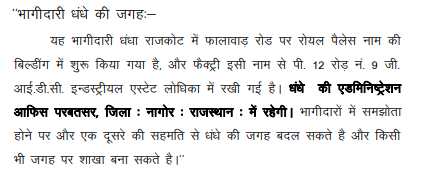
9. A bare perusal of the above clause reflects that it was agreed between the parties that the administrative office of the business of the firm would be at Parbatsar, District Nagaur. The effect and application of the above clause to the present suit in question would definitely be a subject matter for an issue to be framed and decided by the Court. Definitely, the plaint cannot be rejected on the count of lack of jurisdiction.
10. So far as judgment in Subodh Kumar Gupta V. Shrikant Gupta & Ors.:1993 (2) SCC 1 as relied upon by learned counsel for petitioners is concerned, therein the averments made in plaint were ‘vague’ and nothing was placed on record to establish that b
The court affirmed that a suit for dissolution and accounts is not barred under Section 69 of the Indian Partnership Act, 1932, as it falls within the exceptions provided for unregistered firms.

The main legal point established in the judgment is that the jurisdictional fact of registration of the partnership firm must be averred in the plaint to avoid the suit being rendered void under Sect....

The main legal point established in the judgment is the scope of revisional powers under Section 115 of the CPC and the principles of rejection of plaint under Order VII Rule 11 of the CPC.
The exceptions under Section 69(3)(a) of the Indian Partnership Act, 1932, apply to suits seeking rendition of accounts between partners after the dissolution of a firm.

(1) Suit for enforcing right of avoidance of a document on the ground of fraud and misrepresentation as also statutory rights of seeking declaration and injunction can be filed by an unregistered par....

An unregistered partnership firm cannot file a suit for enforcement of a contract against a third party, as per Section 69 of the Indian Partnership Act.

The court affirmed that suits regarding partnership rights can proceed even if the firm is unregistered and emphasized the requirement of proper evidence to establish claims of profit-sharing.

Point of Law : Section 154 (1)(c) of Assam Land and Revenue Regulation cannot act as a bar as regards the maintainability of suit for which said cannot also be a substantial question of law involved ....

A suit for recovery of money by partners of an unregistered firm is not maintainable under Section 69 of the Indian Partnership Act, 1932, which mandates registration for such suits.
A suit cannot be instituted by an unregistered partnership firm, as per Section 69 of the Indian Partnership Act, rendering such suits barred by law.



An indispensable Tool for Legal Professionals, Endorsed by Various High Court and Judicial Officers
Please visit our Training & Support
Center or Contact Us for assistance

Scan Me!
India’s Legal research and Law Firm App, Download now!


For Daily Legal Updates, Join us on :



 Back to top


