
 Back
Back





IN THE HIGH COURT OF JUDICATURE FOR RAJASTHAN AT JODHPUR
SANJEET PUROHIT, J.
Arvind Kumar S/o Bhagwati Lal Dhiliwal – Appellant
Versus
LRs. of Late Shri Shivnath S/o Kishan Nath – Respondent
S.B. Civil Writ Petition No. 15695 of 2025
Decided On : 22-01-2026
| Table of Content |
|---|
| 1. factual basis for specific performance and cancellation of sale deed (Para 2 , 3) |
| 2. impleadment of dinesh sharma as a necessary party denied (Para 4) |
| 3. arguments of petitioner on dominus litis and necessity for impleadment (Para 5) |
| 4. counterarguments regarding the lack of clean hands and motives (Para 6) |
| 5. judicial discretion in impleadment and its limits (Para 8) |
| 6. conclusion on dinesh sharma's necessity in the suit (Para 9 , 10) |
| 7. rejection of similar prior application establishes consistent judicial stance (Para 11 , 12 , 14 , 15) |
| 8. scope of judicial review under article 227 (Para 16 , 17) |
| 9. final dismissal of the writ petition (Para 18 , 19) |
ORDER :
1. The present writ petition has been filed challenging order dated 29.07.2025 passed by Court of learned Additional District and Sessions Judge No. 2, Chittorgarh (“learned trial court”) in Civil Original Suit No. 3/2026 (Arvind vs. Shivnath & Ors.) rejecting the application of petitioner-plaintiff filed under Order 1 Rule 10 CPC and refusing to implead Shri Dinesh Sharma S/o Shri Nandlal Sharma, as party-defendant in suit proceedings.
2. Facts giving rise to the present writ petition are stated in succinct as below:
2.1. Petitioner-plaintiff preferred a suit for specific performance as well as cancellation of sale deed dated 12.02.2016, stating therein that four agreements to sell dated 08.02.2010 and three other agreements to sell dated 11.06.2010, said to be executed by defendants, promising to sell their share of land to the plaintiff. However, defendants have refused to execute sale deed in favour of plaintiff, which has given cause of action to the plaintiff to seek prayer of specific performance of the said agreements to sell.
2.2. It is further stated that instead of executing sale deed in favour of the plaintiff, defendant nos. 1, 2 and 3 have executed a sale deed dated 12.02.2016 in favour of defendant nos. 4 to 9 , thus, prayer for cancellation of sale deed was also made.
2.3. It is further stated that during pendency of the suit proceedings, third-party rights have been created by way of registered sale deeds and the subsequent purchasers were impleaded as party defendants nos. 15 to 17 by allowing application of petitioner-plaintiff under Order 1 Rule 10 CPC by order dated 25.05.2018.
3. The defendants arraigned in the suit have filed their respective written statements and on the basis of the pleadings of the parties, learned trial court framed issues for adjudication on 26.07.2019.
4. Thereafter, petitioner-plaintiff filed an application under Order 1 Rule 10 CPC on 14.05.2025 stating therein that petitioner has come to know that one agreement to sell dated 25.10.2013 was also executed by defendant nos. 1, 2, and 3 in favour of one Dinesh Sharma S/o Shri Nandal Sharma, who has also instituted a suit (Civil Original Suit No. 1/2016), which is pending consideration before the same court.
4.1. It is averred that since Dinesh Sharma has also prayed for specific performance of the agreement to sell relating to same property and that since the outcome of the said suit is likely to affect the adjudication of the suit preferred by petitioner-plaintiff, therefore, Dinesh Sharma shall also be impleaded as party respondent in his suit. The said application was contested by existing defendants.
4.2. Learned trial court vide its order dated 29.07.2025 has dismissed the application preferred on behalf of petitioner-plaintiff and refused to implead Dinesh Sharma as party defendant in the suit on the ground that no relief as such has been prayed as against Dinesh Sharma and even the pleadings of the plaint nowhere contains any reference with regard to the alleged agreement to sell being executed in favour of Dinesh Sharma. Said order dated 29.07.2025 has been challenged in the present writ petition.
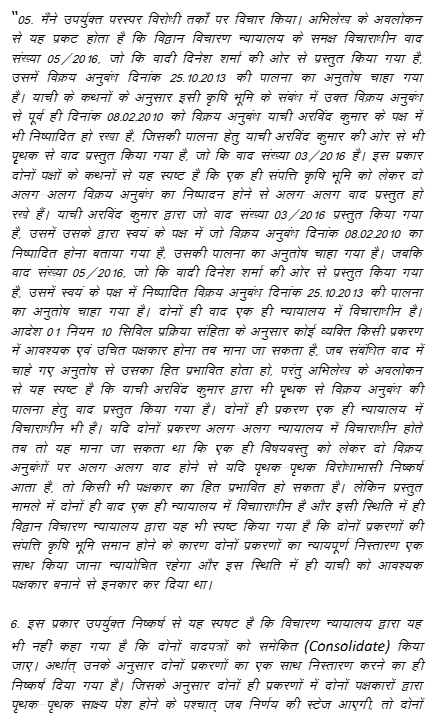
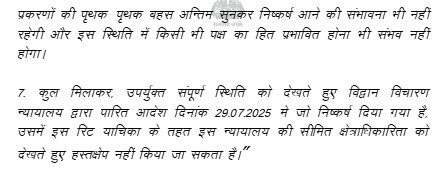
5. Challenging the said order, counsel for petitioner argued that petitioner is a plaintiff, having dominus litis, has all the rights to pray for impleadment of any person i
AI
The court affirmed that a plaintiff's right to join parties (dominus litis) is subject to judicial discretion, and a proposed party must be necessary for a complete adjudication of the suit.

The High Court's supervisory powers under Article 227 are limited to ensuring subordinate courts act within their authority, and it cannot interfere without evidence of jurisdictional abuse.

The court may compel the addition of necessary parties to a suit despite the plaintiff's choice, ensuring all interested parties can be adjudicated effectively.

A court may exercise discretion to add necessary or proper parties in a suit for effective adjudication, distinguishing necessary parties (essential for decree) from proper parties (important for adj....


The court emphasized that a necessary or proper party can only be added if it is essential for effective adjudication and not against the wishes of the dominus litis principle.

The main legal point established in the judgment is that the impleadment of a party is not necessary if no legal right has been created in their favor, and their presence is not required to effective....
The court affirmed the principle that parties with substantial interest must be joined for effective adjudication in specific performance suits, emphasizing judicial discretion under Order 1 Rule 10.
A plaintiff in a civil suit is the dominus litis and cannot be compelled to implead parties against their will unless their involvement is necessary for just adjudication.

An applicant seeking impleadment must demonstrate a direct legal interest and right to relief concerning the controversy in a suit; absence of such a link renders the request for impleadment invalid.



An indispensable Tool for Legal Professionals, Endorsed by Various High Court and Judicial Officers
Please visit our Training & Support
Center or Contact Us for assistance

Scan Me!
India’s Legal research and Law Firm App, Download now!


For Daily Legal Updates, Join us on :



 Back to top


