
 Back
Back





HIGH COURT OF JUDICATURE FOR RAJASTHAN AT JODHPUR
Chandra Shekhar Sharma, J.
Bhanwar Singh S/o Shri Banshi Singh Rajput - Appellant
Versus
Ramesh Kumar Sabu S/o Shri Jugal Kishore Sabu - Respondent
S.B. Civil Misc. Appeal No. 1465 of 2013
Decided On : 11-12-2025
| Table of Content |
|---|
| 1. appellant's claim background and accident details. (Para 1 , 2) |
| 2. arguments by appellant and respondent. (Para 3 , 4 , 5 , 6) |
| 3. judicial observations on section 163-a application. (Para 7 , 8 , 10 , 11 , 12 , 13 , 14 , 15) |
| 4. change in law regarding section 163-a. (Para 9) |
| 5. final ruling and order on appeal. (Para 16 , 17) |
ORDER :
CHANDRA SHEKHAR SHARMA, J.
Appellant-claimant– Bhanwar Singh has preferred this appeal under Section 173 of the Motor Vehicles Act, 1988 (for short, ‘the Act’) against the impugned judgment dated 28.02.2013 passed by Motor Accident Claims Tribunal, Bhilwara (for short ‘the Tribunal’) in claim case No.590/2013 (470/2005) whereby the Tribunal rejected the claim petition filed by the claimant.
2. Brief facts of the case in nut shell are that the appellant- claimant was driving a Maruti Car bearing registration No.RJ14- 01C-9856. At about 12:30 am, when he reached near M.T.M. Mill, an unidentified truck collided with the car, as a result of which the appellant–claimant sustained various injuries of simple as well as grievous in nature. Thus, a claim petition was filed by the appellant-claimant. After service of notice, respondent No.2- Insurance company filed its reply and denied the averments made in the petition. On the basis of the pleadings of the parties, the Tribunal framed following three issues on 12.10.2009:-
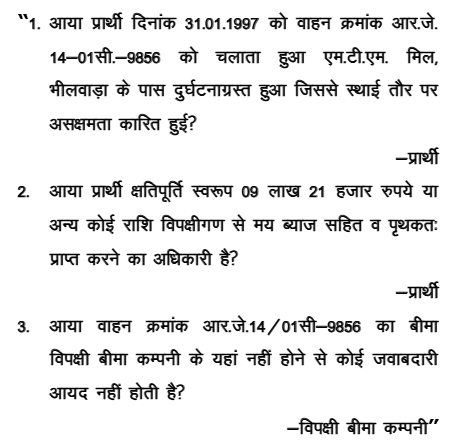
In support of his case, the appellant-claimant produced two witnesses and also exhibited-documents. After conclusion of the trial, the Tribunal rejected the claim petition of the appellant-claimant.
3. Learned counsel for the appellant submitted that the impugned judgment dated 28.02.2013 passed by the Tribunal is ex-facie illegal, arbitrary, perverse, and wholly contrary to the settled principles of law governing adjudication under Section 163 -A of the Act. Learned counsel submitted that the Tribunal, despite rightly recorded the findings on the occurrence of the accident and the resultant 12% permanent disability as well as on the fact that the offending vehicle was duly insured with Respondent No.2, committed grave illegality while passing the order impugned.
4. Learned counsel for the appellant further contended that the Tribunal, in deciding Issue No.3, manifestly exceeded its jurisdiction, as the claim petition was filed under Section 163 -A of the Act. Learned counsel argued that there were no pleadings alleging negligence, no issue framed to that effect, and no evidence whatsoever led by the respondents to substantiate such a case and therefore any finding based on negligence is wholly unsustainable.
5. Learned counsel for the appellant further submits that the dismissal of the claim petition on a ground which was neither pleaded by the parties nor framed as an issue, and for which no evidence was led, is a clear violation of the principles of natural justice. It is contended that the appellant was never given an opportunity to meet or rebut any allegation of negligence, as such a question was not part of the dispute before the Tribunal. Therefore, the impugned order is not sustainable in the eye of law. In these circumstances, learned counsel for the appellant prayed that the impugned judgment dated 28.02.2013 may be quashed and set aside and reasonable amount as claimed in the claim petition may be awarded in favour of the claimant.
6. Learned counsel for the respondent–Insurance Company, on the other hand, supported the impugned judgment and submitted that the Tribunal has rightly dismissed the claim petition. It is argued that the evidence on record clearly indicates that the accident occurred solely due to the negligence of the appellant himself, and therefore, the Tribunal was justified in holding that the claimant was not entitled to any compensation. Thus, it is prayed that the impugned judgment does not warrant interference by this Court and deserves to be upheld.
7. Heard learned counsel for the parties at length and perused the impugned order and the findings
AI
In claims under Section 163-A of the Motor Vehicles Act, negligence cannot be considered; claimants are entitled to compensation without proof of fault.

Under Section 163-A of the Motor Vehicles Act, the claimants are entitled to compensation without the necessity of proving negligence on the part of the deceased.

A tortfeasor is ineligible for compensation under Section 163A of the Motor Vehicles Act, as it is designed for victims not responsible for the accident.

In claims under Section 163-A of the Motor Vehicles Act, insurers cannot raise defenses of negligence against the claimants.


The main legal point established in the judgment is that under Section 163A of the Motor Vehicles Act, the claimant is not required to plead or establish the wrongful act, neglect, or default of the ....

The judgment establishes the principle that in a claim under Section 163-A of the Motor Vehicles Act, claimants are not required to plead or establish wrongful act or neglect of the vehicle owner, an....



An indispensable Tool for Legal Professionals, Endorsed by Various High Court and Judicial Officers
Please visit our Training & Support
Center or Contact Us for assistance

Scan Me!
India’s Legal research and Law Firm App, Download now!


For Daily Legal Updates, Join us on :



 Back to top


