Back
Back





2026 Supreme(Raj) 187
HIGH COURT OF JUDICATURE FOR RAJASTHAN AT JODHPUR
SANDEEP SHAH, J.
Rawta, S/o. Shri Ashaji Meghwal – Appellant
Versus
Makna Ram, S/o. Choga Ji Meghwal – Respondent
S.B. Civil Misc. Appeal No. 576 Of 2011
Decided On : 12-02-2026
For the Appellant : Ms. Vaishnav Nikita Mr. Jitendra M. Choudhary
For the Respondent: Mr. Tushar Jain for Mr. Aishwarya Anand
Parents can qualify as dependents under the Workmen’s Compensation Act if they can show they were wholly or partially dependent on the deceased's earnings at the time of death.
Headnote:(A) Workmen’s Compensation Act, 1923 - Section 30 and Section 2(1)(d) - Appeal against dismissal of compensation claim by Commissioner - Commissioner dismissed claim on grounds that parents do not qualify as dependents under the Act - Court held definition of ‘dependent’ includes parents if they are wholly or partially dependent on the deceased’s earnings - Previous adjudicative oversight noted; essential issues were not decided - Case remanded for thorough adjudication. (Paras 1, 6, 12, 22)
(B) Procedural Law - Obligation of the adjudicating authority to decide framed issues based on the evidence presented - Failure to do so constitutes a serious lapse and leads to a perverse judgment. (Paras 10, 18)
Facts of the case:
Claimants, parents of the deceased, filed a compensation claim due to death caused by negligence of the driver. Denial of dependency due to claimed marriage was contested, with supporting evidence presented by both sides regarding marital status and dependency. (Paras 2, 4, 10)
Findings of Court:
The learned Commissioner failed to adjudicate all framed issues properly, focusing instead on one issue related to marital status, thus invalidating the claims. (Paras 20, 21)
Issues: Primarily, whether parents qualify as dependents under the Act and the consequences of ignoring critical evidence in adjudication for dependency claims. (Paras 13, 21)
Ratio Decidendi: The court ruled that the definition under Section 2(1)(d) includes parents as dependents, stressing the need for comprehensive review of all evidence and issue resolution by the learned Commissioner. (Paras 14, 22)
Result: Appeal allowed; judgment set aside and matter remanded for fresh adjudication.
| Table of Content |
|---|
| 1. factual background of the compensation claim (Para 1 , 2 , 3 , 4 , 5) |
| 2. arguments presented by appellants and respondents (Para 7 , 8 , 9 , 10 , 11) |
| 3. court's analysis on dependency and legal definitions (Para 12 , 13 , 14 , 15 , 16 , 17 , 18 , 19 , 20 , 21) |
| 4. final conclusion and remand of the case (Para 22 , 23 , 24 , 25) |
JUDGMENT :
SANDEEP SHAH, J.
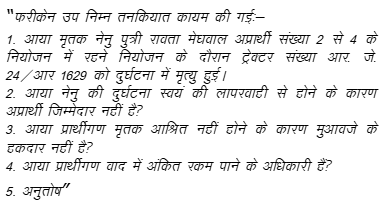
1. The present appeal under Section 30 of the Workmen’s Compensation Act, 1923 (hereinafter to be referred as ‘the Act of 1923’) (as it then was) has been filed challenging the judgment and award dated 21.07.2006 passed by the learned Commissioner, Workmen Compensation Act, 1923, Sirohi in Claim No. W.C./F/11/99, vide which, the claim petition filed by the appellants, i.e., father and mother of the deceased Nanu, was dismissed mainly on the ground that the parents do not fall within the definition of dependents under Section 2(1)(d) of the Act of 1923.
Factual Matrix
2. Brief facts of the case are that a claim petition under Section 22 of the Act of 1923 was filed by the appellants initially against respondent Nos. 1 & 4; however, subsequently respondent Nos. 5 & 6 were impleaded on an application under Order 1 Rule 10 of the C.P.C. By way of the claim petition, it was stated that deceased Nanu, i.e., the daughter of the appellants, was working as a labourer under the employment of respondent Nos. 2 to 4 and was at the relevant time undertaking the work of transferring the concrete and respondent No. 1 was driving the tractor in which she was engaged for the purpose of undertaking her employment. The respondent No. 1 drove the tractor rashly and negligently, causing her to fall down, and the tractor ran over her, resulting in her immediate death. It was stated that for the incident in question, an FIR was lodged for the offences punishable under Sections 279 & 304-A IPC. The claimants further stated that the deceased was 17 years of age and was earning Rs. 1,800/- per month. The claimants further stated that they were dependent upon the deceased and, therefore, by way of filing claim petition, an amount of Rs.2,50,000/- as compensation with 18% interest and 50% penalty was claimed.
3. Post impleadment of the respondent Nos.5 & 6, the amended claim was filed while asserting that the respondent Nos. 2 to 4 were undertaking the work for the principal employer i.e. respondent Nos.5 & 6, for the construction of the road from Fugni to Tawri. It was asserted that the contract for construction was given by the respondent No.5 i.e. PWD Department to the respondent No.6 i.e. Natwar Lal, the Contractor, who had further given the sub-contract to respondent Nos.2 to 4.
4. The respondents filed their replies. As far as respondent Nos. 2 to 4 are concerned, they filed the reply while denying the deceased being in their employment, however, they admitted the fact that the death of the deceased was caused during the work being undertaken, but was due to the negligence and fault of the deceased herself. It was, however, asserted that the deceased was married and the appellants were not dependent upon the deceased. It was further asserted that Gena Ram i.e. husband of the deceased had entered into a settlement with the respondents and, therefore, the claim petition was not maintainable. The respondent No.5 filed a separate reply while asserting that the deceased was not under the employment of the respondent-PWD Department, but was under the employment of respondent Nos.2 to 4 only. It was further asserted that in the month of June 1999, under the Famine Relief Project, the road was being constructed from Fugni till Hanumanji Ka Marg, for which, the contract was given to respondent No.6 i.e. Natwar Lal, who was responsible for bringing the labourers and the workers and the department had got no role to play. It was thus asserted that there was no proximity of the deceased with the department and no employer-employee relationship existed.
5. After filing of the reply, the learned Commissi