
 Back
Back





HIGH COURT OF JUDICATURE FOR RAJASTHAN, BENCH AT JAIPUR
SHUBHA MEHTA, J.
Trilok Mittal, S/o. Shri Bhanwar Lal – Appellant
Versus
Balbir Kumar Chaurdiya, (Adopted), S/o. Birdichand Chaurdiya – Respondent
S.B. Civil Second Appeal No. 377 of 2025
Decided On : 03-12-2025
Order :
SHUBHA MEHTA, J.
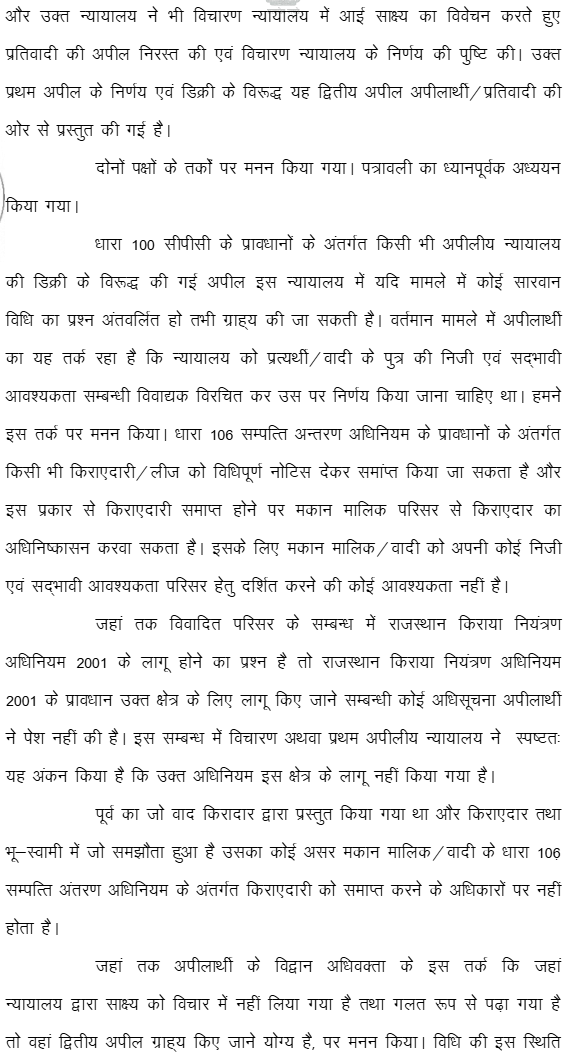
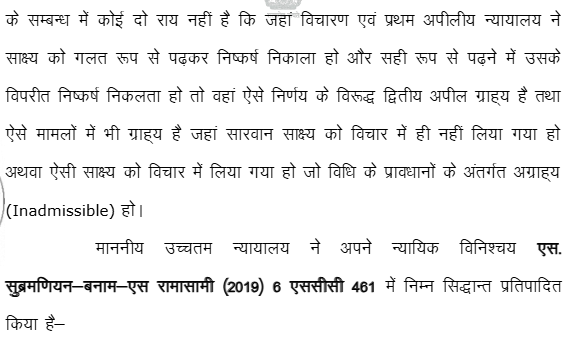
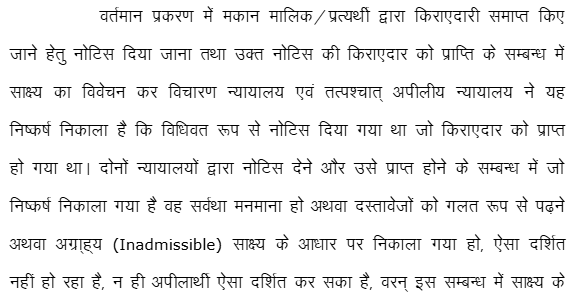
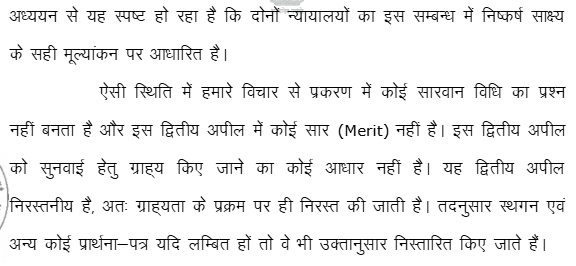
Even otherwise, it is required to be noted that as per catena of decisions of this Court and even as provided under Section 100 of the CPC, the Second Appeal would be maintainable only on substantial question of law. The Second Appeal does not lie on question of facts or of law. The existence of ‘a substantial question of law’ is a sine qua non for the exercise of the jurisdiction under Section 100 of the CPC. As observed and held by this Court in the case of Kondiba Dagadu Kadam (Supra), in a second appeal under Section 100 of the CPC, the High Court cannot substitute its own opinion for that of the First Appellate Court, unless it finds that the conclusions drawn by the lower Court were erroneous being: (i) Contrary to the mandatory provisions of the applicable law; OR
(ii) Contrary to the law as pronounced by the Apex Court; OR (iii) Based on inadmissible evidence or no evidence. It is further observed by this Court in the aforesaid decision that if the First Appellate Court has exercised its discretion in a judicial manner, its decision cannot be recorded as suffering from an error either of law or of procedure requiring interference in Second Appeal. It is further observed that the Trial Court could have decided differently is not a question of law justifying interference in Second Appeal.
8.3 When a substantial question of law can be said to have arisen, has been dealt with and considered by this Court in the case of Ishwar Dass Jain (Supra). In the aforesaid decision, this Court has specifically observed and held :
“Under Section 100 CPC, after the 1976 amendment, it is essential for the High Court to formulate a substantial question of law and it is not permissible to reverse the judgment of the first appellate court without doing so. There are two situations in which interference with findings of fact is permissible. The first one is when material or relevant evidence is not considered which, if considered, would have led to an opposite conclusion. The second situation in which interference with findings of fact is permissible is where a finding has been arrived at by the appellate court by placing reliance on inadmissible evidence which if it was omitted, an opposite conclusion was possible. In either of the above situations, a substantial question of law can arise.”
8.4 Applying the law laid down by this Court in the aforesaid decisions and the substantial questions of law formulated/framed and answered by the High Court, reproduced hereinabove, it cannot be said that the said questions of law can be said to be substantial questions of law. All can be said to be questions of law or questions of fact and cannot be said to be Substantial Questions of law.
AI
A second appeal under Section 100 CPC requires substantial questions of law; mere questions of fact or law do not justify interference by the High Court.

The court emphasized that in second appeals, it must identify and frame substantial questions of law, confining its jurisdiction to these formalized issues. Substantial questions must bear real signi....

Second appeals must address substantial questions of law; failure to demonstrate such questions results in dismissal. The need for procedural compliance in appellate procedures is essential for valid....

If question is settled by highest Court or the general principles to be applied in determining question are well settled and there is a mere question of applying those principles or that the plea rai....

Existence of substantial question of law is sine qua non for the exercise of jurisdiction under the provisions of section 100 of the Code of Civil Procedure, 1908 (CPC) Pleadings.

Second appeal – Section 100 of CPC grants power to High Court to consider a regular Second Appeal only on a substantial question of law.

Order XLII Rule 2 provides power of Court to direct that appeal be heard on question formulated by it.

A second appeal under Section 100 of the CPC cannot be heard without the formulation of substantial questions of law at the time of admission, as this is a prerequisite for legal proceedings.
Formulation of a substantial question of law is sine-qua non for invoking jurisdiction under Section 100 CPC by High Court.

The judgment emphasizes the importance of substantial questions of law under Section 100 of CPC and the impact of such questions on the final decision between the parties.



An indispensable Tool for Legal Professionals, Endorsed by Various High Court and Judicial Officers
Please visit our Training & Support
Center or Contact Us for assistance

Scan Me!
India’s Legal research and Law Firm App, Download now!


For Daily Legal Updates, Join us on :



 Back to top


