
 Back
Back





HIGH COURT OF JUDICATURE FOR RAJASTHAN BENCH AT JAIPUR
MAHENDAR KUMAR GOYAL, BHUWAN GOYAL, JJ.
Sunil Kumar Son of Shri Kailash Chand - Appellant
Versus
State of Rajasthan Through Public Prosecutor - Respondent
D.B. Criminal Appeal No. 421 of 2025
Decided On : 28-04-2026
JUDGMENT :
BHUWAN GOYAL, J.
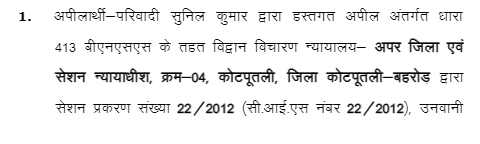
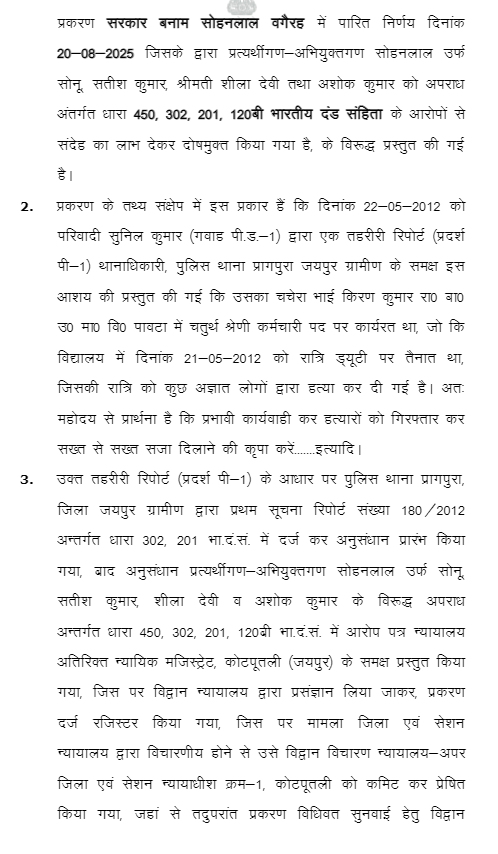
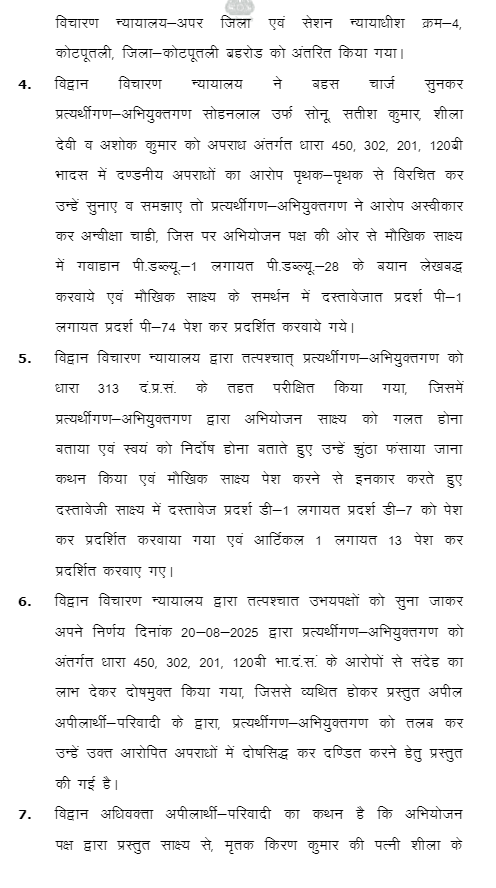
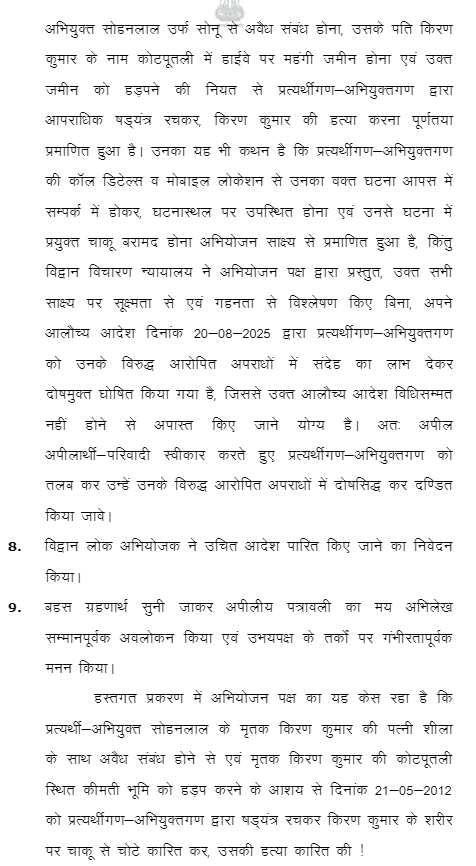
“38. Further, in H.D. Sundara v. State of Karnataka, (2023) 9 SCC 581 this Court summarised the principles governing the exercise of appellate jurisdiction while dealing with an appeal against acquittal under Section 378 Cr.PC as follows:
“8. xxx xxx xxx
8.1. The acquittal of the accused further strengthens the presumption of innocence;
8.2. The appellate court, while hearing an appeal against acquittal, is entitled to reappreciate the oral and documentary evidence;
8.3. The appellate court, while deciding an appeal against acquittal, after re-appreciating the evidence, is required to consider whether the view taken by the trial court is a possible view which could have been taken on the basis of the evidence on record;
8.4. If the view taken is a possible view, the appellate court cannot overturn the order of acquittal on the ground that another view was also possible; and
8.5. The appellate court can interfere with the order of acquittal only if it comes to a finding that the only conclusion which can be recorded on the basis of the evidence on record was that the guilt of the accused was proved beyond a reasonable doubt and no other conclusion was possible.”
39. Thus, it is beyond the pale of doubt that the scope of interference by an appellate court for reversing the judgment of acquittal recorded by the trial court in favour of the accused has to be exercised within the four corners of the following principles:
(a) That the judgment of acquittal suffers from patent perversity;
(b) That the same is based on a misreading/omission to consider material evidence on record; and
(c) That no two reasonable views are possible and only the view consistent with the guilt of the accused is possible from the evidence available on record.”
An appellate court can only overturn an acquittal if it finds that the guilt of the accused is the only reasonable conclusion based on the evidence, reaffirming the presumption of innocence.
An appellate court cannot overturn an acquittal unless it finds pervasive errors indicating that guilt is the only reasonable conclusion possible from the evidence.

An appellate court has extensive power to review acquittals; however, it should respect trial court's findings unless they are manifestly perverse or contrary to established law.

The presumption of innocence in favor of the accused is reinforced by the trial court's acquittal, and appellate courts should only interfere with an order of acquittal in exceptional cases with comp....

The appellate court should not disturb the finding of acquittal unless the lower court's approach is vitiated by manifest illegality and the decision is characterized as perverse. The judgment and or....

An appellate court should refrain from disturbing an acquittal unless sufficiently compelling reasons justify it, emphasizing the presumption of innocence and proper evaluation of trial court decisio....



An indispensable Tool for Legal Professionals, Endorsed by Various High Court and Judicial Officers
Please visit our Training & Support
Center or Contact Us for assistance

Scan Me!
India’s Legal research and Law Firm App, Download now!


For Daily Legal Updates, Join us on :



 Back to top


