1. Challenge to provisional select list and appointment orders for Class-IV Employees — denial of bonus marks for experience. (Para 2 , 3 , 4 , 5 , 17 , 18 )
 Back
Next 





2026 Supreme(Raj) 568
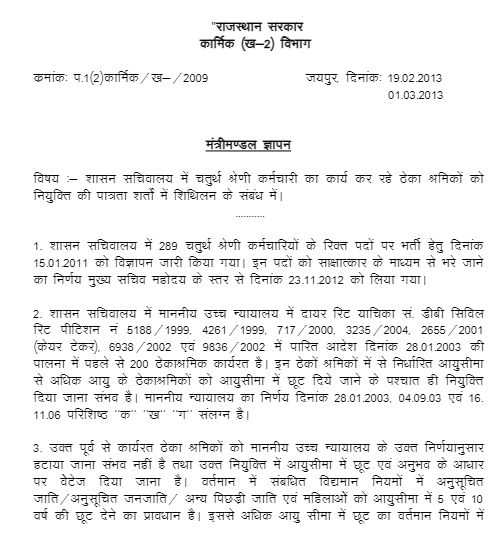
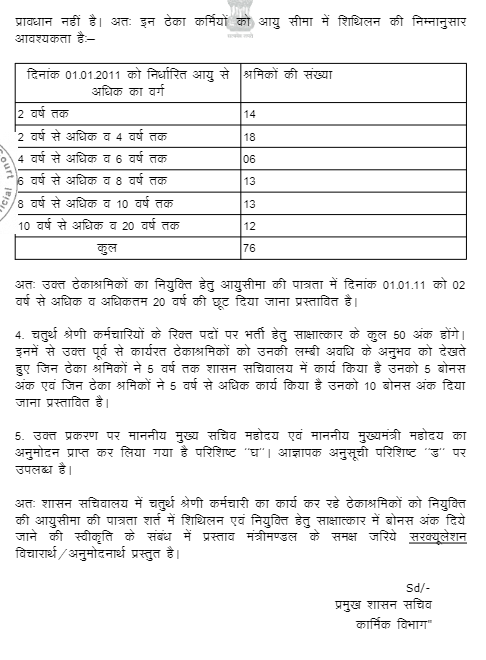
HIGH COURT OF JUDICATURE FOR RAJASTHAN BENCH AT JAIPUR
ANAND SHARMA, J.
Rakesh Saini S/o Sh. Jagdish Prasad Saini – Petitioner
Versus
The State Of Rajasthan, Through Principal Secretary, Department Of Personnel – Respondent
S. B. Civil Writ Petition No. 15084 of 2016, S. B. Civil Writ Petition No. 3815 of 2011, S.B. Civil Writ Petition No. 12905 of 2013, S.B. Civil Writ Petition No. 14822 of 2013, S. B. Civil Writ Petition No. 15633 of 2013, S. B. Civil Writ Petition No. 20060 of 2013, S. B. Civil Writ Petition No. 14884 of 2016, S. B. Civil Writ Petition No. 16420 of 2016, S. B. Civil Writ Petition No. 3456 of 2018
Decided On : 16-03-2026
Important Points
A settlement between the state and specific employees is *inter partes* and does not grant parity to others. However, long-term contractual employees performing perennial duties under the state's control are entitled to consideration for regularization to prevent exploitation and perpetual ad-hocism.
Subject
Service Law - Recruitment and Regularization
Act Referred
Headnote
(A) Constitution of India - Articles 14, 16, and 226 - Recruitment and regularization of Class-IV employees - Denial of bonus marks for work experience - Parity with candidates who were parties to a prior settlement - A settlement arrived at between the State Government and a specific union or individuals is *inter partes* and not a judgment *in rem* - Persons not privy to such settlement cannot claim parity or similar benefits as they do not fall in the same class as those who were parties to the settlement (Para 17) - Courts are generally slow to interfere with completed selection processes, especially when candidates are not guilty of fraud or illegality, as doing so would disrupt administrative stability (Para 18) - Doctrine of acquiescence and estoppel applies to candidates who participate in a selection process without protest and challenge the criteria only after being unsuccessful (Para 19).
(B) Service Law - Regularization of contractual employees - Prolonged ad-hocism for perennial and essential duties is violative of Articles 14, 16, and 21 - State as a model employer cannot extract regular work from daily-wage employees without sanctioning posts or initiating regular recruitment (Paras 22, 35) - Mere nomenclature of “temporary” or “contractual” cannot defeat substantive rights where the employee performs essential duties under the direct control of the employer (Para 34) - While illegal appointments cannot be regularized, one-time regularization of employees with long continuous service against sanctioned posts is permissible if the appointment was irregular rather than illegal (Para 31).
(C) Administrative Law - Selection Process - The discretion of the Interview Committee in determining the duration and nature of interviews for lowest-grade posts is subject to limited judicial review, and standard formulas for such interviews cannot be rigidly applied (Para 34).
(D) Reservation Policy - If a reserved category is sufficiently represented in the total cadre strength, the absence of reserved vacancies in a specific recruitment advertisement does not constitute a violation of the reservation policy (Paras 26-28).
Facts of the case:
Multiple writ petitions were filed challenging the recruitment process for Class-IV employees. Some petitioners sought bonus marks based on their contractual work experience, claiming parity with candidates who were granted such marks following a prior settlement and subsequent court orders. Other petitioners challenged the transparency of the interview process, the lack of advertised vacancies for the Scheduled Caste category, or the denial of an interview call. Additionally, some petitioners who had served as contractual employees for 15 to 20 years sought regularization of their services.
Findings of Court:
The court found that bonus marks granted pursuant to a settlement are limited to the parties of that settlement and cannot be extended to others. The court also declined to unsettle a completed selection process involving several years of service of the appointed candidates. However, the court recognized that petitioners who had rendered long, continuous, and essential service through contractors are entitled to have their cases considered for regularization to prevent exploitation.
Issues: Whether non-parties to a settlement can claim parity in bonus marks; whether a concluded selection process can be interfered with; whether long-serving contractual employees are entitled to regularization; and whether the absence of reserved vacancies in a specific recruitment advertisement violates reservation policy.
Ratio Decidendi: A settlement between the State and specific employees is *inter partes* and does not establish a general legal right for all similarly situated persons. However, the State must act as a model employer; the continuous performance of perennial duties for a prolonged period creates a constitutional obligation to rationalize or regularize engagement, provided the appointment is not illegal.
Result: Writ petition No. 15084/2016 partly allowed (denied bonus marks but directed the respondents to consider regularization/absorption in accordance with law); all other writ petitions dismissed.
Legal Category Hierarchy
- administrative law
- constitutional law
- practice and procedure
- service law
Advocates Appeared:
For the Petitioner:Mr. H.V. Nandwana Advocate with Mr. Y.V. Nandwana Advocate, Mr. Savyasachi Puri Advocate and Ms. Yashsvi Sharma Advocate. Mr. C.P. Sharma Advocate. Mr. Tanveer Ahamed Advocate with Mr. Iliyas Khan Advocate. Mr. Bharat Yadav Advocate with Mr. Akshay Yadav Advocate. Mr. K.N. Sharma Advocate with Mr. Vijay Choudhary Advocate. Mr. Pradeep Singh Advocate.
For the Respondent:Mr. Vigyan Shah Additional Advocate General with Mr. Sankalp Singh Advocate and Ms. Monisha Agarwal Advocate.
Table of Contents
2. Petitioners: arbitrary denial of bonus marks despite long service. Respondents: bonus marks limited to earlier-litigation parties with verifiable records. (Para 8 , 9 , 10 , 12 , 34 )
3. Petitioners were not parties to earlier settlement or litigation; prior judgments were in personam, not in rem, so no parity can be claimed. (Para 17 , 18 )
4. A settlement-based judgment in personam does not confer rights on non-parties; concluded selection processes should not be unsettled after long delay. (Para 17 , 18 , 19 )
5. Primary relief of quashing select list and appointment rejected; respondents directed to consider regularization of long-serving contractual employees. (Para 24 )
6. Can a court extend the benefit of a settlement-based judgment to persons who were not parties to the original litigation?
No, because the judgment was in personam, not in rem, and the rights were created by a settlement to which only the original parties were privy. (Para 17 )
7. Should a court interfere with a concluded selection process after a long lapse of time?
No, courts should be slow to interfere with completed selections, particularly when no fraud or illegality is shown and appointments have been made. (Para 18 )
8. Does the doctrine of acquiescence apply if a candidate participates in a selection process without protest and challenges it only after being unsuccessful?
Yes, such a candidate is estopped from challenging the process after participating without objection and is bound by the doctrine of acquiescence. (Para 19 )
9. Are long-serving daily-wage/contractual employees entitled to consideration for regularization despite their appointments being irregular?
Yes, prolonged continuous service of a perennial nature against sanctioned posts, combined with administrative inaction, creates an obligation to consider regularization. (Para 21 , 22 , 23 )
10. Can bonus marks be awarded to candidates for work experience without violating statutory recruitment rules?
Yes, bonus marks awarded pursuant to a court-recognized settlement and Cabinet decision are not illegal even if not prescribed in the statutory rules. (Para 34 )
JUDGMENT :
ANAND SHARMA, J.
1. This batch of writ petitions has been filed by the petitioners invoking the extraordinary jurisdiction of this Court under Article 226 of the Constitution of India, in the matters relating to recruitment on the post of Class-IV Employees initiated vide advertisement dated 31.12.2010. With the consent of parties, all the writ petitions were heard together and are being decided by this common judgment in following manner:
S. B. Civil Writ Petition N o. 15084/2016 :
2. In this writ petition, petitioners have laid a challenge to the provisional select list dated 14.10.2016 and the consequential appointment orders dated 27.01.2017 issued for recruitment to the posts of Class-IV Employees in the Government Secretariat, State of Rajasthan. The petitioners have also sought consequential directions for their appointment by grant of bonus marks and in the alternative, they have prayed for regularisation of their services and other ancillary reliefs.
3. The facts, in brief, are that the petitioners were engaged between the years 2003 to 2008 as Class-IV Employees/Safai Karmcharis in the Secretariat through contractors on daily wage basis. It is their case that they have continuously worked for long durations and have been discharging duties identical to those performed by regularly appointed Class-IV Employees. Experience certificates dated 18.04.2013 were issued to them by the competent authorities showing their period of engagement.
4. The State Government issued an advertisement dated 15.01.2011 (revised subsequently) for recruitment to Class-IV Employees posts. The petitioners, being eligible, applied and appeared in the interview process. It is the grievance of the petitioners that despite having more than five years of experience, they were not granted bonus marks as per the Cabinet decision dated 19.02.2013/01.03.2013 and the directions flowing from earlier litigation culminating in the judgment of the Hon’ble Supreme Court dated 03.08.2016. Consequently, their names did not find place in the provisional select list dated 14.10.2016.
5. It is further pleaded that similarly situated persons were granted bonus marks for having experience of the similar nature qua the petitioners and by virtue of getting bonus marks, they were appointed on the post of Class-IV Employees, whereas the petitioners were denied such benefit on the ground that they were not parties to earlier litigation or that their service record was not available, which according to them is arbitrary and discriminatory. The petitioners have also placed reliance on subsequent developments, including police investigation confirming the genuineness of their experience certificates and have asserted that they continue to work even as on date through contractors.
6. Replies to the writ petitions have been filing by the respondents to oppose the writ petitions, contending therein that the recruitment process was conducted strictly in accordance with the applicable rules and the directions of the Hon’ble Supreme Court on the basis of settlement between the employees union/ individuals and the respondent-Government. It is contended that bonus marks were awarded only to those candidates, who were parties to the earlier litigation and fulfilled the criteria laid down pursuant to the Cabinet decision, i.e., completion of requisite years of service as on the date of advertisement and availability of supporting official record.
7. It is further asserted in reply to the writ petition that the petitioners were not granted bonus marks as there was no verifiable official record available in the Secretariat regarding their continuous service and the experience certificates relied upon by them were not issued from official records. The respondents have denied any arbitrariness or discrimination and contended that the selection process has attained finality, appointments have already been made, therefore, no interference is warranted at this belated stage.
8. Mr. Hars