1. Suit for possession of land based on title — dispute over encroachment versus claim of ownership through oral gift and adverse possession. (Para 2 , 3 )
 Back
Next 





2026 Supreme(HP) 1051
IN THE HIGH COURT OF HIMACHAL PRADESH, SHIMLA
Rakesh Kainthla, J.
Lal Singh (Deceased) Through LRs And Ors. - Appellants
Versus
Mulakh Raj (Deceased) Through LRs And Ors. Respondents
RSA No. 132 of 2006
Decided On : 01-10-2026
Important Points
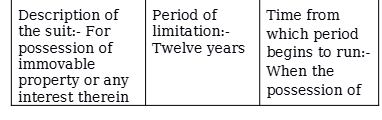
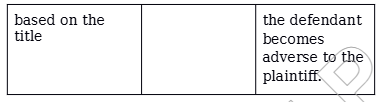
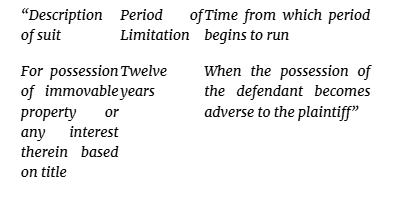
Adverse possession requires a hostile assertion in denial of the true owner's title, not mere long possession. A suit for possession based on title under Article 65 of the Limitation Act, 1963, is not barred by limitation unless the defendant proves adverse possession.
Subject
Civil Law - Property Law
Act Referred
LIMITATION ACT: Art.64, Art.65
Headnote
(A) Limitation Act, 1963 - Articles 64 and 65 - Adverse Possession - Distinction between long possession and adverse possession - Adverse possession means a hostile assertion, expressly or impliedly in denial of the title of the true owner (Paras 24, 25) - Mere possession, however long, does not necessarily mean it is adverse to the true owner; it must be peaceful, open, continuous, and accompanied by a conscious and hostile assertion of ownership (Paras 25, 27, 28) - A party claiming adverse possession must clearly plead and prove the specific date, month, and year when the adverse possession commenced and the nature of such possession (Paras 27, 28).
(B) Suit for possession based on title - Limitation - A suit for recovery of possession based on title under Article 65 of the Limitation Act, 1963, is not barred by limitation unless the defendant proves adverse possession for the prescriptive period (Paras 30, 31, 32) - Once the defendant fails to establish adverse possession, a suit based on title cannot be dismissed as time-barred on the ground that it was filed more than twelve years from the date of dispossession (Paras 30, 34).
Facts of the case:
Plaintiffs filed a suit for possession of land, alleging that the defendant encroached upon the property in 1985. The defendant contested the suit, claiming ownership through an oral gift received in 1949 and subsequently asserting title by way of adverse possession, citing the installation of an electricity meter in 1975 and payment of house tax since 1973-74. The Trial Court partly decreed the suit, granting possession of the vacant portion but not the constructed portion. The First Appellate Court reversed this, holding that the defendant had acquired ownership through adverse possession due to long and uninterrupted possession.
Findings of Court:
The court found that the defendant failed to provide evidence of a hostile assertion of title in denial of the real owner. The defendant did not specify the date when the possession became adverse, nor was there any evidence of an overt act to show hostile title. The First Appellate Court erred by conflating long possession with adverse possession.
Issues: The primary issues were whether the First Appellate Court erred in granting ownership via adverse possession based on long possession and whether the suit was barred by limitation.
Ratio Decidendi: Adverse possession requires an animus possidendi—a hostile intention to possess the land in denial of the true owner's title. Long possession alone does not ripen into ownership. Furthermore, in suits based on title under Article 65 of the Limitation Act, 1963, the burden lies on the defendant to prove adverse possession to bar the suit; otherwise, the suit is not barred by limitation simply because the period of twelve years from dispossession has passed.
Result: Appeal allowed; judgment and decree of the First Appellate Court set aside and those of the Trial Court restored.
Legal Category Hierarchy
Advocates Appeared:
For the Appellant :Ms Radhika Gautam, Advocate, Mr Jai Ram Sharma, Advocate, [In Person]
For the Respondent:Mr Mohinder Verma, Advocate.
Table of Contents
2. Plaintiffs contend adverse possession requirements were not met; defendant argues the suit is barred by limitation due to long-term possession. (Para 11 , 12 )
3. Long possession is not adverse possession; the defendant failed to prove hostile intent or specify the date when possession became adverse. (Para 14 , 15 , 16 , 17 , 18 , 19 , 20 , 21 , 22 , 23 , 24 , 25 , 26 , 27 , 28 , 29 )
4. Adverse possession requires hostile assertion in denial of the true owner's title, specifically pleaded and proved with a definite commencement date. (Para 24 , 25 , 26 , 27 , 28 )
5. Appeal allowed — judgment and decree of the First Appellate Court set aside and Trial Court's decree restored. (Para 38 )
6. What is the legal distinction between long possession and adverse possession?
Long possession does not automatically ripen into adverse possession. Adverse possession requires a hostile assertion, expressly or impliedly denying the true owner's title, and must be peaceful, open, and continuous. (Para 24 , 25 , 26 , 27 , 28 )
7. What are the essential pleading requirements for a party claiming title via adverse possession?
A party claiming adverse possession must clearly plead and prove the exact date, month, and year when the possession became adverse, the nature of the possession, and that the possession was open and undisturbed to the knowledge of the true owner. (Para 26 , 27 , 28 )
8. Is a suit for possession based on title barred by limitation if the defendant fails to prove adverse possession?
No. A suit for possession based on title under Article 65 of the Limitation Act is not barred by limitation unless the defendant successfully proves adverse possession for the statutory period. (Para 30 , 31 , 32 , 34 )
JUDGMENT :
Rakesh Kainthla, J.
The present appeal is directed against the judgment and decree dated 15.12.2005, passed by learned Additional District Judge, Fast Track Court, Kangra at Dharamshala (learned First Appellate Court), vide which the judgment and decree dated 3.5.2001, passed by learned Sub-Judge-II, Nurpur, District Kangra (learned Trial Court), were set aside. (The parties shall hereinafter be referred to in the same manner as they were arrayed before the learned Trial Court for convenience).
2. Briefly stated, the facts giving rise to the present appeal are that the plaintiffs filed a civil suit before the learned Trial Court for seeking possession of the suit land mentioned in the head note and para-1 of the plaint. It was asserted that the suit land is owned and possessed by the plaintiffs and was entered in their ownership and possession before the settlement. The defendant encroached upon part of the suit land in the last week of July 1985 and constructed a structure/abadi on the suit land. The plaintiffs asked him to remove the encroachment. The defendant assured that he would vacate the suit land if any encroachment was detected during the settlement; however, he failed to adhere to his promise and got his name recorded in the revenue record as kabij. Hence, the suit was filed for seeking the relief mentioned above.
3. The suit was opposed by filing a written statement taking preliminary objections regarding lack of maintainability and cause of action, the plaintiffs being estopped by their act and conduct from filing the suit, the suit being bad for non-joinder of necessary parties, and the plaintiffs having acquiesced by their act and conduct to the acts of the defendant. The contents of the plaint were denied on merits. It was asserted that the defendant came to India after partition in 1947. He was poor and had no money to purchase the land. He resided with Sarnu for some time. Sarnu made an oral gift/donation of the suit land to the defendant somewhere in the year 1949. The defendant started cultivating the suit land and raised construction upon part of it. Rooms were added to the original construction from time to time. Purshotam and Kuldeep Chand, sons of the defendant, also raised construction on the suit land. The construction was also electrified. No protest was raised by any person. The defendant also raised an orchard of different fruit-bearing trees. The possession of the defendant is open, continuous, and peaceful, to the knowledge of the plaintiffs and their predecessors, and he has become the owner by way of adverse possession. The suit hasbeen filed without any basis; hence, it was prayed that the suit be dismissed.
4. No replication was filed.
5. The learned Trial Court framed the following issues on 22.12.1998: -
(1) Whether the plaintiffs are owners of the suit land? OPP.
(2) If Issue No.1 is proved, whether the plaintiffs are entitled for possession of the suit land? OPP.
(3) Whether the suit is not maintainable? OPD.
(4) Whether the plaintiffs are estopped by their act and conduct from filing the present suit? OPD.
(5) Whether the plaintiffs have no cause of action to file the present suit? OPD.
(6) Whether the suit is bad for non-joinder of necessary parties? OPD.
(7) Whether the plaintiffs have acquised on account of the defendant, as alleged? OPD.
(8) Whether the defendant has become owner of the suit land by way of adverse possession, as alleged? OPD.
(9) Relief.
6. The parties were called upon to produce their evidence. The plaintiffs examined plaintiff No. 1 Lal Singh (PW-1) and Jagdish Raj (PW-2). The defendant examined himself (DW- 1), Khazan Singh (DW-2), Prakash Chand (DW-3), Hukmi Ram (DW-4), and Raj Kumar (DW-5).
7. The learned Trial Court held that the defendant had installed an electricity meter in his residential house in the year 1975. The plaintiffs’ witness also admitted that he had seen the defendant in possession for more than 22 years. The house tax was being paid by the defendant