
 Back
Back





IN THE HIGH COURT OF JHARKHAND AT RANCHI
Sujit Narayan Prasad, A.C.J., Arun Kumar Rai, J.
Soma Bas Mahali @ Soma Bans Mahali Son of Shri Dago Bans Mahali and ors.- Appellants
Versus
The State of Bihar (Now Jharkhand) - Respondent
Cr. Appeal (DB) No.11 of 1997(R)
Decided On : 28-08-2024
JUDGMENT :
Sujit Narayan Prasad, A.C.J.
1. The instant appeal filed under Section 374 (2) of the Code of Criminal Procedure, is directed against the judgment of conviction and order of sentence dated 28.11.1996 passed by the learned 1st Additional Judicial Commissioner, Khunti in Sessions Trial No.645/1994, whereby and whereunder, the appellants have been convicted for the offence punishable under Sections 302 and 149 of the Indian Penal Code and Appellant namely, Marki Bas Mahali @ Marki Bans Mahali, further convicted under Section 323 of the Indian Penal Code and all the appellants have been sentenced to undergo R.I. for life for the offence punishable under Sections 302 /149 of the Indian Penal Code and appellant, namely Marki Bas Mahali @ Marki Bans Mahali, have further been sentenced to undergo R.I. for three months for the offence under Section 323 of the Indian Penal Code.
Prosecution case
2. This Court, before proceeding to examine the legality and propriety of the judgment of conviction and order of sentence, deems it fit and proper to refer the background of prosecution case, as per the fardbayan of Jeetan Kumari (informant and daughter of the deceased), which reads as under:
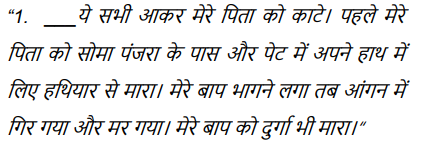
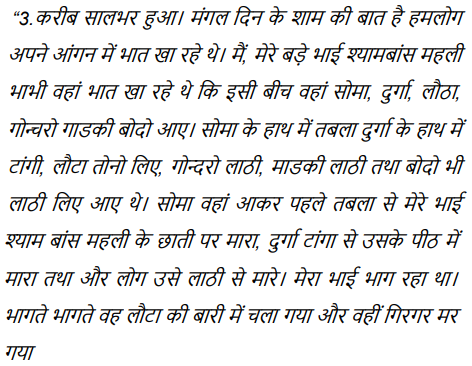
3. (i) The prosecution case as unfolded in the fardbayan of the Informant Jeetan Kumari (P.W.2), wherein, she has stated that about one month prior to the occurrence, accused Soma Bas Mahali had told against the informant’s character in the village and for that reason, quarrel had taken place in between accused Soma Bas Mahali and the deceased. Thereafter, Soma Bas Mahali had quarreled with the deceased on 17.05.1994 in the evening and at about 7:30 p.m., while the deceased was taking his meal outside his house, all the accused persons had arrived there, armed with farsa, tangi and lathi and started assaulting the deceased (informant’s father). The deceased had sustained injuries in his stomach, arm and other places of the body due to which he died on the spot.
(ii) It is further alleged that the other members of the family, namely, Pus Bas Mahali, Jagarnath Bas Mahali and wife of the deceased, namely, Sunia Devi had tried to save the deceased and in course thereof, they had also sustained injuries as the accused persons had assaulted them also.
(iii) It has also been mentioned in the FIR that the Gondro Bas Mahali was armed with Tangi (Axe), Guruwa Bas Mahali was armed with Lathi and other accused persons were armed with farsa .
(iv) It has been further alleged that the accused persons had killed the informant’s father and had injured the other family members of the informant.
4. On the basis of fardbeyan of the informant, Police registered Tamar P.S Case No. 43 of 1994 dated 18.05.1994 under Sections 302/149/323 of the I.P.C. During investigation, the Police got the post-mortem report of dead body of the deceased and got the report of injured persons who were examined by the doctor.
5. On conclusion of the investigation, Police submitted charge-sheet vide charge-sheet no.51 of 1994 dated 31.07.1994 against the accused persons.
6. Accordingly, learned A.C.J.M., Khunti took cognizance of the offence against the accused persons. The case was committed to the Court of Sessions for trial and disposal. After framing of charges the accused persons pleaded not guilty and claimed to be tried.
7. In order to prove its case, prosecution altogether examined altogether 9 witnesses, i.e., P.W.1-Sunia Bas Mahali (Widow of the deceased), P.W.2-Jeetan Kumari (daughter of the deceased and Informant), P.W.3-Dr. Sunil Oraon, P.W.4-Bal Ram Singh Munda, P.W.5-Dr. Tulsi Mahto, P.W.6-Tangru Bas Mahali, P.W.7-Maheshwar Jha (Investigating Officer), P.W.8-Narayan Bas Mahali (brother of the deceased) and P.W.9-Md. Sakil Azam.
8. The trial Court, after concluding the evidence of prosecution, recorded the statement of the accused persons under Section 313 of the Criminal Procedure Code, in which, accused persons had denied the prosecution evidence and claimed to be innocent.
9. The lear
AI
The prosecution must establish a common object for unlawful assembly under Section 149 IPC; absence of motive and specific allegations can lead to acquittal.

The court established that in cases of unlawful assembly, all members can be held vicariously liable for the actions taken in furtherance of a common object, and that the prosecution's failure to exp....

Point of Law : Unlawful assembly – Common object - No doubt section 149 IPC is wide in its sweep but in fixing the membership of the unlawful assembly and in inferring the common object various circu....

The court affirmed the conviction for murder based on the established common object of the unlawful assembly, supported by credible witness testimonies and medical evidence.

The prosecution must prove the formation of an unlawful assembly and the shared common object beyond reasonable doubt, and essential witnesses must be produced to unfold the narrative.

(1) Murder – Evidence of eye-witness should be of very sterling quality and calibre and it should not only instil confidence in court to accept the same but it should also be a version of such nature....


The court affirmed the conviction under Sections 302 and 307 IPC, emphasizing the credibility of eyewitnesses and the common object of the accused in a fatal assault.

Conviction for murder upheld based on unlawful assembly doctrine; presence in assembly sufficient for accountability under Section 149 IPC.



An indispensable Tool for Legal Professionals, Endorsed by Various High Court and Judicial Officers
Please visit our Training & Support
Center or Contact Us for assistance

Scan Me!
India’s Legal research and Law Firm App, Download now!


For Daily Legal Updates, Join us on :



 Back to top


