Back
Back





2025 Supreme(Jhk) 1429
IN THE HIGH COURT OF JHARKHAND AT RANCHI
SUJIT NARAYAN PRASAD, A.C.J., RAJESH KUMAR, J.
Ganesh Ram, son of late Sukhlal Ram and Anr. – Appellants
Versus
The State of Bihar (now Jharkhand) – Respondent
Cr. Appeal (D.B) No. 45 of 1998 (R) With Cr. Appeal (D.B) No. 24 of 1998 (R)
Decided On : 22-07-2025
For the Appellants :Mr. A.K. Kashyap, Sr. Advocate, Mrs. Supriya Dayal, Advocate
For the State : Mrs. Priya Shrestha, Spl.PP
In criminal law, the prosecution must prove guilt beyond reasonable doubt; inconsistencies and lack of direct evidence can lead to acquittal.
Headnote:(A) Criminal Procedure Code - Section 374(2) - Indian Penal Code - Sections 148, 302/149 - Appeals against conviction for murder - Court finds prosecution failed to prove charges beyond reasonable doubt. Essential discrepancies in witness testimonies noted. Previous enmity established. Appeals allowed, conviction quashed, appellants discharged from liabilities. (Paras 29, 74, 80, 82)
(B) Criminal Law - Legal burden of proof - The prosecution must establish guilt beyond a reasonable doubt. Conviction cannot be sustained if evidence does not exclude possibility of innocence. (Paras 38, 76)
Facts of the case:
The appellants were convicted in connection with the murder of the informant's father. The alleged incident took place on the night of 25 May 1996, during which multiple assailants reportedly abducted the victim, who was later found dead in a river. (Paras 2, 8)
Findings of Court:
The trial court's conviction based on inconsistent witness testimonies and circumstantial evidence. Significant contradictions emerged, casting doubt on the prosecution case. (Paras 61, 74)
Issues: Whether the prosecution proved the charges against the appellants beyond reasonable doubt? Whether circumstantial evidence sufficiently established guilt? (Paras 29, 30)
Ratio Decidendi: The court highlighted the necessity for a complete chain of evidence to establish guilt, emphasizing that the prosecution's evidence did not convincingly link the appellants to the crime. (Paras 38, 51, 76)
Result: Appeals allowed, judgments of conviction and sentences quashed. Appellants discharged from all criminal liabilities.
| Table of Content |
|---|
| 1. background of criminal appeal and convictions. (Para 1 , 2 , 3 , 4 , 5 , 6) |
| 2. arguments challenging the conviction based on reasonable doubt. (Para 7) |
| 3. prosecution defense and appeal rationale. (Para 9 , 10) |
| 4. court's analysis of witness testimonies. (Para 11 , 12 , 13 , 14) |
| 5. legal standards for proving circumstantial evidence. (Para 29 , 32 , 36) |
| 6. circumstantial evidence must meet rigorous criteria for conviction. (Para 30 , 31) |
| 7. requirement for proving guilt beyond reasonable doubt. (Para 74) |
| 8. conclusion quashing trial court's order and discharging appellants. (Para 80 , 81 , 82 , 83) |
JUDGMENT :
Sujit Narayan Prasad, A.C.J.
1. Since both these appeals are arising out of the same trial being Sessions Trial No.509 of 1996 and, as such, both are taken together.
2. These appeals under section 374(2) of the Code of Criminal Procedure are directed against the judgment of conviction dated 27.01.1998 and the order of sentence dated 28.01.1998 passed by the learned 2nd Addl. Sessions Judge, Palamu, Daltonganj in Sessions Trial No. 509 of 1996 whereby and whereunder the appellants, above-named, have been convicted under sections 148, 302/149 of the INDIAN PENAL CODE and sentenced to undergo RI for two years for the offence under section 148 of the INDIAN PENAL CODE and imprisonment for life under section 302/149 of the INDIAN PENAL CODE and all the sentences shall run concurrently.
3. At the outset, it needs to mention here that in Criminal Appeal No. 45 of 1998 (R) out of four, only two appellants, namely, Ganesh Ram and Bhola Ram are alive and the rest two appellants had died during pendency of the appeal. Vide orders dated 16.12.2024 and 04.04.2025 passed in the present proceeding, Criminal Appeal No. 45 of 1998 (R) qua the appellants, namely, Ram Sundar Ram and Gatauri Ram stands abated.
4. It also needs to mention here that in Criminal Appeal No. 24 of 1998 (R) out of four, one appellant, namely, Belas Ram had died during pendency of the appeal and vide order dated 16.12.2024 passed in the present proceeding, Criminal Appeal No. 24 of 1998 (R) qua the appellant, namely, Belas Ram stands abated.
5. The prosecution story in brief as per the allegation made in the FIR lodged on the basis of fardbayan of Sahbir Ram, the informant, reads as under:
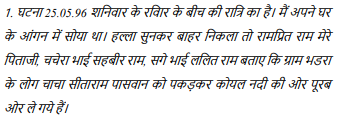
(i) It is stated in the FIR that in between the night of 25th and 26th May, 1996 at about 1 A.M., 8 to 10 persons came to the house of the informant. They awoke to hear the sound of their steps and saw that they were encircled by the miscreants. The informant along with his father, his uncle Ramprit Ram, cousin Lalit Ram were sleeping in front of their house after meal. The accused persons threatened them to do away with their life in case they alarmed and so they keep silence.
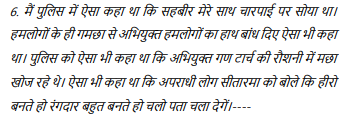
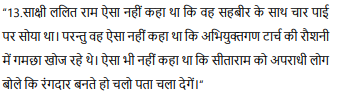
(ii) It is alleged that the accused persons tied the hands of his uncle and cousin from backside by means of gamchhi (towel). They were flashing torches in the light of which Ganesh Ram, Ramchandra Ram, Ram Sundar Ram, Gatauri Ram, Bhola Ram all armed with balua and Sunil Ram, Suneshwar Ram armed with pistol and Belas Ram, Arjun Ram and Sudeshwar Ram armed with lathi were identified. They had taken away his father after tying his hands from backside shouting as he was imposing him as Hero (cgqr ghjks curk gS) towards east in the night. They did not search his father at night due to threatening of the accused persons.
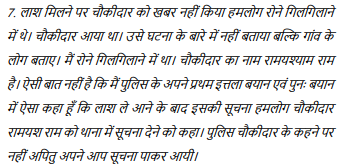
(iii) In the morning with the help of villagers, they started to search and ultimately at about 12 noon they could find the dead body of informant’s father in the bed of Koel river. Neck of the dead body was cut from front and backside. They brought the dead body to their house and asked Ramyas Ram-chaukidar to inform the matter to the police station. Lastly, it is claimed that all the above persons had taken his father towards Koel river and chopped him resulting into his death.
(iv) On the basis of the said fardbayan, Majhiaon PS Case No.26 of 1996 was registered under sections 147/14