
 Back
Back





IN THE HIGH COURT OF JHARKHAND AT RANCHI
Anubha Rawat Choudhary, J.
Bhola Mahto, Son of Late Kashi Mahto - Appellant
Versus
Chola Ram Mahto, Son of Late Kashi Mahto - Respondent
S.A. No. 187 of 2008
Decided On : 11-05-2026
| Table of Content |
|---|
| 1. procedural context and identification of substantial question of law regarding female inheritance prior to 1956. (Para 1 , 2 , 3 , 4) |
| 2. parties' contentions regarding the devolution of property of a hindu male dying intestate before 1956 upon his widow and daughters. (Para 5 , 6 , 7 , 8 , 9 , 10 , 11 , 12 , 13 , 14 , 15 , 16 , 17) |
| 3. summary of trial court findings, pleadings, and established genealogical facts. (Para 18 , 19 , 20 , 21 , 22 , 23 , 24) |
| 4. application of hindu law and the hindu widows remarriage act, 1856 to property devolution when a widow remarries. (Para 25 , 26 , 27 , 28 , 29 , 30 , 31 , 32 , 33 , 34 , 35 , 36 , 37 , 38 , 39) |
| 5. formal disposal of the appeal and directions regarding legal remuneration. (Para 40 , 41 , 42 , 43 , 44 , 45) |
JUDGMENT :
Anubha Rawat Choudhary, J.
1. This appeal has been filed by the plaintiffs against the judgment and decree dated 16.06.2008 (decree signed on 24.06.2008) passed by learned Additional District Judge Fast Track Court No.III, Hazaribag in Title Appeal No.11 of 2004 affirming the judgment dated 20.02.2004 (decree signed on 05.03.2004) in Title Suit No. 29 of 1994 passed by learned Sub-Judge-V, Hazaribag.
2. The suit was partly decreed. The partition was allowed with respect to schedule B property and so far as schedule A property is concerned, it was decreed to the extent of Khata No.15 and ½ of Khata No.56. The suit was not decreed with respect to Khata No. 57 and half of Khata No.56. The sale deed executed by Bauni Devi and Bilasho Devi dated 11.04.1970 was held to be valid. The prayer to set-aside the aforesaid sale deed was also held to be barred by limitation.
3. The learned 1st appellate court has affirmed the judgment passed by the learned trial court.
4. This appeal was admitted for final hearing vide order dated 19.02.2020 on the following substantial question of law:-
“Whether or not the appellate court, in view of admission of D.W. Chola Ram Mahto about the death of Radha Mahto in the year 1936 can dismiss the partition suit overlooking the well settled principle of law that before the year 1937 or before the year 1956, daughter and widow were not entitled to the properties of their father or husband.”
Arguments of the appellants:-
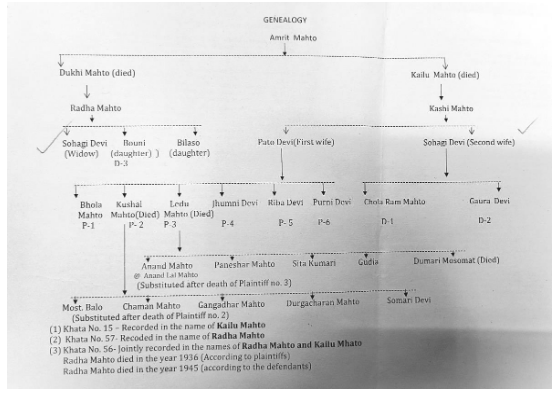
5. The learned counsel for the appellants while referring to the substantial question of law has submitted that admittedly Radha Mahto had expired prior to 1956 and Sohagi Devi [widow of Radha Mahto] had remarried her brother-in-law namely Kashi Mahto and it was the case of the plaintiffs that they came in possession of Khata No. 15, 57 and 56 Kashi Mahto paid rent till 1938 and after vesting, zamabandi was opened in his name and continued to pay rent.
6. The learned counsel for the appellants has further submitted that admittedly Chola Ram Mahto and Gaura Devi, defendant no. 1 and 2 respectively, were born from the 2nd wife of Kashi Mahto namely Sohagi Devi and Sohagi Devi died in the year 1950 and Kashi Mahto died in the year 1966. Further, on 11.04.1970 the daughters of Radha Mahto namely Bauni Devi and Bilasho Devi executed a sale deed in favour of Chola Ram Mahto (defendant no.1) with respect to the entire land of Khata No. 57, and the sale deed was under challenge in the suit. It was the case of the plaintiffs that Bouni and Bilasho had not inherited their father’s property as their father died prior to commencement of the Hindu Succession Act, 1956.
7. It is further not in dispute that Khata No.15 was recorded exclusively in the name of Kailu Mahto son of Amrit Mahto, Khata No. 57 was recorded exclusively in the name of Radha Mahto s/o Dukhi Mahto s/o Amrit Mahto and further Khata No.56 was jointly recorded in the name of Radha Mahto and Kailu Mahto.
8. At the time of death of Radha Mahto, his wife, Sohagi Devi was alive along with two daughters and subsequently, she married Kashi Mahto who was the son of Kailu Mahto and was the cousin brother of Radha Mahto.
9. Learned counsel for the appellants has submitted that since
AI



An indispensable Tool for Legal Professionals, Endorsed by Various High Court and Judicial Officers
Please visit our Training & Support
Center or Contact Us for assistance

Scan Me!
India’s Legal research and Law Firm App, Download now!


For Daily Legal Updates, Join us on :



 Back to top


