Back
Back





2024 Supreme(Mad) 838
IN THE HIGH COURT OF JUDICATURE AT MADRAS
THE HONOURABLE MR.JUSTICE RMT.TEEKAA RAMAN
Chinnusamy – Appellant
Versus
R.Poovaragavan K.Kuppusamy(Died) – Respondent
C.M.A.No.4295 of 2019 and CMP No.24281 of 2019
Decided on : 17-04-2024
Advocate Appeared:
For the Appellants : Mr.A.K.Kumarasamy Senior Counsel for Ms.J.Prithivi
For the Respondent: Mr.S.Rajendrakumar
IMPORTANT POINT
The propounder of a will bears the burden of proving its validity, particularly when suspicious circumstances exist, and failure to do so results in the dismissal of the probate application.
Headnote:
PROBATE - WILL VALIDITY - Indian Succession Act, 1925 - Sections 59, 63, 68; Limitation Act, 1963 - Article 137 - The court discussed the requirements for a valid will under the Indian Succession Act, emphasizing the need for the testator to have a sound disposing mind at the time of execution, the necessity of attestation by witnesses, and the burden of proof on the propounder to dispel any suspicions surrounding the will. The court highlighted that the absence of registration and the circumstances of execution raised significant doubts about the will's authenticity, ultimately influencing the decision to dismiss the probate application.
Fact of the Case:
The case involves a challenge to the probate of a will executed by Kandasamy Gounder, which was claimed to be forged by the appellants. The will, dated 13.08.2003, was executed shortly before the testator's death on 07.10.2003. The appellants contended that Kandasamy Gounder was bedridden and unable to execute a valid will, while the respondent claimed the will was valid and attested by witnesses.
Finding of the Court:
The court found that the respondent failed to prove the will's validity due to significant suspicious circumstances surrounding its execution, including the testator's mental and physical condition at the time, the lack of registration, and the credibility of the attesting witnesses. The court concluded that the burden of proof was not met, leading to the dismissal of the probate application.
Issues: 'Whether the probate petition is barred by limitation?', 'Whether the will is true and valid or forged?', 'Whether the petitioner proved the will in the manner known to law?'
Ratio Decidendi: The court reiterated that the propounder of a will must prove its validity by dispelling any suspicions surrounding its execution. The principles established in previous case law were applied, emphasizing the need for sound mind, proper attestation, and the burden of proof resting on the propounder, especially in the presence of suspicious circumstances.
Final Decision: The appeal was allowed, and the order granting probate was set aside, resulting in the dismissal of the probate application.
JUDGMENT :
THE HONOURABLE MR.JUSTICE RMT.TEEKAA RAMAN
Prayer in CMA No.4295 of 2019 : Civil Miscellaneous Appeal filed under Section 299 of Indian Succession Act, 1925 against the fair and final order in Probate O.P.No.63 of 2005 on the file of the Additional District (Fast Track Court), Mettur dated 26.07.2019.
For the sake of convenience, parties are referred to as per their ranking in the Probate OP.
2. Challenging the grant of probate to the alleged Will of Kandasamy Gounder S/o Chinnappa Gounder, the respondents 2 to 4 (Appellants herein) have preferred the present appeal.
3(a) The first respondent herein is the petitioner who filed Probate OP No.63 of 2005 before the Additional District Judge, (Fast Track Court), Mettur in connection with Will executed by Kandasamy Gounder S/o Chinnappa Gounder wherein the other respondents and appellants herein were made as parties.
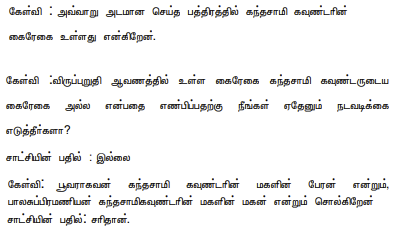
3(b) The first respondent/Poovaragavan filed the above OP for probate of the Will under Section 276 of the Indian Succession Act for grant of probate in favour of the first respondent, in respect of the Will dated 13.08.2003 said to have been executed by Kandasamy Gounder s/o Chinnappa Gounder.
4. The brief averments that are necessary for determination of the appeal are as under -
4(i)(a) As per the petition, the schedule of property absolutely belongs to one Kandasamy Gounder s/o Chinappa gounder who is the maternal grandfather of the first respondent and the said Kandasamy Gounder acquired the property by virtue of a Registered Partition Deed bearing No.5790 of 1973 that are described as 'A' schedule property in the said partition deed.
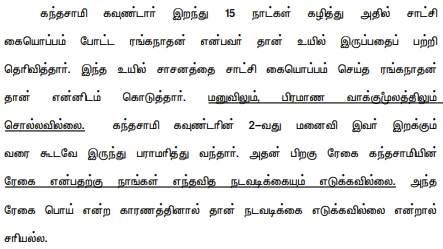
4(i)(b) It is alleged that on 13.08.2003, the said Kandasamy Gounder had executed a Will in favour of the first respondent in respect of the property which was attested by a notary public and executed in the presence of two witnesses namely Kandasamy and Ranganathan. Supporting affidavits were also filed. At the time of filing of the petition, the said Kandasamy Gounder died on 07.10.2003 at Karuppa Reddiyur Kattu Valavu and the death certificate was also filed.
4(i)(c) Pending Probate Proceedings, some of the respondents have also died and hence their legal heirs were brought on record and some of the persons who agitated in the property were also added as parties. The main contestants are the respondents 1 & 2 before the Trial Court.
4(ii)(a) It is the specific case of appellants/respondents that 'A' schedule property in the partition deed registered as Regn.No.5790 of 1973 and allotted to Kandasamy Gounder is admitted but it is denied that the Will was executed by Kandasamy Gounder in favour of the first respondent herein. Kandasamy Gounder is the father of the first respondent and grand father of the second respondent.
4(ii)(b) Kandasamy Gounder had four brothers namely Rathinam, Subramaniam, Kuppusamy, Rasapan and two daughters namely Periya Pappa and Chinna Papa. The first respondent's father divided his property into six equal shares and allotted four shares to his sons and retained one such share for himself and the remaining one share was allotted to his wife Periyammal. Kandasamy Gounder divided his share into four equal shares and allotted to his sons in the year 2002 itself and therefore, pursuant to the oral allotment, they are in possession and enjoyment of the property and hence the alleged Will is ranked forgery. Kandasamy Gounder died on 07.10.2003 is admitted.
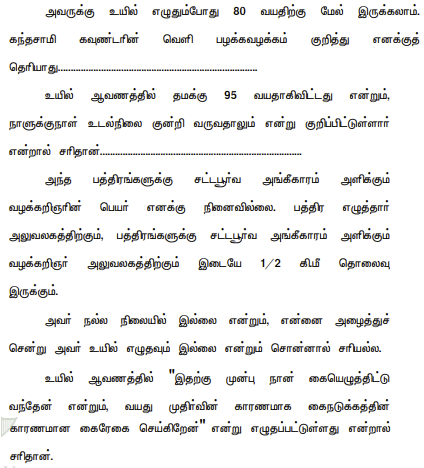
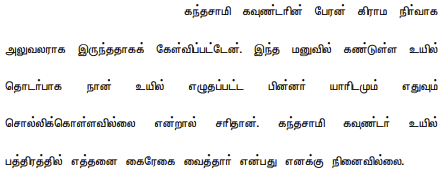
4(iii) Further, it is the specific case of the first respondent that Kandasamy Gounder was bedridden from 2002 to till his death. He was unable to move anywhere and he was unconscious till his death and hence the alleged Will is forged and fraudulent one. The father of the first respondent herein was a Village Administrative Officer (VAO). Hence, in connivance with some unscrupulous persons, he has created the Will. The alleged Will was executed in a suspicious circumstances and the same was not registered. It was created by the first respondent herein for getti