
 Back
Back





IN THE HIGH COURT OF JUDICATURE AT MADRAS
THE HONOURABLE MR. JUSTICE V. LAKSHMINARAYANAN, J.
C. Chinnappa - Appellant
Versus
Jayamma and Ors. - Respondents
S.A.No.1399 of 2013 and C.M.P.No.11947 of 2016
Decided On : 02-02-2024
PARTITION - CIVIL PROCEDURE CODE - Section 100, Order 9 Rule 13, Order XLI Rule 27, Section 52, Section 2(9) - The court addressed the maintainability of a second partition suit under the Civil Procedure Code, emphasizing that a second suit for partition is not maintainable if the property has already been partitioned and a decree has been finalized. The court interpreted the provisions of the Code, particularly regarding the requirements for a valid judgment and the rights of a lis pendens purchaser, ultimately concluding that the previous decree was binding and the second suit was improperly filed.
Fact of the Case:
The case involves a dispute over property ownership following a partition suit filed by Mallamma in 1974, which was decreed in her favor. After her death, her legal heirs filed a second partition suit in 2005, which was decreed ex parte. The appellant, who purchased the property from Mallamma's heirs, contested the second suit's validity.
Finding of the Court:
The court found that the second suit for partition was not maintainable as the property had already been partitioned and a decree had been finalized. The court also noted that the ex parte judgment in the second suit did not meet the requirements of a valid judgment under the Civil Procedure Code.
Issues: 1) Whether the lower Appellate Court erred in deciding that the plaintiffs were barred from filing the second suit under Section 11 of the Civil Procedure Code? 2) Whether the second suit for partition was maintainable given the previous decree? 3) Whether the trial Court's ex parte decree was valid?
Ratio Decidendi: The court held that a second suit for partition is not maintainable if the property has already been partitioned and a decree has been finalized. It emphasized that the judgment must meet the requirements of the Civil Procedure Code, and a lis pendens purchaser has the right to appeal against a decree affecting their vendor.
Final Decision: The appeal was allowed, the judgment and decree of the lower courts were set aside, and the second suit for partition was dismissed.
JUDGMENT :
(V. Lakshminarayanan, J.)
(Prayer : Second Appeal filed under Section 100 of the Code of Civil Procedure against the Judgment and decree dated 19.07.2013 made in A.S.No.30 of 2011 on the file of the Court of Principal Subordinate Judge, Hosur, confirming the judgment and decree dated 15-12-2005 made in O.S.No.128 of 2005 on the file of the Court of District Munsif cum Judicial Magistrate, Denkanikottai.)
This case has a checkered history. The suit schedule mentioned properties are items belonging to one Chinna Mallegoudu @ Mallaiah. Mallaiah and his wife Ammaiakka @ Puttamma had one son by name Puttiah and 5 daughters namely Mallamma (deceased), Jayamma, Devarajamma, Dhakshayini @ Sulochana and Nirmala. Mallamma seems to have passed away leaving behind her husband Mahadevan and three daughters namely Sailashri, Bhuvanashri, Sudhashri as her legal heirs.
2. Tmt.Mallamma filed a suit for partition and separate possession in O.S.No.105 of 1974 on the file of the District Munsif Court at Hosur. She sought for the relief of partition by metes and bounds and separate possession of her 1/7th share. The present suit schedule mentioned property namely S.No.225 of Arulam village in Denkonikottai taluk, Dharmapuri District (presently Krishnagiri District) is shown as item 1 of the suit schedule mentioned property in O.S.No.105 of 1974. Summons were issued in the said suit and the defendants entered appearance before the Court on 28.06.1974. The suit was decreed as prayed for, with costs.
3. To put the preliminary decree so obtained into operation, an application was taken out for passing of final decree in I.A.No.1144 of 1975. The said final decree application was allowed on 26.04.1975. At the time of final decree, it was noticed that there were practical difficulties in dividing the house and house sites and therefore, the plaintiff therein, Mallamma, gave up her right with respect to house and house sites and in lieu of this giving up of her share, she was alloted additional extent of 1.40 cents to her share in Survey No.225 of the aforesaid Village.
4. Mallamma initiated execution proceedings to take possession of the properties situated in S.No.225. The Execution petition was numbered as R.E.P.No.2 of 1976. The learned District Munsif at Hosur ordered delivery of possession of the property on 29.01.1976 and the delivery was taken on 01.02.1976 and execution petition was terminated on 19.02.1976. By virtue of the aforesaid proceedings, Mallamma became the absolute owner of the suit schedule mentioned property.
5. All things were quiet for a period of nearly 40 years. The defendants 2, 4, 5 & 6 in O.S.No.105 of 1974 presented a fresh suit for partition in O.S.No.128 of 2005. In the meantime, as Mallamma had passed away her legal heirs Mahadevan, Sailashri, Bhuvanashri and Sudhashri were impleaded as defendants 2 to 5. They were served with summons and it seems they had also filed written statement giving forth the details of the previous suits. After having filed the statement they remained exparte. Consequently, the trial Court passed the judgment in the following terms:
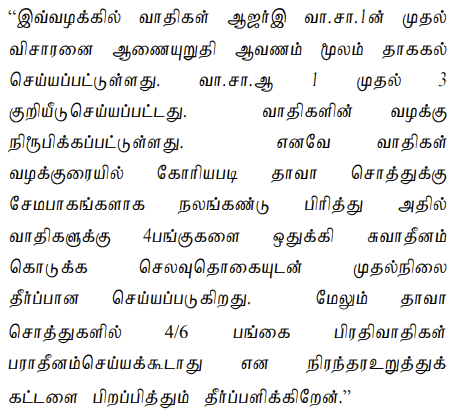
6. This exparte decree was passed on 15.12.2005. In order to set aside the exparte judgment and decree, an application was taken for condonation of delay of 40 days in filing the petition under Order 9 Rule 13 CPC. This application was numbered as I.A.No.99 of 2007. It was application was allowed on the condition of payment of cost of Rs.500/- on or before 21.04.2008. Since the cost was not paid, the application stood dismissed on 25.04.2008. As the preliminary decree had already been passed in the proceedings, an application was taken out for passing of final decree in I.A.No.489 of 2008. This application was allowed by an order of the Court, on 05.09.2011.
7. While these are the Court proceedings, the defendants in O.S.No.128 of 2005, namely legal heirs of M
AI
A second suit for partition is not maintainable if the property has already been partitioned and a decree has been finalized; a lis pendens purchaser has the right to appeal against a decree affectin....

The court ruled that a second suit for partition is not maintainable if a previous decree regarding the same property exists, emphasizing the rights of a lis pendens purchaser to appeal.

A second suit for partition is not maintainable concerning property previously partitioned; purchasers under lis pendens retain the right to appeal against decrees affecting their interests.

The court reaffirms that a sale pending litigation is not void but does not bind the party in the pending suit, allowing partial claims based on property allocation.


(1) Lis Pendens – Section 52 of T.P. Act has no application where transfer in favour of subsequent purchaser is not after filing of suit but before filing of suit for specific performance.(2) Resista....

Subsequent purchasers of property cannot independently challenge a partition decree that has attained finality; their rights are limited to those of the transferor.
The doctrine of lis pendens under Section 52 of the Transfer of Property Act binds purchasers to the outcomes of ongoing litigation concerning the property, negating claims of bona fide purchase with....

The court affirmed that a decree binds successors-in-interest unless declared void, and collusion in prior judgments affects the applicability of the doctrine of lis pendens.
Purchasers of undivided shares in a partition suit, who bought the property prior to the suit, are necessary parties in the final decree proceedings and are entitled to work out their remedy.



An indispensable Tool for Legal Professionals, Endorsed by Various High Court and Judicial Officers
Please visit our Training & Support
Center or Contact Us for assistance

Scan Me!
India’s Legal research and Law Firm App, Download now!


For Daily Legal Updates, Join us on :



 Back to top


