
 Back
Back





IN THE HIGH COURT OF JUDICATURE AT MADRAS
N.Senthilkumar, J.
Casa Grande Civil Engineering Pvt. Ltd. Rep. By its Managing Director - Petitioner
Vs.
Moorthy - Respondent
W.P. No. 34756 of 2024 and W.M.P. Nos.34727 of 2023, 12002 & 12004 of 2024
Decided On : 30-08-2024
Industrial Disputes - Workman - Section 2(s) - The court interpreted Section 2(s) of the Industrial Disputes Act, 1947, emphasizing that the respondent, as an Assistant Manager drawing a salary above the threshold, did not qualify as a 'workman', influencing the decision to quash the Labour Court's award.
Fact of the Case:
The petitioner challenged the Labour Court's award directing reinstatement of the respondent, who claimed to be a workman despite being an Assistant Manager with a salary exceeding the threshold defined in the Industrial Disputes Act.
Finding of the Court:
The court found that the respondent did not qualify as a workman under Section 2(s) of the Industrial Disputes Act due to his managerial position and salary, leading to the conclusion that the Labour Court's award was not maintainable.
Issues: Whether the respondent qualifies as a 'workman' under Section 2(s) of the Industrial Disputes Act, 1947, and if the Labour Court's award for reinstatement was justified.
Ratio Decidendi: The court held that the respondent, being an Assistant Manager with a salary above the stipulated limit, did not fall under the definition of 'workman' as per Section 2(s) of the Act, thus invalidating the Labour Court's award.
Result: The order of the Labour Court is set aside and the writ petition is allowed.
ORDER :
PRAYER: Writ Petition filed under Article 226 of the Constitution of India praying to issue a Writ of Certiorari calling for the records pertaining to the impugned award dated 27.02.2023 passed by the I Additional Labour Court, Chennai in O.P.No.4 of 2022 and quash the same.
The Writ Petition is filed challenging the order passed by the I Additional Labour Court, Chennai in O.P.No.4 of 2022 dated 27.02.2023.
2. The case of the petitioner is that the respondent joined the services of the petitioner company as an Office Assistant on 01.04.2011 and he was working as an Assistant Manager (Safety) when he decided to quit work from 03.04.2019 and thereafter, he did not report to the office of the petitioner. A letter was sent by the petitioner on 06.04.2019, 10. 04.2019 and 15.04.2019. The respondent though did not give any reply to the letters sent by the petitioner, raised an Industrial Dispute before the Assistant Commissioner of Labour-III, (Conciliation), Kuralagam, Chennai-108, alleging that he was orally denied employment from 13.02.2019. The further case of the petitioner is that during the conciliation proceedings, the respondent was directed to report to duty. The respondent did not make any attempt to resume to his work. Per contra, he insisted for settlement of his dues with the petitioner. The petitioner management had made an attempt to settle the dues of the respondent for which the respondent was initially agreeing, but thereafter he denied accepting the settlement offer made by the petitioner. The conciliation proceedings initiated by the Assistant Commissioner of Labour ended in failure and the failure report was submitted to the Government of Tamil Nadu on 24.06.2019.
3. The further case of the petitioner is that the respondent filed a Claim Petition after a period of 2 years and 10 months from his alleged oral termination. The Additional Labour Court has passed an award in O.P.No.4 of 2022 giving a direction to the petitioner management to reinstate the respondent with all other benefits. The main contention raised by the writ petitioner is that the respondent will not fall under the category of Section 2(s) of the Industrial Disputes Act, 1947 (hereinafter referred to as, 'the Act' in short). For the sake of convenience, Section 2(s) of the Act is extracted hereunder:-
“Section 2(s): “workman” means any person (including an apprentice) employed in any industry to do any manual, unskilled, skilled, technical, operational, clerical or supervisory work for hire or reward, whether the terms of employment be express or implied, and for the purposes of any proceeding under this Act in relation to an industrial dispute, includes any such person who has been dismissed, discharged or retrenched in connection with, or as a consequence of, that dispute, or whose dismissal, discharge or retrenchment has led to that dispute, but does not include any such person -
(i) who is subject to the Air Force Act, 1950, or the Army Act, 1950, or the Navy Act, 1957 or
(ii) who is employed in the police service or as an officer or other employee of a prison, or
(iii) who is employed mainly in a managerial or administrative capacity or
(iv) who, being employed in a supervisory capacity, draws wages exceeding (ten thousand rupees) per mensem or exercises, either by the nature of the duties attached to the office or by reason of the powers vested in him, functions mainly of a managerial nature.”
4. The next contention raised by the writ petitioner is that the respondent did not report for duty on the basis of the advise given by his Advocate. The other contention of the writ petitioner is that the respondent neither pleaded nor argued that he falls under the category of Section 2(s) of the Act, which establishes that he was not a 'workman'. The respondent did not plead and prove that he was discharging his duties as a workman as contemplated under Section 2(s) of the Act.
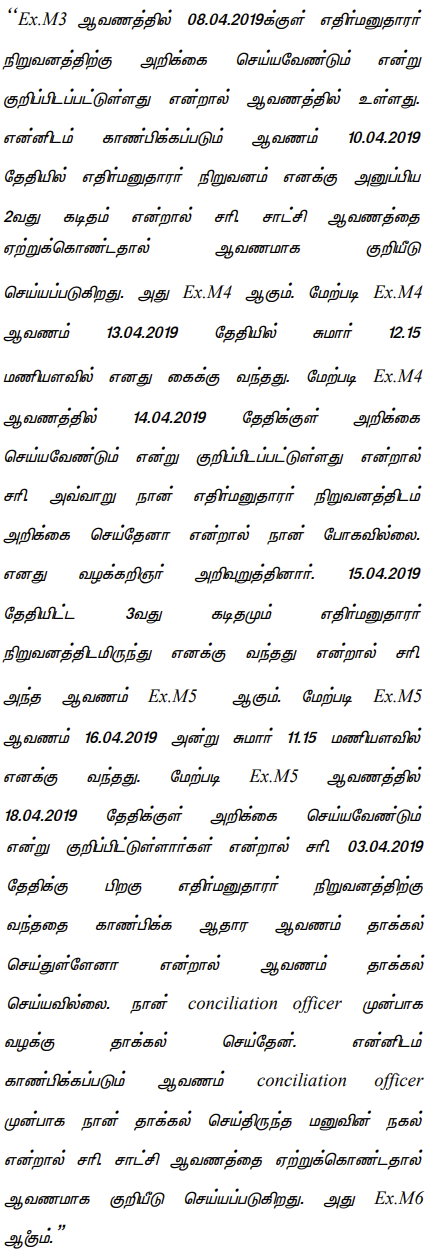
5. The next contention of the writ petitioner is that the respondent hi
AI

The burden of proof regarding the status of an employee as a 'workman' lies with the employee, not the employer, as per the Industrial Disputes Act.

The unlawful termination of service without complying with statutory procedures mandates reinstatement and full back wages for the workman under the Industrial Disputes Act.

Government reference of an industrial dispute is not subject to individual limitations under the Act, affirming workman's status despite apprenticeship.


The main legal point established in the judgment is the requirement for compliance with the provisions of the Industrial Disputes Act, 1947, particularly in cases of termination and retrenchment, and....

The court ruled that employees in managerial roles and earning above Rs.10,000 do not qualify as 'workmen' under Section 2(s) of the Industrial Disputes Act, reversing the Labour Court's decision.

The main legal point established in the judgment is the interpretation of Section 2(s)(iv) of the Industrial Disputes Act, 1947, regarding the definition of a 'workman' and the requirement for follow....

The court emphasized that an employee must establish their status as a 'workman' under the Industrial Disputes Act, and failure to provide cogent evidence can justify dismissal without a departmental....

The main legal point established is that the voluntary resignation of the workman led to the denial of relief under the Industrial Disputes Act.

Section 10 reads as reference of disputes to Boards, Courts or Tribunals.



An indispensable Tool for Legal Professionals, Endorsed by Various High Court and Judicial Officers
Please visit our Training & Support
Center or Contact Us for assistance

Scan Me!
India’s Legal research and Law Firm App, Download now!


For Daily Legal Updates, Join us on :



 Back to top


