
 Back
Back





IN THE HIGH COURT OF JUDICATURE AT MADRAS
R. SAKTHIVEL, J.
Renganathan – Appellant
Versus
K.G. Kaliyaperumal Chettiyar (Died) – Respondent
S.A. No. 1064 of 2005, C.M.P. No. 14582 of 2005
Decided On : 19-06-2024
Property - Ownership - Civil Procedure Code Section 100, Limitation Act Article 113 - The court interpreted the provisions regarding ownership and adverse possession, concluding that the plaintiff maintained rightful ownership and possession of the property, while the defendants failed to establish their claim of adverse possession.
Fact of the Case:
The plaintiff claimed ownership of a 6 Cents property, asserting it was inherited and possessed since 1962. The defendants contended they acquired the property through adverse possession and a disputed sale deed. The trial court dismissed the suit, but the appellate court ruled in favor of the plaintiff.
Finding of the Court:
The appellate court found that the plaintiff had established possession and ownership through revenue records, while the defendants failed to prove their claim of adverse possession or title over the property.
Issues: Whether the appellate court erred in granting possession and awarding mesne profits, particularly in light of the Limitation Act and the evidence presented.
Ratio Decidendi: The court held that the plaintiff's continuous possession and the lack of evidence for the defendants' adverse possession established the plaintiff's title, while the defendants' claims were insufficient to overcome the presumption of ownership.
Result: The Second Appeal is partly allowed, affirming the plaintiff's ownership and ordering the defendants to vacate the property.
JUDGMENT :
R. SAKTHIVEL, J.
Prayer: Second Appeal filed under Section 100 of Civil Procedure Code against the judgment and decree of the Additional Subordinate Judge's Court at Vridhachalam, dated October 5th, 2004 in A.S. No. 118 of 2003 reversing the judgment and decree of the District Munsif cum Judicial Magistrate at Neyveli, dated September 12th, 2003 in O.S. No. 1 of 1998.
1. This Second Appeal is directed against the judgment and decree dated October 5 , 2004 passed in A.S. No. 118 of 2003 by ‘the Additional Subordinate Court, Vridhachalam' [henceforth 'First Appellate Court'].
2. The appellants herein and the first respondent herein are the defendants 1 to 5 and the plaintiff respectively in O.S. No. 1 of 1998 on the file of 'District Munsif cum Judicial Magistrate Court, Neyveli' [henceforth 'Trial Court'].
3. Since the plaintiff/first respondent herein died on August 5, 2018, his legal heirs were brought on record as respondents 4 to 8 vide order of this Court dated April 22, 2021, in CMP No. 3341 of 2020 in S.A. No. 1064 of 2005.
4. For the sake of convenience, the parties will be referred to as per their array in the Suit i.e., the appellants 1 to 5 will be referred to as defendants 1 to 5; first respondent will be referred to as plaintiff; and respondents 2 and 3 will be referred to as defendants 6 and 7.
Case of the Plaintiff:
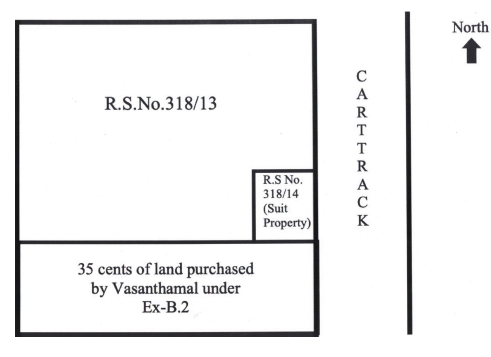
5. The Suit Property is an extent of 6 Cents in R. Survey No. 318/14 which originally belonged to one Iyyakannu Chettiar S/o Ramasamy Chettiar. The plaintiff's paternal uncle - Uthandi Chettiar purchased the Suit Property along with some other properties from the said Iyyakannu Chettiar vide Sale Deed dated October 20,1938. The said Uthandi Chettiar and his wife passed away without any issues. After their demise, plaintiff's father - Govinda Chettiar acquired the Suit Property along with some other properties by way of survivorship. The plaintiff's father - Govinda Chettiar passed away in the year 1954. After his demise, the plaintiff and his brother - Subramaniam had orally partitioned the properties in the year 1962. The plaintiff's mother - Radhambal had informed that she did not want any share in the properties. Hence, she was not allotted any Property. The Suit Property fell to the share of the plaintiff.
5.1. The plaintiff's mother - Radhambal passed away in the year 1987. From the date of partition, the plaintiff is in possession and enjoyment of the Property by paying Kist to the Government. Patta stands in the name of the plaintiff. The first defendant had no title and right over the Suit Property.
5.2. The first defendant has Property on the northern and the western side of the Suit Property. Taking advantage of the same, the first defendant had encroached upon the Suit Property and has constructed a house two years ago. Hence, the first defendant is a trespasser. The plaintiff came to know the fact that the first defendant with a connivance of the defendants 6 and 7 had changed the Patta in his name. The defendants 6 and 7 without conducting any proper enquiry, had issued Patta in favour of the plaintiff and hence, it is not legally valid.
5.3. The Suit Property is a cultivable land. The plaintiff was cultivating Ragi and Kambu. Since the defendants 1 to 5 have encroached upon the Property and had constructed houses, the plaintiff could not get income from the Suit property. On July 12, 1997, the plaintiff issued notice to the defendants 1, 6 and 7 directing the first defendant to vacate and hand over the vacant site and calling upon the defendants 6 and 7 to cancel the Patta.
5.4. The first defendant issued reply notice on July 29, 1997 with false allegations. In the said reply, the first defendant has stated that his father had purchased the Suit Property from them and had constructed a house in the year 1983 itself. He has been in possession and enjoyment of the same and thus, he has prescribed title by adverse possession.
5.5. Therefore, the plaintiff filed a Suit for declaration, for rec
AI
The judgment establishes that continuous possession and proper documentation can affirm ownership, while claims of adverse possession require clear evidence and specific pleading.

Long possession alone does not establish adverse possession; clear evidence of hostile intent against the rightful owner is required.


The main legal point established in the judgment is the requirement to plead and prove essential facts to establish adverse possession, including continuity, publicity, and hostility to the true owne....
Long possession without clear evidence of hostile intent does not equate to adverse possession, and permissive possession cannot turn adverse without communication of hostility.
Long-standing possession supported by revenue records can establish entitlement to property, negating the need for a formal declaration of title.
to approach the Civil Court for adjudicating the title in issue and when the defendant's patta had been cancelled during 1995 merely on the production of certain electricity bills and house tax recei....



An indispensable Tool for Legal Professionals, Endorsed by Various High Court and Judicial Officers
Please visit our Training & Support
Center or Contact Us for assistance

Scan Me!
India’s Legal research and Law Firm App, Download now!


For Daily Legal Updates, Join us on :



 Back to top


