
 Back
Back





IN THE HIGH COURT OF JUDICATURE AT MADRAS
R. SUBRAMANIAN, R. SAKTHIVEL, JJ.
A.L. Deivanathan & Ors. - Appellants
Versus
R. Rajavarman (Died) & Ors. - Respondents
A.S. No. 273 of 2017 and CMP No. 10462 of 2017
Decided On : 13-06-2024
Specific Performance - Sale Agreement - CPC Sections 96, Order II Rule 2 - The court analyzed the validity of a sale agreement, the payment of advance, and the readiness of the plaintiffs to perform their part, ultimately ruling against specific performance while allowing a partial refund of the advance paid.
Fact of the Case:
The plaintiffs entered into a sale agreement with the defendants for a property but claimed the defendants failed to execute the sale deed despite receiving an advance. The defendants denied the agreement and the receipt of the full advance, leading to a suit for specific performance.
Finding of the Court:
The court found the sale agreement incomplete due to lack of signatures and insufficient evidence of payment. It ruled that the plaintiffs were not ready and willing to perform their part of the contract, thus denying specific performance but allowing a refund of part of the advance.
Issues: Whether the sale agreement is valid and enforceable, whether the plaintiffs paid the claimed advance, whether they are entitled to specific performance, whether the suit is barred under Order II Rule 2 of CPC, and whether they are entitled to a refund of advance money.
Ratio Decidendi: The court held that the plaintiffs did not prove their readiness to perform the contract and that the sale agreement was incomplete and unenforceable due to lack of necessary signatures and registration.
Result: The appeal is partly allowed; specific performance is denied, but the plaintiffs are entitled to a refund of Rs.5,00,000 with interest.
JUDGMENT :
R. SAKTHIVEL, J.
[PRAYER: First Appeal filed under Section 96 read with Order XLI Rule 1 of Code of Civil Procedure, 1908, praying to set aside the judgment and decree dated 18.01.2017 passed in O.S.No.191 of 2011 by the learned III Additional District Judge, Salem.]
The appellants herein are the plaintiffs in O.S.No.191 of 2011 on the file of 'III Additional District Judge, Salem' (henceforth 'Trial Court').
2. For the sake of convenience, henceforth, the parties will be referred to as per their array in the suit i.e., the appellants herein and the respondents herein will be referred to as plaintiffs and defendants respectively.
3. Feeling aggrieved with the judgment and decree dated January 18, 2017, passed by the Trial Court in O.S.No.191 of 2011, the plaintiffs have preferred this Appeal under Section 96 read with Order XLI Rule 1 of the ‘Code of Civil Procedure, 1908’ (henceforth ‘CPC’), praying to set aside the aforementioned judgment and decree. It is brought to our notice that the 1st respondent in this appeal died pending appeal. The other 3 respondents are his children they are recorded as his legal representatives.
Plaintiffs’ case
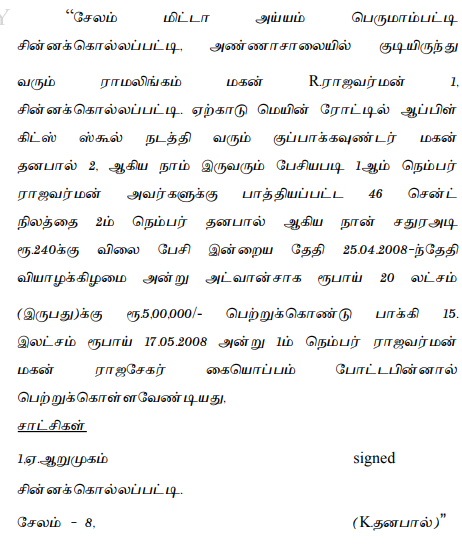
4. The case of the plaintiffs is that, the 1st defendant is the father, the 2nd defendant is his son, and the 3rd and 4th defendants are his daughters. Defendants acquired the Suit Propriety measuring an extent of 46 Cents under a registered Partition Deed dated June 13, 1985.
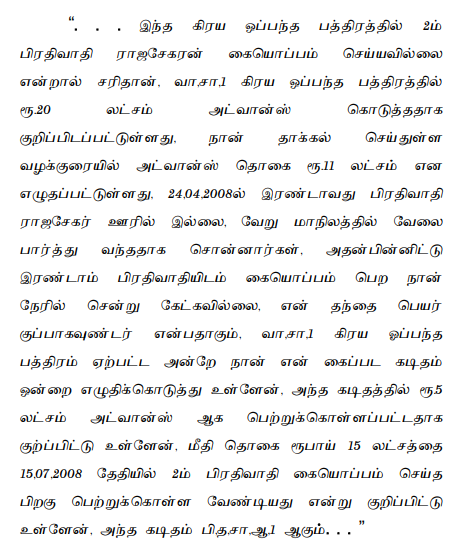
4.1. According to the plaintiffs, on April 24, 2008, the defendants entered into an agreement of sale with the plaintiffs to sell the Suit Property on or before September 30, 2008 and the sale price was fixed at Rs.240/- per sq.ft., which totally comes to a sum of Rs.48,13,440/-(Rupees Forty Eight Lakh Thirteen Thousand Four Hundred and Forty only). While executing the sale agreement on April 24, 2008, the plaintiffs paid a sum of Rs. 10,00,000/- (Rupees Ten Lakhs Only) as advance. A further sum of Rs. 1,00,000/- was paid on July 7, 2008 towards the sale consideration. Thus, in total, a sum of Rs.11,00,000/- (Rupees Eleven Lakhs Only) had been paid to the defendants by the plaintiffs as advance towards purchase of the Suit Property. The defendants duly acknowledged the receipt of said sum in the presence of Mr.V. Pal Arumugam and Mr. M.Mohan.
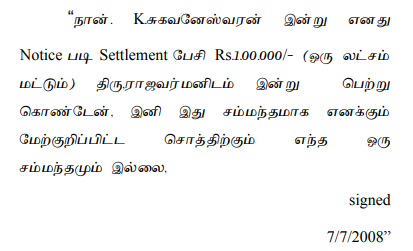
4.2. According to the plaintiffs, on June 25, 2007, the first defendant entered into a sale agreement with K. Sugavaneswaran to sell the Suit Property, after receiving an advance of Rs.1,00,000/- (Rupees One Lakh only) as part of total sale consideration. The agreed sale price was Rs. 165 per sq. ft. However, the first defendant failed to honour the agreement and did not execute the sale deed in favour of K. Sugavaneswaran. Consequently, K. Sugavaneswaran issued a legal notice to the first defendant and the plaintiffs. In response, the first defendant approached the plaintiffs, received Rs. 1,00,000/-, and settled the matter with K.Sugavaneswaran in the presence of the plaintiffs. This clearly demonstrates the defendants’ greed and unwillingness to execute the sale deed in favour of the plaintiff.
4.3. Despite the repeated demands from the plaintiffs, the defendants did not come forward to execute sale deed in favour of the plaintiffs. The defendants openly proclaimed to sell the Suit Property to 3rd parties for a higher price. Hence, the plaintiffs issued a legal notice to the defendants on February 14, 2010 calling upon them to execute sale deed by enforcing the agreement of sale dated April 24, 2008. On February 17, 2010, the defendants sent a reply notice denying the execution of sale agreement as well as the receipt of sale advance of Rs.11,00,000/-
4.4. On March 22, 2010, the 2nd defendant sent a reply notice denying the execution of the sale agreement as well as the receipt of sale advance of Rs.11,00,000/-. Hence, the plaintiffs filed a suit for specific performance of contract. The plaintiffs also made an alternate prayer for return of advance amount.
Defendants' case
5.
AI
The court established that a sale agreement lacking necessary signatures and evidence of payment cannot be enforced for specific performance, but a partial refund of advance is permissible.

A sale agreement must be duly stamped and registered if it involves possession transfer; time is of the essence unless explicitly stated otherwise.
The court established that a sale agreement not duly registered is unenforceable, and time is essential in contracts unless explicitly stated otherwise.

The plaintiff's failure to prove readiness and willingness to perform the contract precludes specific performance, but the first defendant must return the advance amount with interest.

Specific performance of a contract is a discretionary remedy that requires the plaintiff to prove readiness and willingness to perform their obligations within the stipulated time.

The plaintiff's failure to file the suit within the limitation period and to prove readiness and willingness to perform the contract resulted in dismissal of the specific performance claim.
The main legal point established in the judgment is the requirement for the plaintiff to demonstrate readiness and willingness to perform an agreement of sale, and the court's discretion to consider ....



An indispensable Tool for Legal Professionals, Endorsed by Various High Court and Judicial Officers
Please visit our Training & Support
Center or Contact Us for assistance

Scan Me!
India’s Legal research and Law Firm App, Download now!


For Daily Legal Updates, Join us on :



 Back to top


