
 Back
Back





IN THE HIGH COURT OF JUDICATURE AT MADRAS
M.SUNDAR, K.GOVINDARAJAN THILAKAVADI, JJ.
D.Selvakumari - Appellant
Versus
The State Human Rights Commission Tamilnadu - Respondent
W.P.No.17369 of 2018 and W.M.P.No.20630 of 2018
Decided on : 29-04-2025
(A) Human Rights Act - Sections 1 and 2 - Writ petition challenging the order of the State Human Rights Commission regarding alleged human rights violations - The Commission awarded compensation of Rs.2,00,000/- to the complainant and recommended disciplinary action against the petitioner - The petitioner, a police official, contended that the complaint was a counterblast to lawful actions taken during an inquiry into domestic violence allegations - The court found that the complainant failed to substantiate claims of human rights violations and that the petitioner acted within legal bounds. (Paras 2, 12, 13, 14)
(B) Human Rights Violations - The court emphasized that mere allegations without corroborative evidence do not establish a violation of human rights - The petitioner’s actions in conducting a preliminary inquiry were deemed lawful and necessary. (Paras 13, 14)
Facts of the case:
The petitioner, a police inspector, faced allegations of human rights violations from the 2nd respondent after conducting an inquiry into a domestic violence complaint lodged by the 2nd respondent's wife. The SHRC found in favor of the complainant, awarding compensation and recommending disciplinary action against the petitioner.
Findings of Court:
The court determined that the allegations against the petitioner were unsubstantiated and that the actions taken were lawful and necessary for the inquiry process. The SHRC's order was set aside.
Issues: The main issues included whether the petitioner violated the human rights of the complainant and whether the SHRC's findings were supported by evidence.
Ratio Decidendi: The court ruled that the complainant did not provide sufficient evidence to support claims of human rights violations, and the petitioner acted lawfully in conducting the inquiry. The SHRC's recommendations were therefore unsustainable.
Result: Writ Petition allowed, and the SHRC's order set aside.
ORDER :
K .GOVINDARAJAN THILAKAVADI, J.
The petitioner has preferred the instant writ petition challenging the order dated 14.05.2018 passed by the State Human Rights Commission in S.H.R.C case No.7861/2013.
2. The writ petitioner is a police official and respondent in the complaint preferred by the 2nd respondent before the State Human Rights Commission, i.e., the 1st respondent herein. The State Human Rights Commission held that the 2nd respondent was subjected to Human rights violation by the writ petitioner without following the procedure laid down in law and passed the impugned order stating that the complainant is entitled to get a sum of Rs.2,00,000/- (Rupees Two Lakhs only ) from the writ petitioner as compensation and recommended the Government to pay the said amount and to recover the same from the writ petitioner. The SHRC also recommended to initiate disciplinary action against the writ petitioner. Aggrieved by the same, the writ petitioner is before this Court challenging the order of SHRC in S.H.R.C case No.7861/2013 dated 14.05.2018.
Brief facts that are necessary for the disposal of this writ petition are as follows:
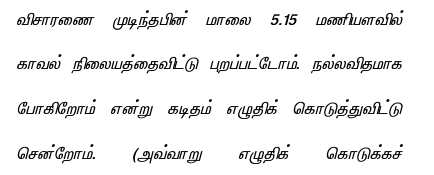
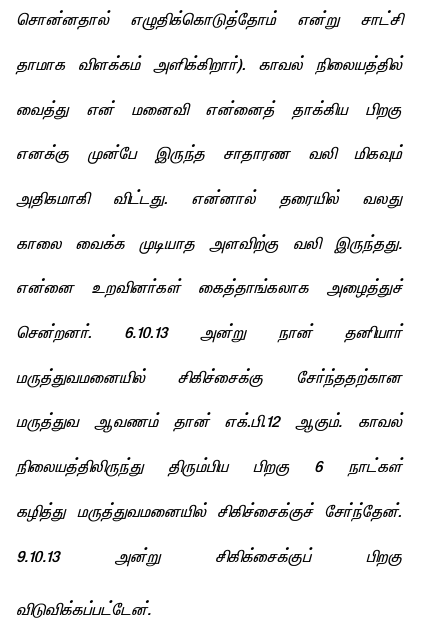
3. The Writ Petitioner while working as Inspector of Police, All Women Police Station, Ambattur, Chennai, the 2nd respondent's wife lodged a complaint on 26.08.2013 against her husband (2nd respondent herein) and his family members for harassing and giving life threat to her. After enquiry, the said complaint was taken on file vide C.S.R No.264/2013 and thereafter summons were issued to the 2nd respondent and his family members to appear before the petitioner for preliminary enquiry on 30.09.2013. On enquiry, prima facie case was made out and therefore, the petitioner registered the FIR. As counter blast, the 2nd respondent/complainant lodged a complaint before SHRC alleging that he was subjected to human rights violation by the writ petitioner at the time of the said enquiry.
4. Mr.P.Arumugavel, learned counsel appearing for the petitioner submits that after receipt of summons the 2nd respondent and his family members appeared before the petitioner and enquiry was conducted. At the time of enquiry, the petitioner treated them with due respect and dignity. But the 2nd respondent and his family members threatened him to close the complaint. The petitioner did not heed to their threat and conducted the enquiry in a fair manner. Since prima facie an offence was made out from the complaint, the petitioner registered the First Information Report on 25.10.2013 in Cr.No.8/2013, on the file of All Women Police Station, Ambattur under sections 498A and 506(i) of I.P.C against the 2nd respondent and his family members. As a counter blast, on the very same day i.e., on 25.10.2013 vide S.H.R.C No. 7861/2013 the 2nd respondent herein lodged a complaint against the petitioner before the State Human Rights Commission i.e., the 1st respondent herein. Thereafter, enquiry was conducted by the 1st respondent and the impugned order was passed without proper appreciation of facts.
5. His further contention is that the complaint lodged by the 2nd respondent is very vague and subsequently the 2nd respondent and his wife got divorced and are living separately. Whereas, for no fault of the petitioner, she was imposed with the punishment by SHRC, the 1st respondent herein.
6. The petitioner's counsel also submits that a criminal case was registered in Cr.No. 8 of 2013, on the file of All Women Police Station, Ambattur, under sections 498A and 506(i) of I.P.C against the 2nd respondent for threatening his wife and the same was taken on file vide C.C.No.167 of 2014 by the learned Judicial Magistrate, Amabttur. The 1st respondent failed to take note of the above facts and passed the impugned order merely based on the vague and false statement of the 2nd respondent. The writ petitioner was punished for doing her lawful duty. The said complaint was only an afterthought in order to wreck vengeance against the writ petitioner for register
Allegations of human rights violations must be substantiated by evidence; mere claims without corroboration do not establish a violation.
The court upheld the State Human Rights Commission's findings of police misconduct, confirming the need for law enforcement to respect citizens' rights and the burden of proof on the accused to dispr....

Police officials must adhere to lawful procedures in arrest and detention; failure to do so constitutes a violation of human rights.
The main legal point established in the judgment is the requirement for specific evidence supporting the violation of human rights and the proper closure of complaints after due enquiry.
A petitioner cannot invoke the extraordinary writ jurisdiction of the High Court to challenge an administrative order when they have failed to contest the proceedings or file a reply before the origi....
Reasons quashing SHRC order against police equally apply to co-respondent petitioner.
Police officer's improper involvement in investigation due to conflict confirmed; compensation upheld but disciplinary action waived due to provocation and time lapse.
The State Human Rights Commission must provide a personal hearing in serious cases involving prominent individuals to ensure procedural fairness.

The court emphasized that human rights commission findings should not interfere with ongoing criminal prosecution, highlighting the need for clear evidence when linking law enforcement officers to al....



An indispensable Tool for Legal Professionals, Endorsed by Various High Court and Judicial Officers
Please visit our Training & Support
Center or Contact Us for assistance

Scan Me!
India’s Legal research and Law Firm App, Download now!


For Daily Legal Updates, Join us on :



 Back to top


