
 Back
Back





IN THE HIGH COURT OF JUDICATURE AT MADRAS
SENTHILKUMAR RAMAMOORTHY, J.
Future Lifestyle Fashion Ltd, - Appellant
Versus
The Registrar of Trade Marks Intellectual Property Building – Respondent
CMA(TM)IPD/11/2023
Decided on : 22-04-2025
(A) Trade Marks Act, 1999 - Sections 9, 11, 12, and 18 - Appeal against the order rejecting opposition to the registration of the trade mark 'CMR CENTRAL' - The appellant claimed prior use of the mark 'CENTRAL' since 2004, while the second respondent asserted use since 2008 - The Registrar disregarded the appellant's evidence due to pending rectification applications by a third party - The court found that the Registrar failed to consider all relevant factors and remanded the matter for reconsideration. (Paras 1, 4, 10, and 11)
(B) Deceptive Similarity - The court emphasized the need to compare the marks as a whole to assess the likelihood of confusion among the public, considering the services offered. (Paras 8 and 9)
(C) Evidence - The court noted that the evidence of prior use and sales turnover presented by the appellant was brushed aside without proper adjudication of the rectification applications. (Paras 7 and 10)
Facts of the case:
The appellant opposed the registration of 'CMR CENTRAL' by the second respondent, asserting prior use of 'CENTRAL' since 2004, while the second respondent claimed use since 2008. The Registrar dismissed the opposition based on pending rectification applications.
Findings of Court:
The court found that the Registrar did not adequately consider the evidence and relevant factors, warranting a remand for reconsideration.
Issues: The main issues included the assessment of prior use, the likelihood of confusion, and the impact of pending rectification applications on the opposition.
Ratio Decidendi: The court ruled that the Registrar's dismissal of the appellant's evidence was inappropriate and emphasized the need for a comprehensive evaluation of all relevant factors in determining the likelihood of confusion.
Result: The impugned order dated 20.04.2023 is set aside and the matter is remanded for reconsideration.
J U D G M E N T
This appeal is directed against order dated 20.04.2023 rejecting opposition No.755028 and allowing application No.1749295 for registration of the trade mark CMR CENTRAL. The second respondent herein applied for registration of the above mentioned trade mark in class 35 in respect of advertising and shopping complex. The application was filed asserting use since 01.10.2008.
2. Upon noticing the advertisement published in Trade Marks Journal No.1427, the appellant filed notice of opposition on 27.01.2010. The second respondent filed counter statement dated 04.05.2010. After both parties adduced evidence in support of the opposition and application, respectively, the order impugned herein was issued on 20.04.2023.
3. Learned counsel for the appellant invited my attention to the impugned order and submitted that the first respondent disregarded the evidence placed on record by the appellant on the ground that M/s.Central Retail Corporation Ltd., Thailand, had filed rectification applications before the Registrar of Trade Marks, Mumbai. She submitted that the appellant's predecessor-in-interest, Pantaloon Retail (India) Limited, adopted and used the trade marks containing the element 'CENTRAL' along with the name of the city wherein the relevant mall is established since early 2004. Upon the amalgamation of the appellant's predecessor-in-interest with the appellant, she further submitted that the appellant filed Form TM-M before the Registrar of Trade Marks to amend the trade mark application so as to reflect the name of the successor-in-interest. By referring to the evidence placed on record before the Registrar of Trade Marks, learned counsel submitted that the appellant had provided evidence of the registration of at least 37 trade marks, each of which contains the prominent feature 'CENTRAL'. She also referred to the certificate issued by Chartered Accountants with regard to the sales turnover from the provision of services under the trade mark containing the element 'CENTRAL'. Since such evidence was not taken into consideration, learned counsel submits that interference with the impugned order is warranted.
4. In response to these contentions, learned counsel for the second respondent submits that the trade mark of the second respondent is 'CMR CENTRAL' and that the acronym 'CMR' was derived from the initials of the promoter of the second respondent, Chandana Mohan Rao. Upon accepting the explanation of the second respondent, learned counsel submits that the Registrar of Trade Marks recorded the finding that the use of the acronym CMR in the trade mark of the second respondent eliminates the possibility of deceptive similarity. As regards the element 'CENTRAL', learned counsel submits that it is a word in common use and that no person is entitled to claim exclusivity in respect thereof. In support of this contention, learned counsel referred to and relied upon the judgment of the Delhi High Court in Institute of Directors v. Worldevcorp Technology and Business Solutions Pvt. Ltd. and Others, 2023 SCC OnLine Del 7841, particularly paragraphs 28 to 34 thereof. Learned counsel further submits that the appellant failed to establish secondary meaning in respect of the element 'CENTRAL' and, therefore, no interference is called for with regard to the finding in such regard by the Registrar of Trade Marks.
5. The first aspect to be examined is with regard to the evidence placed on record by the contesting parties. The appellant has placed on record advertisements published in the Trade Mark Journals pursuant to applications by Pantaloon Retail (India) Limited. These advertisements relate to device marks such as
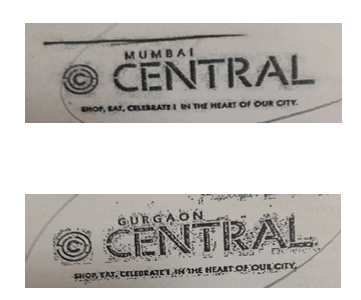
It is noticeable from the advertisements that the applications were lodged on 12.02.2004 on 'proposed to be used' basis. Each device mark contains the element 'CENTRAL' with the prefix of the name of the city wherein the relevant mall is situated.
6. Also on record is a certificate issued by Shambhu Gupta & Co., Char

The court emphasized the need for comprehensive evaluation of evidence regarding prior use and likelihood of confusion in trademark registration disputes.
Trademark registration processes must adhere to principles of natural justice, and the evaluation of deceptive similarity depends on the nature of goods and trade channels.
The court emphasized the necessity for thorough examination of prior trademarks' usage when assessing likelihood of confusion under trademark law.

The impugned mark was ineligible for registration due to similarity with an earlier trade mark, as per Section 11(1)(b) of the Trade Marks Act.


Refusal orders under Section 11(1) must reason rejection of honest concurrent use evidence under Section 12; unreasoned mechanical orders ignoring user affidavits and non-use set aside with remand.

The central legal point established in the judgment is the requirement of likelihood of confusion on the part of the public and the principle of comparing composite marks as a whole under Section 11(....
The central legal point established in the judgment is the application of Section 11(1)(b) of the Trademarks Act to determine the likelihood of confusion based on phonetic similarity and the priority....
The central legal point established in the judgment is that for a trade mark to be ineligible for registration under Section 11(1)(b) of the Trade Marks Act, there must be a cumulative satisfaction o....



An indispensable Tool for Legal Professionals, Endorsed by Various High Court and Judicial Officers
Please visit our Training & Support
Center or Contact Us for assistance

Scan Me!
India’s Legal research and Law Firm App, Download now!


For Daily Legal Updates, Join us on :



 Back to top


