
 Back
Back





IN THE HIGH COURT OF JUDICATURE AT MADRAS
SATHI KUMAR SUKUMARA KURUP, J.
Jagatheeswaran M/s. J.K. Steel Corporation - Appellant
Versus
N. Eswaramoorthy (Deceased) - Respondent
Criminal Revision Case No. 975 of 2020
Decided On : 17-04-2025
| Table of Content |
|---|
| 1. conviction under section 138 for cheque dishonor (Para 1 , 2) |
| 2. arguments highlighting flaws in trial (Para 3 , 4 , 5 , 6) |
| 3. court's observations on the evidence presented. (Para 7) |
| 4. judicial observations on evidentiary value (Para 8 , 12 , 13 , 17 , 19) |
| 5. importance of the complainant's testimony. (Para 9 , 10) |
| 6. failure to cross-examine the key witness and implications. (Para 11) |
| 7. criteria for rebutting statutory presumption (Para 14 , 18 , 21) |
| 8. legal standards concerning statutory presumptions. (Para 15 , 16) |
| 9. conclusions regarding the trial court's decisions. (Para 20 , 22 , 23) |
| 10. final decision upholding lower court's conviction. (Para 24) |
| 11. final dismissal of criminal revision (Para 25 , 26) |
ORDER :
1. This Criminal Revision is filed against the Judgment dated 04.01.2020 made in Criminal Appeal No. 47 of 2018 on the file of the learned III Additional District and Sessions Judge, Coimbatore confirming the Judgment of conviction dated 21.12.2017 made in C.C. No. 141 of 2013 on the file of the learned Judicial Magistrate, Fast Track Court-II (Magisterial Level), Coimbatore.
2. The brief facts, which are necessary for the disposal of this Criminal Revision, are as follows:-
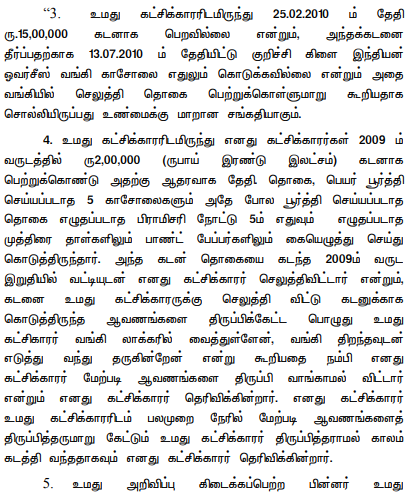
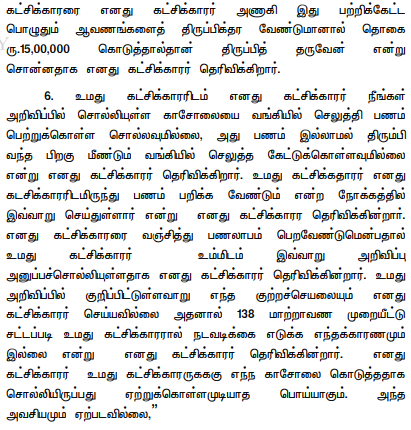
2.1. Originally, the deceased complainant had filed the Complaint in C.C. No. 141 of 2013 under Section 138 of the Negotiable Instruments Act, 1881 against the Revision Petitioners/Accused herein. As per the said complaint, the Revision Petitioner/first Accused borrowed a sum of Rs.15,00,000/- from the deceased Complainant for his business purpose on 25.02.2010 and agreed to repay the said amount on demand. However, inspite of repeated requests, the Revision Petitioner/first Accused did not repay the amount. After persistent demands, the Revision Petitioner/first Accused issued a cheque No. 890801 for Rs.15,00,000/- drawn on Indian Overseas Bank, Kurichi Branch, Coimbatore. When the cheque was presented for collection by the deceased-Complainant, the cheque was returned with an intimation “exceeds arrangement” on 24.07.2010. When it was intimated to the Revision Petitioner/first Accused, he requested the deceased-Complainant to re-present the cheque during the month of September, 2010. Accordingly, when the cheque was presented for collection on 02.09.2010, it was once again returned for the reason “insufficient fund”. Therefore, on 13.09.2010, the deceased-Complainant sent a notice calling upon the Revision Petitioners/Accused to pay the cheque amount. Even though the notice was received, the Revision Petitioners did not pay the cheque amount or issued any reply to the notice dated 13.09.2010. Therefore, the complaint was filed by the deceased-Complainant invoking Section 138 of The Negotiable Instruments Act, 1881.
2.2. The complaint filed by the deceased Complainant was taken on file and his sworn statement was recorded. Thereafter, summons were issued to the Accused and he was questioned regarding the averments made in the complaint. However, the Revision Petitioners/Accused denied the averments and therefore, trial was conducted. During the trial, the Complainant was examined as P.W-1 by filing proof affidavit. Along with the proof affidavit, he had marked seven documents as Ex.P-1 to Ex.P-7. After closure of the complainant side evidence, the Revision Petitioner-first Accused was questioned under Section 313 (1) (b) of the Code of Criminal Procedure regarding the incriminating evidence available against him. The Revision Petitioner-first Accused denied the said evidence as false and claimed to examine evidence. Accordingly, one Selvaraj and Raviraj wre examined as D.W-1 and D.W-2. The Revision Petitioner-first Accused was examined as D.W-3.
2.3. During the pendency of C.C.No. 141 of 2013, the original Complainant died on 13.10.2014 and therefore, his wife was substituted and she prosecuted the complaint filed by her husband. As the Complainant died after his examination in chief by way of proof affidavit was recorded, he could not
AI
The courts held that the presumption of cheque validity under Section 138 persists until contradicted by credible evidence, which was not achieved by the accused.

A complaint under Section 138 must provide sufficient details about the relationship and financial capacity; mere presumption is insufficient for conviction without material evidence.
The initial burden of proof lies with the Complainant to establish a legally enforceable debt, which was not met, leading to the reversal of the conviction.

The court emphasized the importance of documentary evidence, witness testimony, and the presumption of a legally enforceable debt under Sec. 139 of the N.I. Act in establishing the guilt of the accus....
The failure of the complainant to tender for further cross-examination led to the discarding of his evidence, which invalidated the judgments of conviction.
The courts affirmed that under Section 138 of the Negotiable Instruments Act, the initial presumption of liability must be rebutted by the accused with satisfactory evidence, which was not done in th....

The accused may rebut statutory presumptions of liability in cheque dishonor cases; once done, burden shifts back to the complainant to prove the case effectively.
The presumption of a legally enforceable debt under Sections 138 and 139 of the N.I. Act is strong and requires evidence to the contrary by the accused, which was not provided.



An indispensable Tool for Legal Professionals, Endorsed by Various High Court and Judicial Officers
Please visit our Training & Support
Center or Contact Us for assistance

Scan Me!
India’s Legal research and Law Firm App, Download now!


For Daily Legal Updates, Join us on :



 Back to top


