
 Back
Back





IN THE HIGH COURT OF JUDICATURE AT MADRAS
C. KUMARAPPAN, J.
Tmt. V. Chamundeeswari – Appellant
Versus
V. Ganapathy and Ors. – Respondents
A.S.No.83 of 2013
Decided On : 26-02-2025
JUDGMENT :
(C. KUMARAPPAN, J.)
The plaintiff is the appellant and the defendants are the respondents herein.
2. For the sake of convenience, the parties will be referred to according to their litigative status before the Trial Court.
3. The brief facts which are necessary for the disposal of this case is as follows:-
The suit property originally belongs to one Chengeni Naicker and his wife Tmt.Rukmaniammal @ Rukkammal. They had two daughters viz., Tmt.Navaneetham and Tmt.Unnamalai. Among them, Tmt.Navaneetham predeceased her husband and they had no issues. Another daughter Tmt.Unnamalai had one daughter viz., Tmt.Chamundeeswari [plaintiff] and two sons viz., Mr.Nagarajan and Mr.Ganapathi [first defendant]. Whereas Mr.Nagarajan died, and his legal heirs viz., Mr.Karthikeyan and Mr.N.Ganesh were arrayed as defendants 2 and 3. It is is the specific case of the plaintiff that after the demise of her grandfather Chengeni Naicker, the property jointly devolves upon her grandmother Tmt.Rukmaniammal and their two daughters Tmt.Navaneetham and Tmt.Unnamalai. Since Tmt.Navaneetham's husband not claiming any right over the suit property, after the demise of Tmt.Rukmaniammal, all the property jointly devolved upon her and her two brothers. Accordingly, the plaintiff claimed 1/3 share in the suit property under Section 8 of The Hindu Succession Act, 1956 .
4.The said suit was resisted by the defendants by contending that their grandfather Chengeni Naicker died prior to the enactment of Hindu Succession Act, 1956 qua during 1947. Therefore, on the demise of Chengeni Naicker, limited right of life estate was conferred upon the widow of Chengeni Naicker viz., Tmt.Rukmaniammal and that after the advent of “ Hindu Succession Act, 1956 ” [hereinafter called “1956 Act”], by operation of Section 14(1), Tmt.Rukmaniammal's limited right blossomed into a full right. As such, though originally the property belonged to Chengeni Naicker, since he died prior to 1956 Act and by operation of Section 14(1) of the Hindu Succession Act, the suit property becomes the absolute property of Tmt.Rukmaniammal [grandmother of the plaintiff and the 1st defendant]. It is in this background the defendant put forth a will dated 24.08.1982 executed by Tmt.Rukmaniammal, bequeathing the entire suit property to the first defendant and his brother late Nagarajan. Therefore, it is the contention of the defendants that the plaintiff has no right in the suit property, and prayed to dismiss the suit.
5. Before the Trial Court, the plaintiff examined 2 witnesses viz., the plaintiff herself, and Chengeni Naicker's son-in-law Natesan, qua the husband of late Navaneetham. On behalf of the defendants, the 1st defendant himself was examined as DW1, and the attestor to the Ex.B1-Will dated 24.08.1982 was examined as DW2. On behalf of the plaintiff, 10 documents were relied and the defendants relied one document.
6. On the pleadings of either side, the Trial Court has framed the following issues:-
(i) Whether late Tmt.Rukmaniammal is the widow of Kuppusamy Naicker?
(ii)Whether the plaintiff is entitled for partition of the Suit Schedule properties?
(iii)Whether the Plaintiff is entitled for past, present and future mesne profits as claimed in the Plaint?
(iv)Whether the Suit property are the joint family properties of the Plaintiff and the Defendants?
(v)Whether the particulars given by the Plaintiff regarding the relationship are correct?
(vi)To what other reliefs is the Plaintiff is entitled?
(Extracted as it is)
7. In respect of issue nos.1 and 5, the Trial Court held that in view of filing of amended plaint, and the correction of errors regarding the relationship, concluded that Tmt.Rukmaniammal is the wife of Chengeni Naicker, as contended by the defendant. In respect of issue Nos.2, 3 and 4, the Trial Court has concluded that in view of the death of Chengeni Naicker prior to 1956, a limited right vests upon Chengeni Naicker's wife Tmt.Rukmaniammal, and ultimately the same enlarged into a full rig
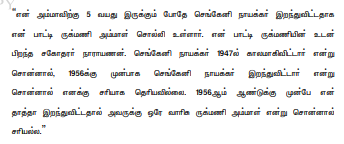
The date of death of the property owner is critical for succession rights under the Hindu Succession Act, and the burden of proof lies on the party asserting an earlier date.
Daughters' rights to inheritance are denied if a son is alive, per Hindu law before 1956, emphasizing the temporal context of death in succession rights.

The court clarified the application of Sections 14(1) and 14(2) of the Hindu Succession Act, emphasizing the need to include all rightful heirs in partition suits.

Daughters are ineligible to inherit under Mitakshara Law prior to 1956, affirming that property succession is limited to male heirs in such cases.
The properties in question were determined to be ancestral, granting coparcenary rights to the daughter under the Hindu Succession (Amendment) Act, 2005.
The Hindu Succession Act's provisions do not apply retrospectively to successions that occurred before its enactment, precluding daughters from inheriting property from fathers who died before 1956.

Daughters are barred from inheriting from their father if succession opened prior to the Hindu Succession Act of 1956, which does not retroactively apply.



An indispensable Tool for Legal Professionals, Endorsed by Various High Court and Judicial Officers
Please visit our Training & Support
Center or Contact Us for assistance

Scan Me!
India’s Legal research and Law Firm App, Download now!


For Daily Legal Updates, Join us on :



 Back to top


