
 Back
Back





IN THE HIGH COURT OF JUDICATURE AT MADRAS
P.T. ASHA, J.
N. Subramaniam - Appellant
Versus
P. Kumarasamy - Respondent
S.A. Nos. 19, 20 of 2013, C.M.P. No. 4363 of 2022, M.P. Nos. 1, 2, 3 of 2013
Decided On : 14-02-2025
ORDER :
1. S.A.No.19 of 2013 arises out of the judgment and decree passed in O.S.No.673 of 2009 dated 04.07.2012 on the file of the Principal District Munsif Court, Erode which was a suit filed for a bare injunction filed by the respondent herein. Against this suit, the plaintiff had filed A.S.No.1 of 2012 on the file of the Sub Court, Sathyamangalam.
2. S.A.No.20 of 2013 arises out from out of the judgment and decree passed in O.S.No.673 of 2009 dated 04.07.2012 on the file of the Principal District Munsif Court, Erode against which the respondent herein had filed A.S.No.1 of 2012 on the file of the Sub Court, Sathyamangalam. O.S.No.675 of 2009 is also a suit for bare injunction filed by the appellant herein against the respondent.
3. The facts of the two suits are herein below set out. The parties are referred to in the ranking as in the suit O.S.No.673 of 2009.
4. Plaintiff's case in O.S.No.673 of 2009: (Respondent in this Second Appeal)
(i) The plaintiff would submit that the two properties described in the schedule of properties in the plaint belonged to defendants 1, 2 and the husband of the 3rd defendant. The 4th defendant and the 5th defendant are the son and daughter-in-law of the 1st defendant, respectively. It is the case of the plaintiff that his father, late Palaniappa Gounder, had taken on lease the suit properties for cultivation and was paying the lease amount to the defendants 1, 2 and the 3rd defendant's husband, late Venkatanarayanan. The plaintiff would also submit that his father, in his capacity as lessee, had entered into an agreement with Bannariamman Sugar Factory to cultivate sugar in the Item-I of the suit property. That apart, he had also addressed the Junior Engineer of the Tamil Nadu Electricity Board regarding the rectification of electricity bill in connection with the service connection No.5 which has been installed in the suit property.
(ii) The plaintiff would submit that his father passed away on 29.03.2001 leaving behind him surviving, the plaintiff as his only legal heir. The plaintiff had continued to contribute his physical labour as a cultivating tenant and was paying annual lease amount to the 2nd defendant for which the 2nd defendant has himself given a receipt in his own handwriting. The kists and house taxes were paid by his plaintiff's father, Palaniappa Gounder and after his demise, the plaintiff has been paying the same. That apart, due to drought and the non availability of water, the plaintiff had installed several bore wells by spending several lakhs of rupees in the suit property and had also purchased motor and other accessories. It is his case that for the last 40 years, the plaintiff and prior to him, his father had been in possession and enjoyment of the property and were paying the annual lease amount to the 2nd defendant. While so, on 20.07.2007, the defendants 4 and 5, with the active support of defendants 1 to 3, had started questioning the plaintiff's right to continue in possession of the property. Therefore, the plaintiff had filed a petition to declare himself as a cultivating tenant in respect of the suit properties.
(iii) The plaintiff would submit that, all of a sudden on 24.07.2009, the defendants along with their musclemen had attempted to forcibly enter the suit properties which was thwarted by the plaintiff. Later, the plaintiff came to learn that the defendants 1 to 5 had sold the suit properties to one Subramaniam (who was subsequently brought on record as the 6th defendant in this suit) and in the Sale Deed, there was a false recital that the 6th defendant had been put in possession of the property in question. He would submit that once again on 22.12.2009, the defendants had tried to forcibly enter the suit property which was also successfully prevented by him. Therefore, the plaintiff has come forward with the suit in question.
5. Written statement of the defendants in O.S.No.673 of 2009:
(i) The defendants had filed a written statement inter-alia denying the l
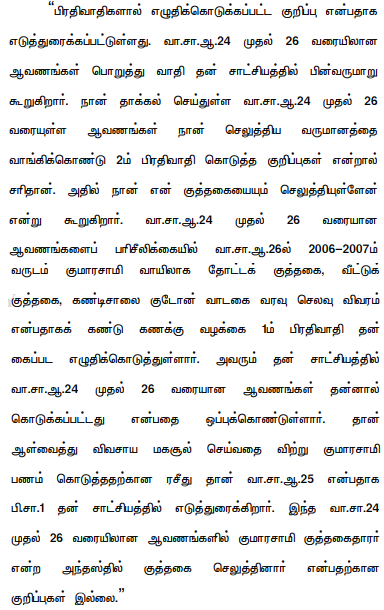
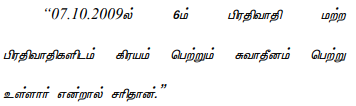
The burden of proof for establishing tenancy rights lies with the claimant, and mere long possession does not confer such rights, particularly for caretakers.

The High Court's jurisdiction under Section 100 CPC is confined to substantial questions of law, without re-assessing evidence or entering factual disputes.
The main legal point established in the judgment is the entitlement of a person related to the original tenant to seek the relief of permanent injunction and the rejection of claims of impersonation.
The court affirmed the plaintiff's status as a cultivating tenant based on revenue records, emphasizing that the appellate court erred in reversing the trial court's decision regarding possession.

Legal heirs claiming cultivating tenant status must establish physical contribution to cultivation; mere documentation of tenancy by a deceased parent is insufficient.
The court reaffirmed that established ownership protects lawful possession, reinforcing the principle that cultivating tenants cannot be evicted without adherence to statutory procedures.
The judgment established the power of Civil Courts to decide the validity of entries made under Act 10 of 1969 and the requirement for genuine entries as per the law.
The burden of proof in property disputes, the principle of possession following title, and the limited jurisdiction of the High Court in second appeals.



An indispensable Tool for Legal Professionals, Endorsed by Various High Court and Judicial Officers
Please visit our Training & Support
Center or Contact Us for assistance

Scan Me!
India’s Legal research and Law Firm App, Download now!


For Daily Legal Updates, Join us on :



 Back to top


