
 Back
Back





IN THE HIGH COURT OF JUDICATURE AT MADRAS
R.N. Manjula, J.
M.Narayanaswamy(died) and ors. - Appellants
Versus
P.Rajasekaran, S/o Ponnudurai - Respondent
S.A.No.1278 of 2013
Decided On : 20-01-2025
JUDGMENT :
R.N. Manjula, J.
The appellant is the plaintiff who filed a suit seeking the relief of permanent injunction restraining the defendant from interfering with his possession over the suit property. The trial Court dismissed the suit and on the First Appeal preferred by the defendant also got dismissed by confirming the judgement and decree of the trial Court. Aggrieved over that the defendant has filed this Second Appeal.
2.The short facts pleaded in the plaint are as follows:
The plaintiff is the owner of the suit property. The plaintiff's predecessors and thereafter, the plaintiff are in continuous possession and enjoyment of the suit property. The plaintiffs' forefathers and subsequently, the plaintiff had spent huge amount on the suit property and they have been in exclusive possession and enjoyment. The defendants have no rights whatsoever in the suit property and he is restrained to interfere with the peaceful possession of the plaintiff. The door number of the suit property is No.24 and previously there was a thatched shed in it. At that point of time there was no assessment of house tax on the property as the plaintiff has been in settled possession of the suit property and he has filed the suit for permanent injunction.
3.The short facts pleaded in the written statement filed by the defendant are as follows:
The suit property forms part of S.No.73/1 which is ancestral property of this plaintiff. In a partition among the members of the plaintiff's family in 1982, Part of S.No.73/1 fell to the share of this defendant. While so, the claim made by the plaintiffs as though he is the owner of the property is preposterous. It is false to state that the defendant has no right over the suit property. The claim of the plaintiff is a bold one. The plaintiff was a farm servant of the defendant's uncle. After the partition of 1982 the plaintiff sought permission of the defendant to put up a small hut in a portion of S.No.73/1 and had put up a hut measuring an extent of 10'x10'. He was permitted to put up a hut only on a condition that he would remove the hut whenever he was called upon to do so. As he is only a licensee in respect of a portion 10'x10' which is situated in the south-western portion of the defendant's land measuring 80' North to South and 25' East to West on the South and 29' on the North. The defendant has plotted out S.No.73/1 in bits and sold them to various individuals. The plaintiff is aware of the various sales effected by the defendant in respect of the said survey number. Hence, the suit of the plaintiff is liable to be dismissed .
4.The defendant has also filed a suit in OS.No.1033/1997 seeking relief of declaration and recovery of possession for 120 sq.ft. that has been decreed and confirmed by the First Appellate Court and the execution of the decree has also been made. In fact the plaintiff who was the defendant in the said suit has filed second appeal challenging the above decree in S.A.No.1279/2013 and the same was dismissed as infructuous in view of the delivery effected by recording a joint compromise memo between the plaintiff and the defendant. In fact the judgment of the Trial Court was a common judgment for both the Original Suits in O.S.No.185/97 in which the present appellant is the plaintiff and and other suit in O.S.No.1033/97 in which the defendant is the plaintiff. So far as this suit is concerned, the Court below has framed the following issues:
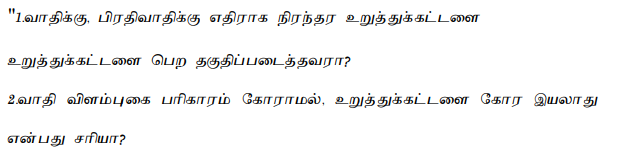
5. During the course of the joint trial on the side of the plaintiff, one witness has been examined as P.W.1 and Exs.A1 to A5 were marked. On the side of the defendant, two witnesses were examined as D.W.1 and D.W.2 and Exs.B1 to B5 were marked. The Commissioner's report and plan have been marked as Ex.C1 and C2.
6. After the conclusion of the trial and on considering the materials available on record, the trial Court has dismissed the suit filed by the plaintiff and decreed the suit filed by the defendant in OS.No.1033/1997. The first appeal prefer
Possession claims must be substantiated with specific evidence of ownership and cannot rely solely on assertions without proper pleadings.

A co-owner's entitlement to seek permanent injunction based on established title, possession, and enjoyment, even in the absence of exclusive possession, when the defendant fails to prove her claim.

When the plaintiff's title to the property is in dispute and there is a threat of dispossession, the plaintiff should sue for declaration of title and the consequential relief of injunction.


The main legal point established in the judgment is that a suit for permanent injunction may not be legally sustainable without seeking the relief of declaration of title, especially when the plainti....

The need for concrete evidence to establish possession and the importance of considering physical features and documentary evidence in property disputes.
A person in peaceful and settled possession is entitled to protection against dispossession without due process, even from the rightful owner.



An indispensable Tool for Legal Professionals, Endorsed by Various High Court and Judicial Officers
Please visit our Training & Support
Center or Contact Us for assistance

Scan Me!
India’s Legal research and Law Firm App, Download now!


For Daily Legal Updates, Join us on :



 Back to top


