
 Back
Back





IN THE HIGH COURT OF JUDICATURE AT MADRAS
R.N. MANJULA, J.
V. Padmavathi - Appellant
Versus
D. Chinnasamy – Respondent
Second Appeal No.1299 of 2014 AND M.P. No.1 of 2014
Decided On : 23-01-2025
JUDGMENT :
(R.N. MANJULA, J.)
This Second Appeal has been filed to set aside the judgment and decree dated 25.06.2014 passed in A.S.No.7 of 2013 on the file of the II Additional District and Sessions Court, Tirupur, partly allowing the judgment and decree dated 28.10.2010 passed in O.S.No.123 of 2007 on the file of the Principal Sub Court, Tirupur.
2. Heard both sides and perused the materials available on record.
3. For the sake of convenience, the parties are referred to as per their rank in the suit as plaintiff and defendant.
4. The appellant, who is the plaintiff, has filed the suit for specific performance and the trial Court had granted the relief of specific performance and the first appeal preferred by the defendant was partly allowed, by modifying the judgment and decree of the trial Court to the extent of granting refund of Rs.4,00,000/- with interest at the rate of 9% p.a. from the date of suit till the date of decree and thereafter, 6% interest, till realisation. The plaintiff has filed the second appeal by challenging the judgment of the first appellate Court, seeking the relief of specific performance.
5. The short facts pleaded by the plaintiff in the plaint are as under :
The suit property is the self-acquired property of the defendant and he agreed to sell the suit property in favour of the plaintiff for a sum of Rs.4,75,000/- and entered into a sale agreement dated 10.08.2004 and on the same date of sale agreement itself, the defendant has received a sum of Rs.4,00,000/- as advance and a time period is agreed for the payment of balance sale consideration of Rs.75,000/-. As the defendant had handed over the original documents to some other persons, he had sought time to get those documents and hand it over to the plaintiff at the time of registering the sale deed. The plaintiff has sent a legal notice on 13.03.2007, calling upon the defendant to execute the sale deed and on receipt of the same, the defendant sent a reply notice on 19.03.2007. In the reply notice, it is alleged that the defendant had obtained loan of Rs.1,00,000/- from the plaintiff and the sale agreement has been executed only as a security. Hence, the plaintiff has filed the suit for specific performance.
6. The defendant resisted the suit by filing the written statement which is given in brief as under :
The plaintiff has concocted the sale agreement by making use of the signatures of the defendant obtained in the empty papers. The defendant had obtained a loan of Rs.1,00,000/- from the plaintiff during the year 2003 and for which, he has been paying interest till January 2004. Since the defendant was not able to pay the interest, the sale agreement was obtained as security.
7. On the basis of the above pleadings, the trial Court has framed the following issues :
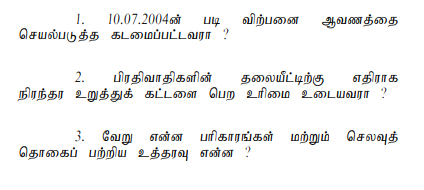
7. During the course of the trial, on the side of the plaintiff, P.W.1 and P.W.2 were examined and Ex.P1 to Ex.P4 were marked and on the side of the defendants, D.W.1 was examined and no document was marked.
8. At the conclusion of the trial and on considering the evidence available on record, the trial Court decreed the suit in respect of the relief of specific performance.
9. The second appeal preferred by the plaintiff was admitted on the following substantial question of law :
i. Whether the lower appellate Court was right in holding that the time is essence of contract in this case ?
Additional substantial question of law :
ii. Whether the first appellate Court is right in denying the relief to the plaintiff on the finding that the plaintiff was not ready and willing to perform her part of contract ?
10. The learned counsel for the appellant/plaintiff submitted that the time is not the essence of the contract, but the first appellate Court has mislead itself and that was the basis for setting aside the judgment of the trial Court. It is further submitted that the plaintiff has been all along ready and willing to perform her part of contract and she also proved the same and hence, the plaintiff
The plaintiff must prove readiness and willingness to perform a contract for specific performance to be granted, and time can be inferred as essential from the contract's nature.


Continuous readiness and willingness to perform a contract must be established for entitlement to specific performance.
Time is not automatically the essence of a contract unless expressly stated; the plaintiff's readiness and willingness to perform must be established.

The Plaintiff must prove continuous readiness and willingness to perform a contract for specific performance, and time can be made of the essence through express terms or circumstances.
Proof of continuous readiness and willingness is essential for specific performance; failure to demonstrate such readiness undermines entitlement to equitable relief.
Specific performance denied for unexplained 13-year delay despite time not being essence; continuous readiness and willingness must be proven.



An indispensable Tool for Legal Professionals, Endorsed by Various High Court and Judicial Officers
Please visit our Training & Support
Center or Contact Us for assistance

Scan Me!
India’s Legal research and Law Firm App, Download now!


For Daily Legal Updates, Join us on :



 Back to top


