
 Back
Back





BEFORE THE MADURAI BENCH OF MADRAS HIGH COURT
V.Sivagnanam, J.
R.Narayanasamy - Appellant
Vs.
Ramaraj - Respondent
S.A(MD)No.1052 of 2005
Decided On : 30-01-2025
| Table of Content |
|---|
| 1. trial court's findings (Para 8 , 9 , 10 , 11 , 12 , 13 , 14 , 15 , 16 , 17 , 18 , 19 , 20 , 21 , 22 , 23) |
| 2. second appeal dismissed (Para 24) |
JUDGMENT :
V.Sivagnanam, J.
The Second Appeal has been filed against the Judgment and Decree passed in A.S.No.42 of 2004 dated 11.07.2005 on the file of the Subordinate Judge, Aruppukottai reversing the Judgment and Decree passed in O.S.No.121 of 2001 dated 28.09.2004 on the file of the District Munsif, Aruppukottai.
2. For the sake of convenience, the parties are referred to as per their ranking in the Trial Court.
3.The plaintiffs in O.S.No.121 of 2001 on the file of the District Munsif, Aruppukottai are the appellants herein.
4. The first plaintiff is the father and the second and third plaintiffs are the sons. Pending suit, the first plaintiff died. His other children are impleaded as the plaintiffs 4, 5 and 6. The suit property is the ancestral property of the plaintiffs. On the southern side portion of their house, they used cattle shed and used the suit property to reach the road on the norther side. In the plaint rough sketch, the suit property is mentioned as ABCD. The first plaintiff's father Veerappa Naickar purchased a property by way of a sale deed dated 12.10.1944. Subsequently, he sold to one Krishnasamy Naickar on 28.11.1944 by way of a registered sale deed. From Krishnasamy Naickar, the first defendant purchased the property. From the sale deeds, east boundary is shown as the suit property. In the plaint schedule, the first defendant's property is shown as FADE. The suit property is shown as ABCD. In the suit property, the defendants had no right and enjoyment. Since the defendant interfered with the plaintiffs' enjoyment, the plaintiffs filed the suit for declaration of right over the plaint schedule property and for permanent injunction restraining the defendant from interfering with the peaceful possession and enjoyment of the plaint schedule property and also permanent injunction restraining the second defendant not to grant planning permission to the first defendant on the basis of the plan submitted by the first defendant.
5.The first defendant filed a written statement and contested suit. The first defendant denied the allegations contained in the plaint. He further contended that the suit property is the form part of the property which was settled in his favour by his father under a settlement deed. The first defendant enjoyed the property for a long period. The plaintiffs have no right and title over the same. He further contended that the first defendant used the suit property to reach the main road on the norther side. The suit property reached to north municipal road on the northern side and thus, pleaded to dismiss the suit.
6.On the basis of the above said pleas set out by the respective parties, the following issues were framed by the Trial Court for consideration:
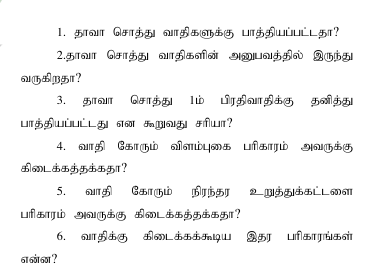
7. Before the Trial Court, on the side of the plaintiffs, the second plaintiff examined as P.W.1 and marked 6 documents as Ex.A1 to Ex.A6. On the side of the defendants, the first defendant examined himself as D.W.1 and marked 14 documents as Ex.B1 to Ex.B14. Besides, 4 court documents have been marked as Exs.C1 to C4.
8. The Trial Court, after considering the oral and documentary evidence, declared the right of the plaintiffs over the suit property ABCD and provided right of pathway to the first defendant and granted injunction against the second defendant granting approval and thus, decreed the suit. Aggrieved by this, the first defendant preferred an appeal in A.S.No.42 of 2004 on the file of the Sub-Court, Aruppukottai. The First Appellate Court, by its Judgment dated 11.06.2005 allowed the appeal and set aside the judgment and decree of the Trial Court. Aggrieved by this, the plaintiffs filed the present second appeal.
9. While admitting the second appeal, this Court has formulated the following substantial questions of law:-
“1.Whether the Ex.B12 the evidence of plaintiff's father w
The First Appellate Court correctly reversed the trial court's decree due to insufficient evidence from the plaintiffs to establish title over the suit property.

Long-standing possession supported by revenue records can establish entitlement to property, negating the need for a formal declaration of title.
The appellate court misdirected its assessment, failing to recognize that property ownership and identity were sufficiently proven by prior deeds and tax records.
The appellate court determined that the First Appellate Court erred in not properly evaluating the ownership evidence, resulting in incorrect distribution of property rights and affirming the Plainti....

Documentary evidence prevails over oral claims in property disputes; adverse possession must be substantiated by valid evidence.

A suit for injunction is maintainable without a declaration of title when the title is not disputed, and survey boundaries are conclusive proof unless modified by a court.
Claimants must provide valid title documents and evidence of ownership in property disputes; reliance on non-title documents like patta is insufficient.



An indispensable Tool for Legal Professionals, Endorsed by Various High Court and Judicial Officers
Please visit our Training & Support
Center or Contact Us for assistance

Scan Me!
India’s Legal research and Law Firm App, Download now!


For Daily Legal Updates, Join us on :



 Back to top


