
 Back
Back





IN THE HIGH COURT OF JUDICATURE AT MADRAS
G.K.ILANTHIRAIYAN, J.
Pappal - Appellant
Versus
The State by., The Inspector of Police - Respondent
Crl.A.No.177 of 2023
Decided on : 20-06-2025
| Table of Content |
|---|
| 1. criminal appeal against acquittal for property damage and assault. (Para 1) |
| 2. prosecution's account of events. (Para 2 , 3) |
| 3. prosecution's evidence and witness testimonies were deemed credible. (Para 4) |
| 4. prosecution's evidence supports allegations. (Para 5 , 10) |
| 5. defense challenges validity of prosecution's timeline. (Para 6 , 11 , 12) |
| 6. court's observations on the credibility of immediate reporting. (Para 7 , 8 , 9) |
| 7. conviction for damages affirmed. (Para 13) |
| 8. court orders sentencing procedure. (Para 14) |
JUDGMENT :
This Criminal Appeal has been filed as against the order dated 23.03.2022, passed by the learned II Additional District and Sessions Judge, Tiruppur, in S.C.No.6 of 2018, thereby acquitted the respondents 2 to 11 offences under Sections 147 , 148, 452, 323 & 324 of IPC and Section 3 (1) of the Tamil Nadu Property (Prevention of Damage and Loss) Act (hereinafter referred to as “TNPPDL Act”.
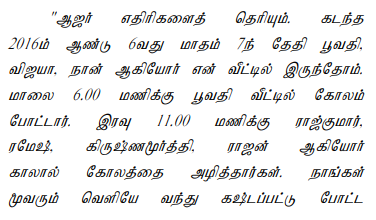
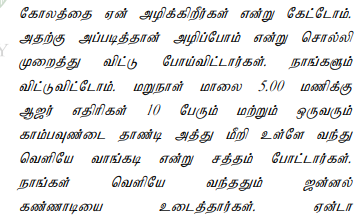
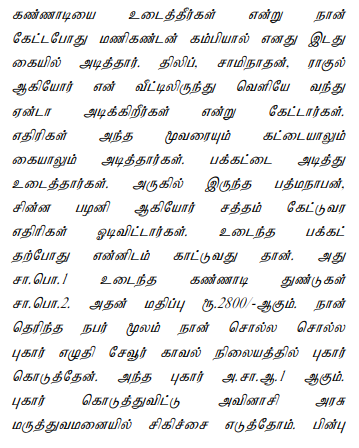
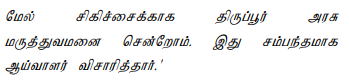
2. The case of the prosecution was that the appellant and the respondents 2 to 11 belong to the same village. While being so, on 07.06.2016 at about 11 p.m., when the appellant had put a Kolam  in front of her house, all the respondents 2 to 11 came there and completely destroyed it. When it was questioned by the appellant, on the next day viz., on 08.06.2016, all the respondents 2 to 11 came to her house at about 5.30 p.m., and trespassed into her house. One of the accused caused damage to the window and plastic bucket with iron rod and caused damage to the tune of Rs2,800/-. When the defacto complaint and others questioned the act of the respondents 2 to 11 herein, they attacked them by hands and using iron rod. The other accused also attacked three other relatives of the appellant. On hearing the noise, when the neighbors were arrived there, all the accused persons flew away from the scene.
3. On the complaint, the first respondent registered the FIR in Crime No.321 of 2016 for the offences punishable under Sections 147 , 148, 324, 323, 452, 354 of IPC and Section 3 of the TNPPDL Act. After completion of investigation, the first respondent filed final report and the same has been taken cognizance by the trial Court in S.C.No.6 of 2018, for the offences punishable under Sections 147 , 148, 324, 323, 452, 354 of IPC and Section 3 of the TNPPDL Act, as against the respondents 2 to 11 and charged for the offences under Sections 147 , 148, 323, 452 of IPC Section 3 (1) of the TNPPDL Act, as against the respondent 2 to 5 and 7 to 11 and charged for the offences under Sections 147 , 148, 324, 452 of IPC Section 3 (1) of the TNPPDL Act as against the sixth respondent.
4. On the side of the prosecution, they examined P.W.1 to P.W.13 and marked documents in Ex.P.1 to Ex.P.12. The prosecution also produced material objects in M.O.1 & M.O.2. On perusal of the oral and documentary evidence, the trial Court found the respondents not guilty and acquitted them. Aggrieved by the same, the victim/P.W.1 filed the present appeal.
5. The learned counsel appearing for the appellant submitted that the defacto complainant was examined as P.W.1 and other injured persons were examined as P.W.2, P.W.3, P.W.4 and P.W.10. They categorically deposed about the specific overtact of the respondents 2 to 11. The accident register of the injured persons were duly marked as Ex.P.5 to Ex.P.8. The doctor who treated the victims was examined as P.W.7. Therefore, the prosecution had categorically proved the charges as against the respondents 2 to 11 herein. In fact, the broken household articles were produced as material objects in M.O.1 and M.O.2. Even then, the trial Court without believing the version of the prosecution mechanically acquitted the respondents 2 to 11.
6. The learned counsel appearing for the respondents 2 to 11 submitted that there are contradictions between the deposition of P.W.1 to P.W.3 and P.W.10. The medical evidence also did not support the case of the prosecution. The doctor who treated P.W.1 to P.W.3 and P.W.10 also faile
AI
The trial court erred in acquitting the accused despite substantial evidence, including witness testimonies, necessitating conviction based on the principle of proving charges beyond reasonable doubt....

The prosecution must prove guilt beyond reasonable doubt, and damage to private property does not fall under public property laws.
The amendment Act 46 of 1994 enlarges the scope of TNPPDL Act, 1992 to include damages caused to private individuals by other private individuals, as interpreted and applied by the court.
The broad scope of the amendment Act 46 of 1994 includes damages caused to private individuals by other private individuals under Section 3(1) of TNPPDL Act, 1992.
The prosecution must prove its case beyond reasonable doubt, and insufficient evidence leads to acquittal.
The TNPPDL Act does not apply to damage caused in private disputes and private properties.

The evidence of an injured witness holds special status and should not be dismissed lightly, especially when corroborated by medical evidence.
The judgment emphasizes the importance of clear and unambiguous charges to provide the accused with a precise notice of the accusations, and the need for sufficient and consistent evidence to support....



An indispensable Tool for Legal Professionals, Endorsed by Various High Court and Judicial Officers
Please visit our Training & Support
Center or Contact Us for assistance

Scan Me!
India’s Legal research and Law Firm App, Download now!


For Daily Legal Updates, Join us on :



 Back to top


