
 Back
Back





IN THE HIGH COURT OF JUDICATURE AT MADRAS
MUMMINENI SUDHEER KUMAR, J.
A.George Alexis (Deceased) - Appellant
Versus
The Chief Engineer/Hydro Generations - Respondent
W.P.No.25436 of 2010 and M.P.No.1 of 2014
Decided on : 05-06-2025
| Table of Content |
|---|
| 1. disciplinary proceedings against the petitioner (Para 2 , 3 , 4) |
| 2. assessment of proportionality of punishment (Para 5 , 6 , 7 , 8) |
| 3. modification of removal to compulsory retirement (Para 9 , 10) |
ORDER :
MUMMINENI SUDHEER KUMAR, J.
The brief facts that are relevant for disposal of this writ petition are as under:
While the 1st petitioner was working as Assistant Engineer (Electrical) in the Tamil Nadu Electricity Board in PUSHE Power house, Masinagudi, Kundah Generation Circle, TNEB, he was subjected to disciplinary proceedings by issuing charge memo dated 15.06.2004 containing three charges.
Charge No.1:
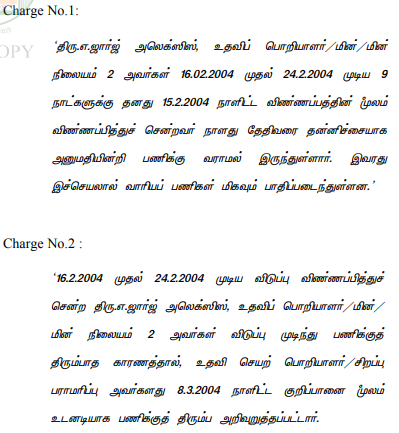
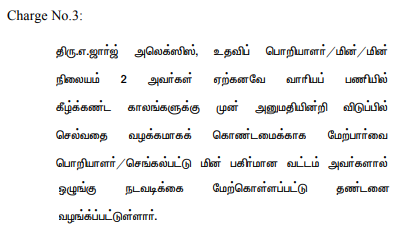
2. Thereafter, an enquiry was conducted an Enquiry Officer and all the charges held to have been proved by the Enquiry Officer. Thereafter, 2nd respondent furnished the copy of the report of a Enquiry Officer to the 1st petitioner and after receipt of further representation from the 1st petitioner, the 2nd respondent afforded opportunities on number of occasions to the 1st petitioner to appear in person and make a submission. However, the 1st petitioner failed to avail such opportunities. In view of the same, the 2nd respondent passed an order dated 24.11.2008 removing the 1st petitioner from service, after accepting the report of the Enquiry Officer. Aggrieved by the same, the 1st petitioner filed an appeal before the 1st respondent but the said appeal was rejected by the 1st respondent through memo No.1127/103/M.18/M.185/2009-I, dated 24.07.2010. It is aggrieved by the said order of removal dated 24.11.2008, as confirmed by memo dated 24.07.2010, the present writ petition has been filed by the 1st petitioner.
3. During the pendency of the present writ petition, the 1st petitioner died and hence, the petitioners 2 to 5 herein were brought on record as the legal representatives of the deceased/1st petitioner.
4. As seen from the charges, which are extracted herein above, the charges 1 & 2 relate to absenteeism from service without submitting proper leave application and the third charge is about habitual absentisim of the 1st petitioner resulting in imposition of punishment on the 1st petitioner on number of occasions. As already noted above, all the charges were held to be proved by the Enquiry Officer and the same was accepted by the 2nd respondent/Disciplinary Authority. It is not in dispute that the 1st petitioner failed to report to duty after expiry of the leave for which he had submitted a proper application i.e., for the period of commencing from 16.02.2004 to 24.02.2004. Though the petitioner claimed to have submitted a subsequent application seeking extension of earned leave, admittedly the said application was not submitted in proper form and the 1st petitioner had in fact submitted a consolidate application for sanction of leave and offered to rejoin the service only on 11.08.2004. Thus, it is evident that the 1st petitioner, who availed leave from 16.02.2004 to 24.02.2004 has reported duty only on 11.08.2004 i.e., almost after lapse of six months. The 1st petitioner remained absent from the services without proper sanction of leave for a period of six months. The 1st petitioner who is holding the post of Officer in the respondent/Board remained absent without proper sanction of leave for six months. The period of absence of the 1st petitioner from 25.02.2004 to 10.08.2004 is not in dispute. It is also not in dispute that the petitioner has suffered punishment on earlier occasions for the same misconduct of unauthorized absence. Further, from the perusal of the impugned order, it is also noticed that the petitioner was afforded number of opportunities to make his submissions in person before the 2nd respondent by issuing memos dated 15.02.2007, 18.12.2007 and 25.02.2008. Inspite of affording such opportunities, the petitioner failed to avail such opportunities and appears to have made a claim for consideration of his name for promotion instead of explaining the reasons for his absence.
5. From the perus
AI
The punishment of removal from service is shockingly disproportionate for unauthorized absence, and compulsory retirement is a more appropriate disciplinary measure, especially for long-serving emplo....

The doctrine of proportionality and the principle of judicial review in determining the quantum of punishment in cases of unauthorized absence and disobedience of orders.
Habitual unauthorised absence, failure to comply with orders, and proportionality of punishment in disciplinary actions

Unauthorized absence leading to removal from service is investigated under service law principles, where severity and proportionality of punishment are critical, independent of mental health claims u....

The court emphasized the necessity for the ultimate authority to review procedural irregularities and the proportionality of disciplinary penalties imposed on employees.

The punishment imposed must be proportionate to the gravity of the proved charges, and the court will interfere only if the punishment is shockingly disproportionate.
The petitioner was given a fair opportunity to show cause and had admitted to the charges of unauthorised absence. The delay in approaching the court after the service termination disentitled the pet....

The doctrine of proportionality in service law and administrative law was applied to determine the reasonableness of the punishment imposed.



An indispensable Tool for Legal Professionals, Endorsed by Various High Court and Judicial Officers
Please visit our Training & Support
Center or Contact Us for assistance

Scan Me!
India’s Legal research and Law Firm App, Download now!


For Daily Legal Updates, Join us on :



 Back to top


