Back
Back





2024 Supreme(Mad) 2422
IN THE HIGH COURT OF JUDICATURE AT MADRAS
R.SAKTHIVEL, J.
Ashim Sahib (Died) - Appellant
Versus
Kamalbi (Died) - Respondent
S.A.No.184 of 2018 And CMP No.4698 of 2018
Decided on : 18-12-2024
Advocate Appeared:
For the Appellants : Mr.S.Rajaraman
For the Respondent: Ms.T.Jayalakshmi for M/s.Paul & Paul & Mr.J.Hudson Samuel Partners
The court ruled that while joint family properties are not recognized under Muslim Law as in Hindu law, acquisitions through joint efforts can establish joint ownership if sufficiently proven.
Headnote:(A) Code of Civil Procedure, 1908 - Section 96 - Muslim Law regarding joint family property - Defined the position of joint family properties under Muslim Law - Court clarified existence of joint family properties is permissible if established by custom or joint efforts. (Paras 12, 16, 22)
Facts of the case:
The original suit was regarding a property purchased by the first plaintiff from Johny Basha, who claimed it as separate property, while the defendants asserted it as joint family property. The lower courts conflicted in their judgments.
Findings of Court:
The Trial Court dismissed the suit, holding that the plaintiffs failed to establish their case, while the Appellate Court held that joint family property principles did not apply, a conclusion overturned by the High Court. (Para 23)
Issues: The key issues included the determination of the Suit Property's nature (joint family vs. separate) and the impact of prior judgments regarding ownership. (Paras 1, 19, 22)
Ratio Decidendi: The court concluded the plaintiffs did not sufficiently prove exclusive ownership of the Suit Property, thereby validating the Trial Court's dismissal. It affirmed that in Islamic law, joint property can exist based on custom. (Paras 16, 22)
Result: Second Appeal allowed; Judgment and Decree of the First Appellate Court set aside; Judgment and Decree of the Trial Court confirmed.
| Table of Content |
|---|
| 1. case background and parties involved (Para 1 , 2) |
| 2. heirs' claims and contest from defendants (Para 3 , 4 , 5) |
| 3. first appellate court's findings and judgment (Para 6 , 7) |
| 4. arguments from both parties (Para 8 , 9) |
| 5. legal principles regarding joint family properties under muslim law (Para 10 , 11 , 12 , 13 , 14 , 15 , 16) |
| 6. burden of proof regarding ownership and joint family properties (Para 17 , 18 , 19) |
| 7. court's decision on the matter and clarification on joint family property (Para 20 , 21 , 22) |
| 8. final judgment and order of the court (Para 23) |
JUDGMENT :
R. SAKTHIVEL, J.
This Second Appeal is directed by the defendants in the Original Suit. Challenging the Judgment and Decree dated September 14, 2017 passed in A.S.No.3 of 2016 on the file of ‘Principal Subordinate Court, Tindivanam’ [‘First Appellate Court’ for short], whereby the Judgment and Decree dated December 3, 2015 passed in O.S.No.156 of 2008 on the file of ‘Additional District Munsif Court, Tindivanam’ [‘Trial Court’ for short] was reversed.
2. During the pendency of the Original Suit, the first plaintiff-Khadar Basha passed away on March 8, 2011. Hence, his legal heirs were impleaded as Plaintiff Nos.2 to 7 vide Trial Court’s Order dated November 14, 2011 in I.A.No.1903 of 2011 in the Original Suit. Hereinafter, for the sake of convenience, the parties will be denoted as per their array in the Original Suit.
PLAINTIFF’S CASE IN BRIEF:
3. In the plaint, it is averred that the Suit Property originally belonged to one Johny Basha as his separate property. He acquired it through the income derived from his mat weaving business. Patta No.886 was issued in his name. Then, on February 14, 2008, Johny Basha sold the Suit Property to the first plaintiff for a valid consideration of Rs.92,000/-. Since then the first plaintiff has been in possession and enjoyment of the same.
3.1. The Defendant Nos.1, 3 and 4 are brothers of Johny Basha and second defendant is first defendant’s son. Johny Basha and his brothers are all divided and living their life separately. While so, one week after the first plaintiff purchased the Suit Property i.e., on February 20, 2008, the defendants caused a notice stating that the Suit Property is their joint family property and that they have right in it. They attempted to interfere with the first plaintiff’s peaceful possession and enjoyment of the Suit Property. Hence the Suit for declaration and permanent injunction.
DEFENDANTS’ CASE IN BRIEF:
4. The defendants filed a written statement, denying the plaint averments except those specifically admitted. Sum and substance of the written statement is that the Suit Property was not separate property of Johny Basha. It belonged to the joint family consisting of Johny Basha and defendants 1, 3 and 4, who are all sons of Nane Sahib, as their joint family property.
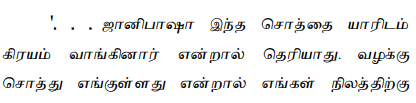
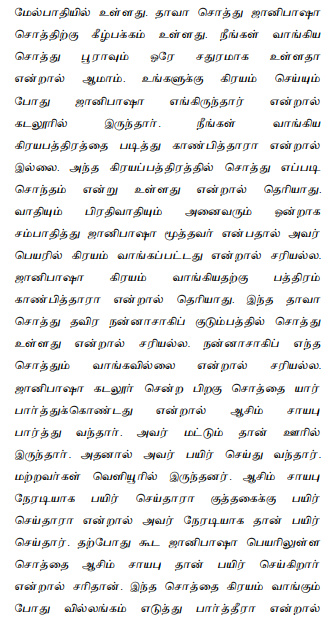
4.1. The Suit Property is 1 Acre 68 Cents, out of which, 68 Cents originally belonged to Nane Sahib and the remaining 1 Acre was purchased in the name of Johny Basha, as he was the eldest son, using the joint exertions of brothers. Though the brothers are engaged in businesses separately, the properties have been held in common. While the other brothers are living outside, the first defendant living in the Suit village is in possession and enjoyment of the Suit Property on behalf of the joint family, paying Kist in his name. When joint family properties were sold before, all the brothers joined together and executed Sale Deed.
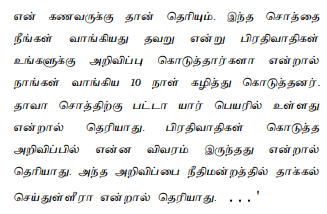
4.2. Further, first defendant sought to obtain an agricultural loan from Nallathur Primary Agricultural Co-operative Credit Society on the security of Suit Property and at that time, Johny Basha wrote a consent letter in front of panchayatdhars stating that the first defendant has share in the Suit Property. Further, the first defendant along with second defendant had executed Mortgage Deed dated June 26, 2006 in respect of Suit Property, factum of which is known to the plaintiff. This Suit has been filed by